


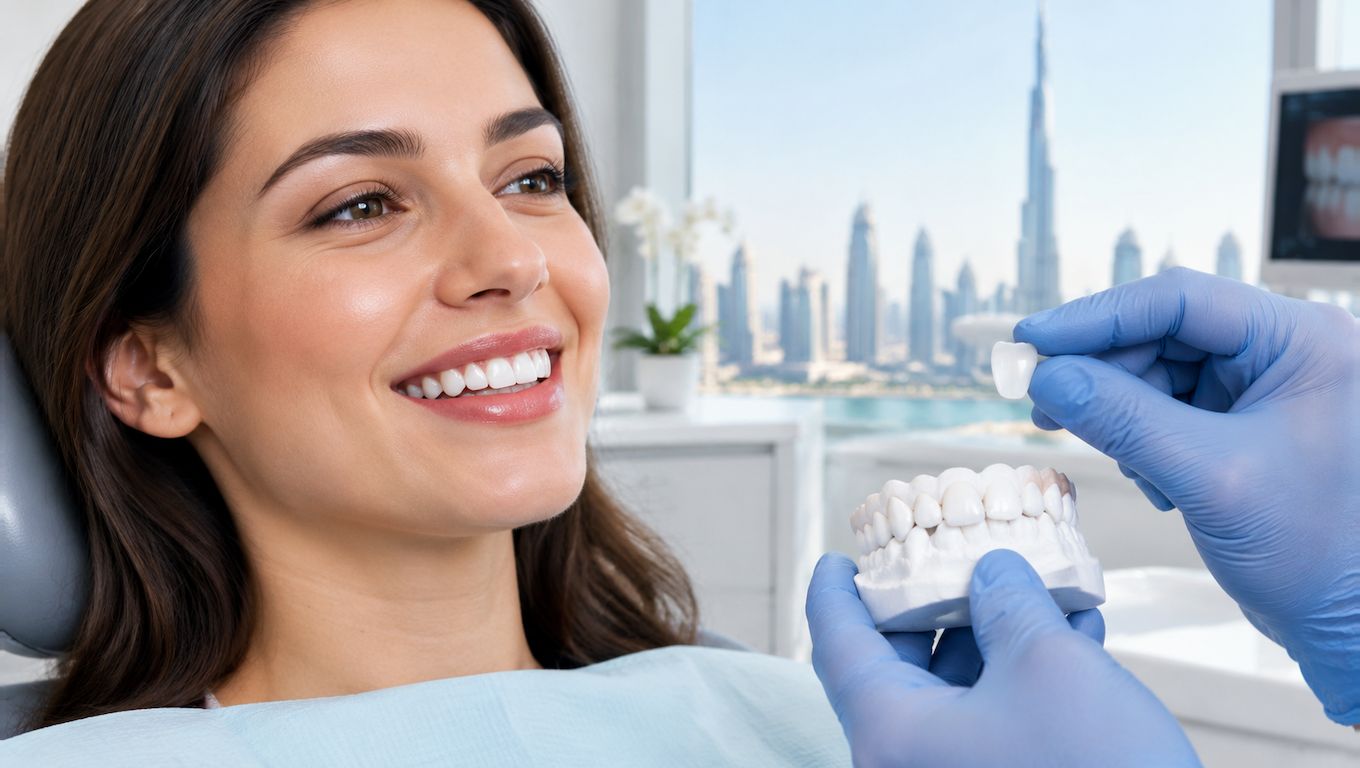
Is a porcelain veneer something you buy off a photograph, or a permanent change to a tooth you still have to live with? In Dubai the second answer is the one that holds up clinically.
Porcelain veneers are thin, custom-made ceramic shells bonded to the front of selected teeth. They can alter shape, length or colour, and once enamel is shaped the change stays. A proper plan covers tooth structure, bite, gum health, shade, lifespan and maintenance. It is not a cosmetic product you order.
This guide sets out who may suit veneers, how the ceramics differ, the visit sequence in a licensed clinic, how veneers compare with whitening, bonding and crowns, what drives cost without a quoted price, and the care that protects the result. Final suitability always depends on examination.
Table of Contents
- Porcelain Veneers at a Glance and Who They Suit
- Porcelain Materials and How Long Veneers Last
- Step-by-Step Veneer Treatment Path in Dubai
- Veneers Compared With Whitening, Bonding and Crowns
- What Drives Veneer Costs in Dubai
- Risks and Daily Care That Protect Your Veneers
- Porcelain Veneers FAQs in Dubai
- Book a Veneer Assessment in Deira Before You Commit
Porcelain Veneers at a Glance and Who They Suit
Porcelain veneers are thin, custom-made ceramic shells bonded to the front surface of visible teeth to change their shape, length or colour.
A veneer works like a thin, made-to-measure porcelain fingernail bonded to the front of a natural nail. It covers the face you see. A crown encases the whole tooth.
| Feature | What to expect |
|---|---|
| Typical use | Visible front teeth with shape, length or colour concerns |
| Enamel preparation | Minimal, carefully shaped enamel removal |
| Reversible | No, the change is permanent |
| Anaesthesia | Local anaesthesia during tooth preparation |
| Lifespan | The clinician states an expected range in the written plan, based on material, habits and care |
| Whitening response | Veneers do not respond to whitening but are designed to resist staining |
| Where to have them | Licensed dental clinic, not at home |
The Dubai Health Authority prosthetic-dentistry guidance classifies porcelain veneers as a technique-sensitive and often irreversible procedure. Before treatment, the clinician should record your objectives, assess the gums and mouth lining, review appropriate radiographs, and use a diagnostic wax-up or mock-up to test tooth shape and facial proportions.
Where reduction is needed, that guidance recommends an enamel-limited chamfer with smooth margins. Preserved enamel is a better bonding surface and can lower the chance of the shell coming off. Decay and gum disease are treated first, because inflammation can disturb the gum line, the dry field needed for cement, and the look over time. Clenching or grinding is treated as a major risk and needs a protective plan, including a night guard.
The DHA home healthcare services guidance states that cosmetic dental services and veneers must not be offered at home, and that complex prosthodontic procedures belong in a fully equipped dental facility.
Who may be a reasonable candidate
Adults with healthy gums, enough sound enamel and few active problems are the usual starting point. People often ask about chipped, worn, slightly gapped or stained front teeth that whitening does not correct. At our clinic the shells are custom-crafted to the facial features, smile proportions and the look you want, and they need a small amount of tooth preparation. They cannot be taken off the way some other treatments can.
Less suitable, at least until something else is handled:
- Untreated decay or gum disease: Infection or inflammation is treated before any ceramic is bonded.
- Heavy clenching or grinding without a guard plan: Repeated force can chip or loosen ceramic.
- Teeth that first need alignment: Position problems are often better moved than covered.
Practical rule: A photograph does not decide suitability. The final plan depends on a clinical examination of the teeth, the bite and the gums.
For porcelain veneers in Dubai, a useful written plan shows the diagnostic design, gum clearance, radiographic review, how enamel would be shaped, a bite check, and a maintenance or night-guard note. That list matters most when a smile change is sold as rapid, because enamel that is removed does not grow back.
Porcelain Materials and How Long Veneers Last
Three ceramics come up in veneer conversations. They are not substitutes for one another.
| Material | Typical thickness | Strength and appearance | Typical use |
|---|---|---|---|
| Feldspathic porcelain | About 0.3-0.5 mm | Highly natural translucence, more brittle | Front teeth with sound enamel |
| Lithium disilicate ceramic | About 0.4-0.7 mm | Good translucence and greater strength | Front teeth needing extra durability |
| Zirconia | Thicker than a thin veneer shell | Very strong, more opaque | Usually crowns; less common for thin veneers |
How thickness, strength and light trade off
Feldspathic porcelain is very thin, so light passes through it in a way that can look close to enamel. It is also the more brittle of the three, which is why it suits front teeth that still have sound enamel and a calm bite. Lithium disilicate is a little thicker and stronger, and it still looks translucent, so it is often chosen when the front teeth need extra durability. Zirconia is very strong and more opaque. Clinicians usually reserve it for crowns rather than a thin front shell.
With proper care and good oral hygiene, veneers can last between ten and fifteen years before they need replacement or maintenance. The written plan should name the ceramic and the range expected for your teeth, because material, case and habits all shift that window.
Life shortens when you:
- Clench or grind at night and skip a guard.
- Bite ice, pens or fingernails.
- Leave plaque at the margins, where ceramic meets enamel.
- Take a knock that chips an edge.
Ask which ceramic is proposed, how much enamel would be shaped for that material, and what changes if you grind. Those answers tell you more than a shade tab.
Step-by-Step Veneer Treatment Path in Dubai
The sequence is a clinical path, not one appointment. It changes with the case, and each step needs your agreement.
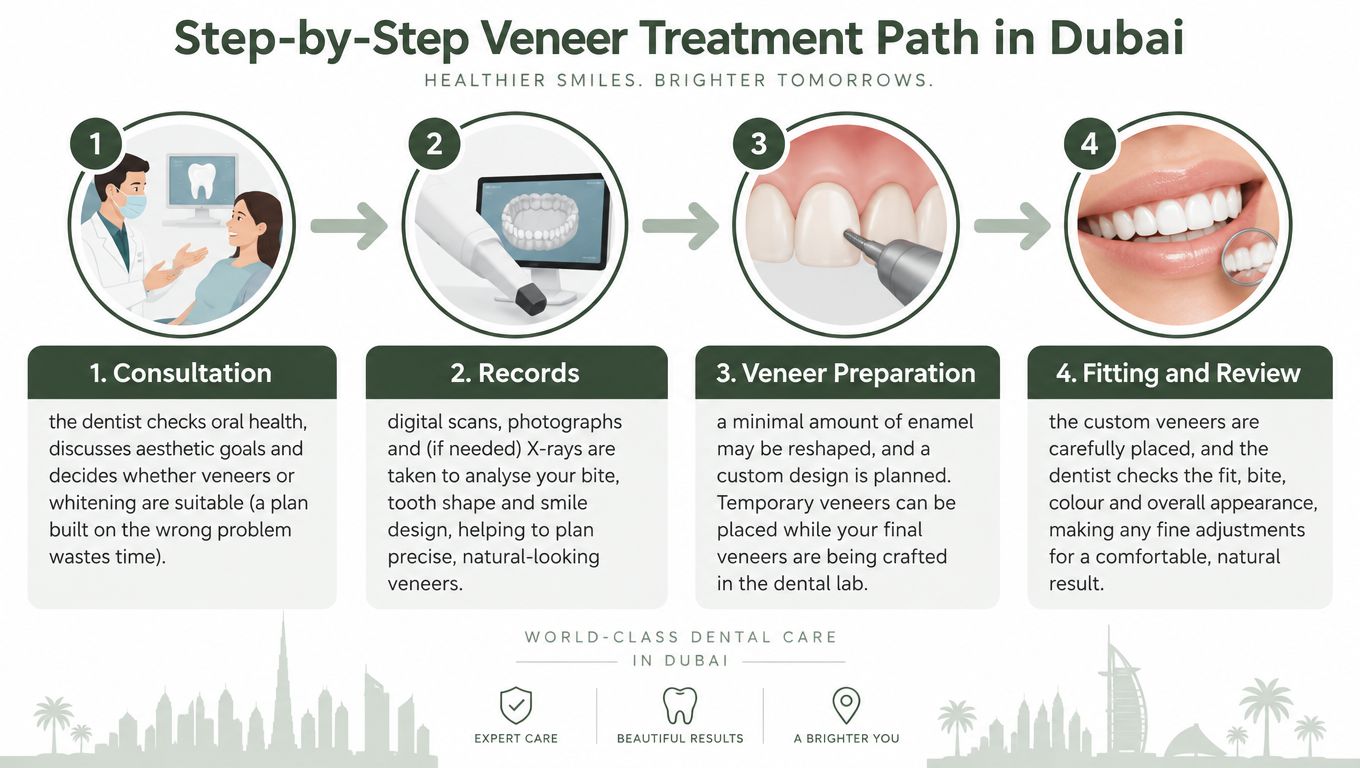
1. Consultation. The dentist checks oral health, discusses your smile goals, and determines whether veneers or whitening address the actual issue. A plan based on the wrong problem wastes time and enamel.
2. Records. Shape, size, alignment and colour are evaluated. Measurements, photographs, and impressions or digital scans give the laboratory an accurate map. A poor record is a common reason a shell feels high or looks bulky.
3. Design. A diagnostic wax-up or mock-up tests shape and proportions before any tooth is changed. You see a preview first. Smile design belongs at this stage, not as an afterthought.
4. Treat first. Decay and gum disease are treated before preparation. Skipping this is the most common reason a later edge looks red or the bond fails.
5. Whitening, when it is part of the plan. It is completed before the veneers are made so the shade match is more accurate. Ceramic will not lighten later.
6. Preparation. Under local anaesthesia, a small amount of enamel is carefully shaped. On a front-six plan, that shaping is limited to the upper six anterior teeth so the shells seat precisely. Enamel is the best bonding surface, which is why the reduction stays shallow when the tooth allows it.
7. Fitting. The custom veneers are tried in, adjusted and permanently bonded to those upper six front teeth. Bite and contact points are checked before you leave.
8. Review. You leave with the aftercare plan, a clear answer on whether a night guard is needed, and a review date.
The mock-up is the reversible part. Once enamel is shaped, that step cannot be undone.
The video below shows how a clinical team talks a patient through veneer planning. Treat it as an illustration of the conversation, not a forecast of your own result.
Veneers Compared With Whitening, Bonding and Crowns
Match the option to the problem, not to a photograph of someone else's smile.
| Option | Tooth reduction | Reversible | Best for | Main limitation |
|---|---|---|---|---|
| Professional teeth whitening | None | Yes | Discoloured natural teeth | Does not change veneers, crowns or fillings |
| Cosmetic bonding | Little or none | Can be repaired or added to | Small chips, gaps or uneven edges | Composite may stain and needs repair over time |
| Porcelain veneers | Minimal enamel | No | Shape or colour issues across several front teeth | Permanent and needs ongoing care |
| Full crowns | Substantial reduction | No | Heavily damaged or compromised teeth | More tooth removed than with veneers |
| Clear aligners | None | Yes | Tooth position and spacing | Moves teeth but does not change colour or shape |
Colour spread across otherwise healthy teeth points toward professional teeth whitening in Dubai. Whitening does not change veneers, crowns or fillings. If both are planned, whitening is typically done first so the ceramic shade is matched to the lightened enamel.
A single chip, a small gap or an uneven edge can often be rebuilt with cosmetic bonding. Tooth-coloured composite is sculpted and polished, and more can be added later if it wears. It can stain, and it needs repair over time.
Several front teeth with shape or colour problems are the usual reason to consider porcelain veneers. You are accepting a permanent change and a maintenance routine.
A tooth that is badly broken, or that has lost a lot of structure, may need a full crown, sometimes after root canal treatment. The crown removes more tooth than a veneer because it has to wrap what is left.
Teeth that are crooked or widely spaced may suit clear aligners, sometimes before any ceramic is discussed. Aligners change position. They do not recolour or reshape a tooth.
A short way to choose
- Stain on sound enamel: ask whether whitening alone is enough.
- One small chip: ask whether bonding can be repaired later.
- Several front teeth, shape and colour: ask how much enamel a veneer would remove.
- A cracked or root-treated tooth: ask whether a crown is the safer cover.
- Teeth in the wrong place: ask whether alignment should come first.
What Drives Veneer Costs in Dubai
No fixed price is quoted here. Any figure should come from a written, itemised plan after examination. Two clinics can both be reasonable and still quote different totals, because the work inside the fee is not the same.
What moves the fee:
- Number of teeth treated. Six visible front teeth are a different job from one tooth.
- Material and laboratory fabrication. Ceramic type and who makes the shells.
- Design complexity, including mock-ups and bite records.
- Care needed first, such as decay treatment, gum care or root canal treatment.
- Whitening, if it is included.
- Diagnostics, including photographs, scans and radiographs.
- A night guard and later maintenance.
- Follow-up visits.
- Warranty or aftercare terms, including what happens if a veneer chips.
Say one quote covers six healthy front teeth, and another covers a single tooth that also needs root treatment. Those numbers cannot be compared until the scope matches. The same test applies when you set a veneer quote beside a dental crown cost estimate. A crown covers more of the tooth and usually involves different laboratory work.
Ask what is included, what is excluded, and who repairs a chip.
Risks and Daily Care That Protect Your Veneers
Sensitivity after preparation is the concern patients mention first. It often settles over the following days. Chipping is the next, usually from biting hard food, ice, pens or fingernails.
Other problems worth naming before you agree:
- Debonding. A veneer can loosen if the bond is stressed or the bite is heavy on one spot.
- Decay at the margin. The join between ceramic and tooth still collects plaque.
- Gum irritation. A thick or rough edge can leave the gum red and sore.
- Clenching or grinding. That force needs a night guard when your dentist advises one, not after the first chip.
Daily care that actually helps
- Brush twice a day with a soft brush and fluoride toothpaste.
- Clean between the teeth with floss or interdental brushes, especially at the edges.
- Stop using teeth as tools for packets, tape or nails.
- Wear a night guard if you have been told to.
- Keep review visits and professional cleaning so a loose edge is caught early.
If a veneer chips or comes off, contact the clinic promptly. Keep the piece if it came away whole. Do not glue it at home. Household adhesive can damage both the tooth and the ceramic, and it makes a proper rebond harder.
Porcelain Veneers FAQs in Dubai
Are porcelain veneers painful? Preparation is done under local anaesthesia. Some sensitivity afterwards is common and often settles. Comfort options are explained at the visit. No dental treatment is completely painless.
Can veneers be removed? Once enamel is prepared, the change is permanent. A later chip means a replacement, not a return to the original surface.
Do veneers stain? They resist stains better than enamel, but the margins and the bonding still need daily cleaning. They do not respond to whitening.
Can I have veneers if I grind my teeth? Possibly. You need an assessment and, where indicated, a night guard before treatment is planned.
Is one visit enough? Most cases need several visits for consultation, records, design, preparation and fitting. The timetable varies.
How do I judge a price? Compare written, itemised plans that cover the same teeth, the same material and the same extras. A lower number with a thinner scope is not a saving.
These answers are general. Suitability depends on examination of your own mouth.
Book a Veneer Assessment in Deira Before You Commit
What should you understand before agreeing to a permanent change to your teeth? Start with an in-person dental consultation, where your oral health and goals can be assessed before treatment is considered.
The DHA circular on veneer consent states that Dubai health professionals and facilities must use the prescribed consent form for veneer services. It explains that the procedure is irreversible and that alternatives exist.
The DHA patient consent guidance says dental consent should cover the proposed treatment, risks and benefits, alternative expected outcomes, and relevant costs. Elective care should be discussed with enough time to understand it. Forms must be available in Arabic and English, and the completed document stays in your health record.
Before signing, check that the written plan names:
- The proposed ceramic and whether a veneer or a fuller crown is indicated.
- The planned tooth preparation, including how much and where.
- Functional limits, such as what you should avoid biting.
- Risks, including fracture or debonding.
- Maintenance, including whether a guard is recommended if you clench.
- Alternatives, such as orthodontics, whitening, composite bonding or other restorative work.
Ask whether the plan includes a mock-up, bite evaluation and post-treatment review. Keep copies of the consent and proposed design, then take time to consider them. Consent records a shared decision; it does not establish that veneers are suitable for every cosmetic concern.
Yoyimé Clinic is located in central Deira, Dubai. The Hollywood Glow pathway begins with a dental consultation to assess oral health, discuss aesthetic goals and determine whether veneers and whitening are suitable. The package combines professional whitening with custom veneers, designed to complement your facial features, smile proportions and desired aesthetic outcome. The consultation does not promise a particular result.
Bring questions about preparation, materials and what a chip might mean. If examination suggests whitening, bonding or alignment is a better fit, that is useful guidance before you make a permanent decision.
Yoyimé Clinic provides dental consultations in Deira for people comparing porcelain veneers with whitening, bonding and other restorative options. Treatment planning is based on an examination, not a photograph. To arrange an assessment before committing, visit Yoyime Clinic and book a dental consultation.