


You've saved a photograph of a smile you like, but you're not sure whether you need whitening, bonding or veneers. A Hollywood smile in Dubai usually means a personalised combination of cosmetic dental treatments that improve tooth colour, shape and balance, rather than a single procedure with a standard price. The right starting point is an examination, followed by a clear explanation of the options, any irreversible steps and the costs. Diagnosis comes before appearance, because the fastest makeover is not always the one your teeth can support.
Table of Contents
- What a Hollywood Smile Means in Dubai
- Hollywood Smile Techniques Compared at a Glance
- How the Hollywood Smile Pathway Unfolds Step by Step
- Hollywood Smile Packages and Which One Fits
- Who Is a Good Candidate and When to Wait
- Results, Limits and Long-Term Care
- What Shapes the Cost of a Hollywood Smile
- Book a Smile Assessment Before You Decide
What a Hollywood Smile Means in Dubai
A Hollywood smile is a popular term for a bright, even and balanced smile achieved through cosmetic dentistry. The name comes from the polished appearance associated with people on screen. It describes an intended look, rather than a diagnosis or a treatment everyone should receive.
Say your teeth look yellow in photographs and a front tooth has an uneven edge. You might assume that veneers are the answer, but the dentist could find that professional cleaning, whitening and a small bonding repair would address your concerns. Someone with similar-looking teeth might need a different plan because their discolouration comes from an old restoration or a problem inside the tooth.
Think of repainting a house. Fresh paint only looks good when the walls underneath are sound, and covering a damp patch doesn't repair its cause. Cosmetic dentistry follows the same principle: healthy teeth and gums provide the foundation for changes in appearance.
A Hollywood smile is decided by diagnosis first and appearance second.
A goal that should fit your own teeth
An attractive result doesn't have to mean the whitest available shade or identical tooth shapes. The dentist considers the teeth visible when you speak and smile, your facial proportions, gum levels and how your upper and lower teeth meet.
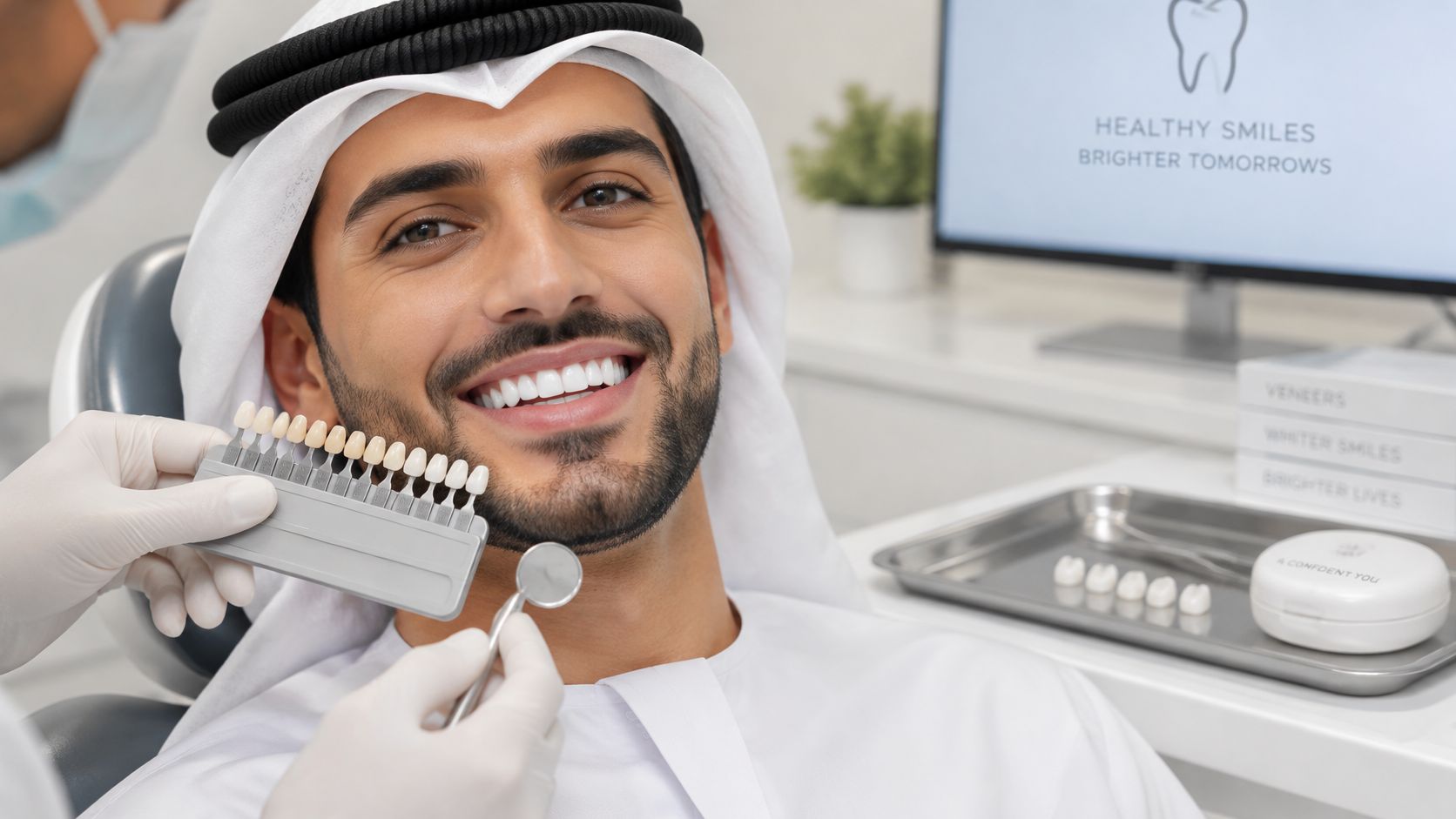
A shade guide helps make that conversation more concrete.
For patients comparing cosmetic dentistry across Dubai, the useful questions are practical: which technique suits my teeth, what happens between consultation and final review, and what determines the quote? A package name alone can't answer them.
At Yoyimé Clinic, a doctor-led clinic in Deira, cosmetic planning starts with a clinical examination. Tell the dentist what bothers you, but also mention sensitivity, previous treatment and anything that affects chewing. Final suitability depends on an in-person examination and your individual dental needs.
Hollywood Smile Techniques Compared at a Glance
Hollywood smile techniques compared
| Option | What It Changes | Tooth Preparation | Permanence | Typical Visits |
|---|---|---|---|---|
| Professional teeth whitening | Surface and deeper stains on natural teeth | None | Shade can drift back over time | Short course set by the dentist |
| Cosmetic composite bonding | Small chips, gaps and uneven edges | Minimal | Can be polished or repaired | Often completed in one visit |
| Porcelain veneers | Shape, colour and apparent minor irregularities of front teeth | Small amount of enamel removed | Long-term; not a removable treatment | Multiple visits, planned in stages |
| Clear aligners or braces | Tooth position and bite-related alignment | Usually no restorative preparation; attachments or limited reshaping may be needed | Teeth can move back without retention | Months, according to the movement required |
| Combined plan | Colour, shape and alignment together | Each stage has its own preparation requirements | Whitening needs maintenance; restorations need ongoing care | Sequenced over weeks to months |
Matching the technique to the concern
Whitening uses bleaching agents to lighten natural tooth colour. It doesn't rebuild a chipped edge, correct a cavity or change tooth position, so a brighter result won't necessarily solve every concern visible in a photograph.
Product strength and age restrictions also matter. Dubai Municipality's technical guidance for cosmetic and personal care products lists a general oral-product hydrogen-peroxide limit of up to 0.1%, with a separate whitening category above 0.1% and up to 6%, whose products aren't allowed for people under 18. Don't assume an imported kit or online whitening service follows the appropriate controls.
Our guide to professional teeth whitening in Dubai explains the treatment in more detail.
Composite bonding involves applying tooth-coloured resin directly to a tooth, shaping it and hardening it with a curing light. It can be useful for a small chip, an uneven edge or a suitable gap, often without extensive tooth reduction.
Porcelain veneers are thin ceramic shells bonded to the front surfaces of teeth. They can change several aspects of appearance together, but the preparation involved makes them a different commitment from bleaching or a small repair.
Clear aligners or braces move teeth rather than disguising their position. If a tooth tilts forwards or crowding affects the bite, alignment may protect more tooth structure than preparing the teeth to make them appear straight.
A combined plan uses these techniques in a deliberate order. For example, alignment may create better spacing before a small bonding addition.
Practical rule: Stain suggests a whitening assessment, small chips suggest bonding, broader shape changes suggest a veneer discussion, and crowding suggests an orthodontic assessment.
These are starting points, not self-diagnoses. A small gap might reflect tooth proportions, tooth position or gum problems, and each calls for a different response.
How the Hollywood Smile Pathway Unfolds Step by Step
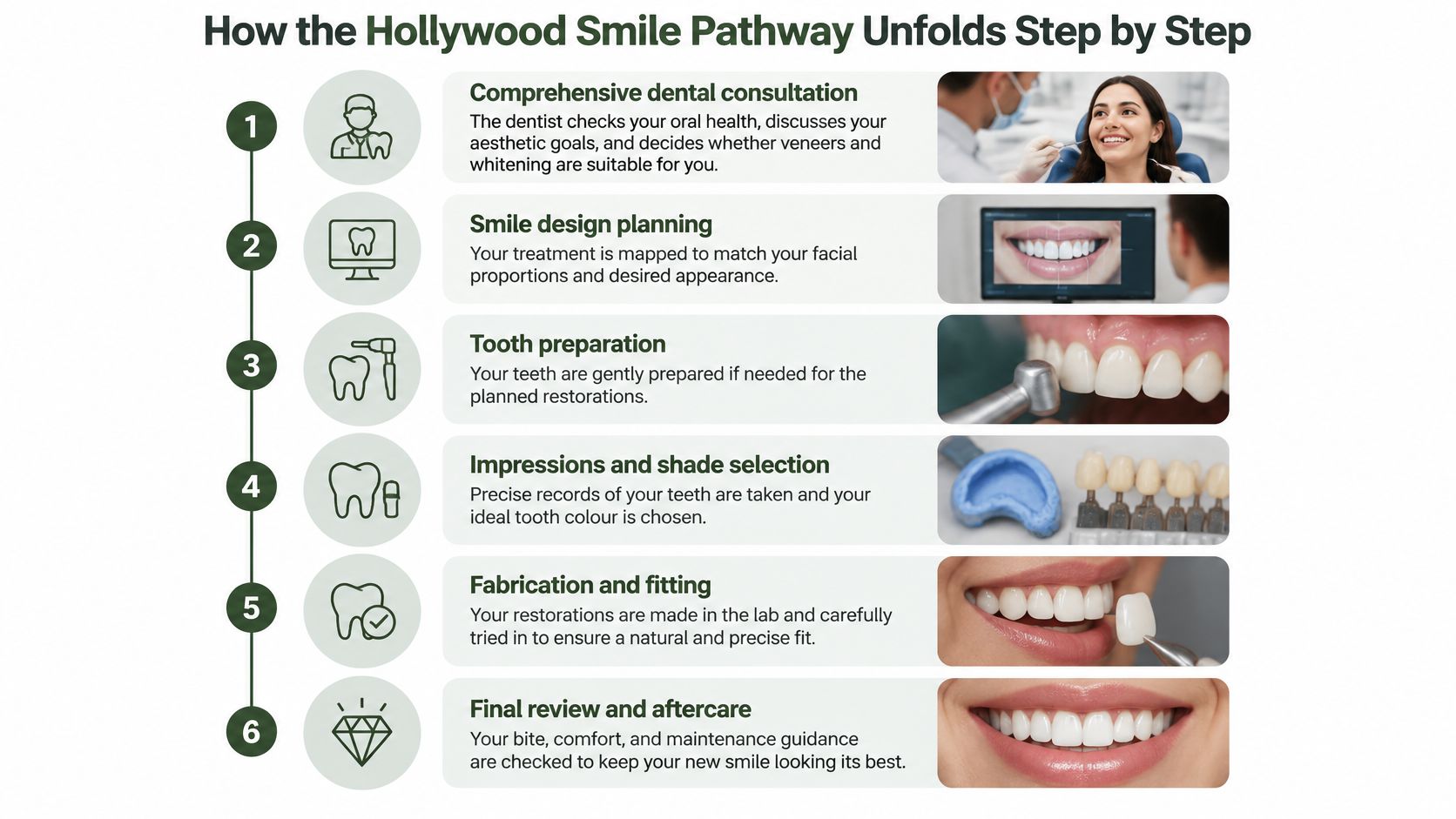
A sound treatment pathway separates planning from irreversible treatment. This visual outlines the clinical stages, although the precise order of records and preparation is adjusted to the chosen procedures.
From examination to final review
Detailed dental consultation. We evaluate oral health, discuss your aesthetic goals and determine whether whitening and veneers are suitable. Explain what you'd like to change and what you'd prefer to preserve.
Smile assessment. The dentist evaluates tooth shape, size, alignment and colour. Measurements, photographs, impressions or digital scans may be taken to plan the restorations and communicate their intended proportions.
Diagnosis and preparation. The dentist checks decay, gum health, existing dental work and the cause of discolouration. DHA restorative-dentistry guidance recommends professional scaling approximately 1–2 weeks before bleaching, alongside baseline shade documentation, protective eyewear and soft-tissue protection during whitening.
Whitening first where indicated. The dentist establishes the intended natural-tooth shade before selecting the colour of visible restorations. Whitening isn't automatically necessary if you're happy with your existing colour.
Veneer preparation and fitting. Where veneers are appropriate, the dentist explains the proposed tooth reduction before proceeding. Custom restorations are then tried in, checked for colour, fit and bite, adjusted and bonded.
Final evaluation. We check the result, make necessary refinements and explain how to care for the treated teeth. Tell the dentist if a tooth feels high when biting or if an edge catches your lip.
Understanding the schedule
Pathway stages and timing
| Stage | What Happens |
|---|---|
| 1. Consultation | Oral-health check and suitability decision; appointment duration confirmed when booking |
| 2. Smile assessment | Measurements, photographs, impressions or scans; scheduling confirmed after examination |
| 3. Diagnosis and preparation | Decay and gum checks, with scaling where indicated; disease treatment completed before elective work |
| 4. Whitening where indicated | Natural-tooth shade established before veneers; course set by the dentist |
| 5. Veneer preparation and fitting | Custom veneers prepared, tried in and bonded; laboratory and fitting dates confirmed in the plan |
| 6. Final evaluation | Refinements and aftercare instructions; review timing set by the dentist |
Our full veneer-and-whitening journey typically spans multiple visits, with most cases completed within two to three weeks. That isn't a promise for every patient: gum treatment, additional restorative care or orthodontic alignment can extend the schedule.
Our smile design guide explains how planning connects your preferences with the clinical findings.
The accompanying video offers another way to understand the treatment discussion.
The pathway is a sequence, not a race. Skipping diagnosis can leave the dentist treating the visible symptom rather than its cause, so whitening must never be used to mask untreated disease or chase a uniform shade without assessing existing restorations.
Hollywood Smile Packages and Which One Fits
A patient with healthy teeth and one chipped edge needs a different plan from someone whose teeth are worn or broken across the whole mouth. Yoyime Clinic groups its cosmetic options into four packages, and each name describes the problem it is built to solve.
Hollywood smile packages by purpose
| Package | Designed For | Points to Confirm at Consultation |
|---|---|---|
| Hollywood Glow | Discolouration, minor imperfections and aesthetic symmetry | Whether significant misalignment needs orthodontic care first |
| Smile Sculpt | Quick aesthetic refresh with small cosmetic flaws | Whether whitening and bonding meet the goal without veneers |
| Hollywood Makeover Smile | Broader cosmetic makeover of the smile | Full scope, number of teeth and number of stages |
| Smile Atelier | Extensively damaged, worn or broken teeth across the mouth | Function and bite first; appearance follows restorative care |
Treat the table as a menu of starting points. The examination decides which procedures belong in your plan and whether treatment should be limited to a small area.
Hollywood Glow brings together four services: a routine dental examination, professional teeth cleaning, teeth whitening and veneers. Scaling removes plaque and tartar, polishing lifts surface stains, and whitening comes before veneer placement so the ceramic shade can be matched to your lightened natural teeth. The custom veneers are then fitted, adjusted and permanently bonded to the upper six front teeth.
Smile Sculpt is the lighter-touch option: examination, scaling, polishing, in-office whitening and cosmetic composite bonding, ending with a final smile assessment. It suits a quick refresh that improves brightness and corrects small flaws without extensive dental treatment. Hollywood Makeover Smile covers a broader cosmetic makeover whose scope and stages are confirmed at consultation, while Smile Atelier pairs examination with root canal treatment, crowns and bridges for extensively damaged teeth, aiming to restore chewing efficiency, speech clarity and bite comfort.
Existing dental work can change the package
The important shade rule comes from DHA restorative-dentistry guidance on bleaching: composite bonding, veneers, crowns and bridges don't change shade when natural teeth are bleached. A package that ignores visible restorations can therefore leave a mismatch rather than an even result.
Say you have a darker crown beside a natural front tooth. Bleaching the natural tooth won't lighten the crown and could make the difference more noticeable. The dentist should assess whether the restoration needs polishing, replacement or another approach before finalising the shade plan.
Use these questions to clarify the proposed scope:
- Included treatment: Which procedures and teeth are covered?
- Excluded treatment: Are preliminary fillings, gum care or other necessary treatments quoted separately?
- Existing restorations: Have visible crowns, fillings and veneers been assessed?
- Written details: Will the plan identify each stage, its fee and the intended review arrangements?
The right package is the smallest one that solves the diagnosed problem. A broader name adds cost and chair time without adding benefit for healthy teeth with a small cosmetic concern.
Who Is a Good Candidate and When to Wait
You may be a suitable candidate for elective cosmetic dental treatment if you have:
- Healthy gums: A stable foundation without active periodontal disease.
- No untreated decay: Teeth that have been examined and any cavities addressed.
- Enough sound tooth structure: A suitable surface to support the proposed restoration.
- A defined cosmetic concern: Discolouration, small chips or proportion differences that the chosen technique can reasonably improve.
- Realistic expectations: An understanding that your own teeth guide the achievable result.
- A maintenance routine: Willingness to brush, clean between teeth and attend reviews.
Not every suitable patient needs veneers. When tooth shape is already acceptable, whitening may be enough; when a small edge is the concern, a bonding-only plan may preserve more natural tooth structure.
Situations that need a different first step
The DHA prosthodontic guidelines describe veneers as an irreversible treatment process and state that dental caries and periodontal disease should be treated before placement. A dentist may therefore recommend postponing cosmetic treatment without ruling it out permanently.
- Inflamed or diseased gums: Begin with periodontal assessment and appropriate gum treatment.
- Untreated decay: Restore cavities and assess the tooth's longer-term needs first.
- Significant crowding or misalignment: Consider orthodontic alignment rather than removing sound tooth structure to disguise position.
- Heavy grinding or clenching: Assess the bite, wear patterns and need for protective measures before selecting restorations.
- Extensive damage or loss of tooth structure: Prioritise restorative rehabilitation and chewing function.
- Discolouration mainly in old restorations: Assess the restoration itself rather than repeating bleaching.
Veneers cover the front surface of a tooth; they don't cure disease beneath or around it. Relevant X-rays, gum examination and bite checks help the dentist identify problems that aren't obvious when you look in the mirror.
A pause can also give you time to decide how much change you want. If you're uncertain about a major colour or shape change, ask whether a conservative alternative or a preview would help you make an informed decision.
Bring these questions to the consultation: Which option fits my teeth? What happens if I wait? What findings would change the plan? The answers should distinguish optional improvements from treatment needed to protect oral health.
Results, Limits and Long-Term Care
Cosmetic dentistry can improve colour, shape and balance, but a photograph isn't a guaranteed endpoint. Your natural teeth, existing dental work and the way light falls on the surfaces all influence how the result looks.
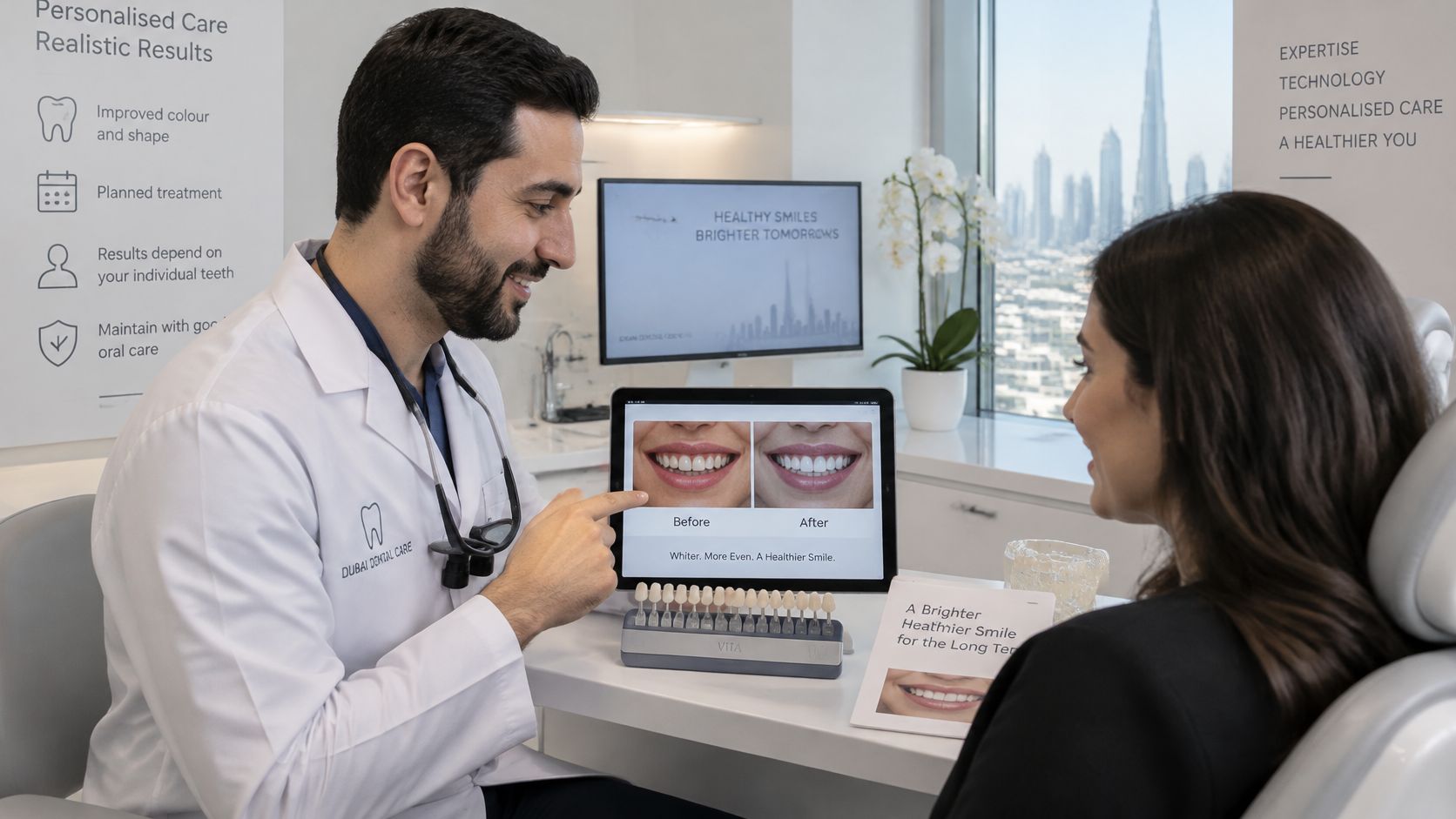
Use the consultation to discuss both the intended appearance and what happens if something needs adjustment.
Consent includes the future of the treatment
DHA patient-consent guidance requires an explanation of proposed treatment, risks, benefits, alternatives, expected outcomes and relevant costs, with consent forms available in Arabic and English; a mandatory veneer-specific consent form was introduced for use from 1 January 2022.
Read the plan before irreversible preparation. Ask how the proposed appearance will be assessed, which changes remain possible before bonding and what repair options exist afterwards.
Veneers change the tooth surface permanently, so plan for their whole lifetime, not only the day they're fitted.
Bonding and veneers can chip, and their margins can develop staining, so establish the repair route. Whitening can fade, while bleaching or preparation may cause temporary sensitivity; discuss maintenance and comfort measures rather than assuming these treatments need no follow-up.
Daily care protects the teeth underneath
- Brush twice daily: Use fluoride toothpaste and a gentle technique along the gumline.
- Clean between teeth: Use floss or appropriately sized interdental brushes.
- Manage staining habits: Limit frequent exposure to staining drinks and follow individual whitening advice.
- Avoid using teeth as tools: Don't open packaging or bite hard objects.
- Follow bite advice: Wear a protective guard if your dentist recommends one.
- Attend reviews: Keep examinations and professional cleaning appointments appropriate to your needs.
Are veneers reversible?
Conventional veneers involve removing tooth structure that doesn't grow back. Once teeth are prepared, they'll generally need ongoing protection with veneers or another suitable restoration.
Does teeth whitening hurt?
Whitening can cause temporary sensitivity or gum irritation, and comfort differs between patients. Tell your dentist about existing sensitivity so the technique and aftercare can be adjusted.
Can whitening change crowns or veneers?
Whitening doesn't lighten the material of existing crowns or veneers. A visible colour mismatch needs restorative assessment rather than stronger or repeated bleaching.
How long do veneers last?
Their lifespan depends on habits, bite, tooth condition and maintenance, so no fixed number applies here. They may eventually need repair or replacement, which should be part of your decision before treatment.
What Shapes the Cost of a Hollywood Smile
The quote is built from the teeth involved, the technique, preliminary treatment and ongoing care. A package headline can't show whether two patients are receiving comparable treatment.
Cost factors for a Hollywood smile
| Cost Factor | Why It Changes the Price | Example |
|---|---|---|
| Number of teeth treated | More teeth require more materials, laboratory work and chair time | Upper six front teeth versus a full smile line |
| Material and technique | Veneers and bonding involve different preparation and fabrication steps | Laboratory-made veneers versus direct bonding for a chipped tooth |
| Preparatory treatment | Necessary decay, gum or root canal treatment adds clinical stages | Treating a cavity before veneer planning |
| Shade matching and laboratory work | Custom shading and fabrication require additional work | Establishing the shade after whitening, then making veneers to match |
| Orthodontic alignment | Tooth movement adds a separate course of care and fees | Correcting crowding before cosmetic treatment |
| Follow-up and future repairs | Reviews, polishing and replacement affect long-term spending | Assessing and repairing a chipped veneer later |
For a hypothetical comparison, veneers on the upper six front teeth would generally involve more preparation and laboratory work than bonding a single chipped tooth. A combined plan also involves more stages than a single technique, but that doesn't make it the right choice unless the examination supports it.
How to read a written quote
- Check inclusions first: Look for consultation, indicated X-rays, cleaning, temporary restorations where needed and review appointments.
- Separate essential and elective care: Identify which fees treat disease and which relate to the appearance you've chosen.
- Request the practical schedule: The plan should explain stages, expected visits and the anticipated timeline.
- Clarify later costs: Ask how polishing, repairs and replacement would be assessed and charged.
Compare quotes against the same treatment scope, not just the package names. A lower headline figure may exclude work another quote includes, while a larger treatment plan may contain procedures you don't need.
Our porcelain veneers guide gives further context for the restorative part of a smile makeover. We provide a personalised quote after consultation; no fixed price is listed in this guide because the final plan must reflect the clinical findings.
Book a Smile Assessment Before You Decide
A veneer bonded today cannot be unbonded tomorrow. Veneers require a small amount of tooth preparation and are a long-term commitment, which is why the assessment comes before the technique rather than after it.
The journey starts with a dental consultation where the dentist checks oral health, discusses your goals and decides whether veneers and whitening suit your case. The smile assessment then evaluates the shape, size, alignment and colour of your teeth, with measurements, photographs or digital scans taken before any veneer is designed. Ask for the findings and the proposed sequence in writing: a plan you can read at home supports a better decision than one explained only in the chair.
To prepare for the appointment, bring:
- Dental records: Previous X-rays or treatment summaries, if available.
- Medical information: A current medicines list and details of allergies.
- Reference photographs: Examples of what you like, with notes about colour or shape.
- Symptom notes: Any sensitivity, grinding, tooth pain or difficulty chewing.
Most cases span multiple visits, so bring your scheduling questions as well.
Yoyimé Clinic is located at 106 Salah Al Din St, Deira, Dubai, United Arab Emirates, and operates under the licensing and regulation of the Dubai Health Authority. You can message the team on WhatsApp for personalised guidance before booking, and the dentistry and cosmetic dental care information can help you identify the concerns you would like to raise.
You do not need to arrive knowing whether you want veneers or whitening. Bring your questions, explain your priorities and let the examination guide the decision.
Yoyimé Clinic offers dental consultations, professional teeth whitening, cosmetic bonding and veneers, with treatment selected according to your oral health and goals. Visit Yoyime Clinic to arrange a smile assessment before committing to a Hollywood smile plan.