



Choosing veneers first and asking about dental health afterwards is the wrong starting point. If you're searching for “smile and design” in Dubai, the useful answer is a dentist-led plan that connects appearance with healthy teeth, stable gums and a comfortable bite.
A staged plan can begin with cleaning, repairing a tooth or moving teeth before anyone changes colour or shape. Each stage ends at a planned review, so you can pause, maintain the improvement or continue.
Bring one decision to the chair: which finding would change the order? That keeps cosmetic steps optional.
Table of Contents
- What Smile Design Means for Your Teeth
- How Common Smile Changes Compare
- The Checks Behind a Balanced Smile Plan
- How the Planning Workflow Unfolds
- Four Starting Points and Realistic Expectations
- Staging Care So the Budget Stays Honest
- Smile Design Questions Patients Ask
- Book a Smile Design Consultation in Deira
What Smile Design Means for Your Teeth
Smile design is a sequence of decisions, not one veneer product or a promise of a perfect result. Your dentist considers what you'd like to change alongside what your teeth can safely support.
Think of an architect planning a renovation. Measurements and drawings come before construction. In dentistry, photographs, tooth dimensions, gum levels and bite records should come before anyone changes enamel, the hard outer surface of a tooth.
Say you're unhappy with a dark front tooth and an uneven edge. Whitening might help the colour, while a small resin repair might address the edge. But if the tooth has decay, a crack or an old filling that's leaking, those findings change the starting point.
The illustration shows how the parts of the assessment fit together.
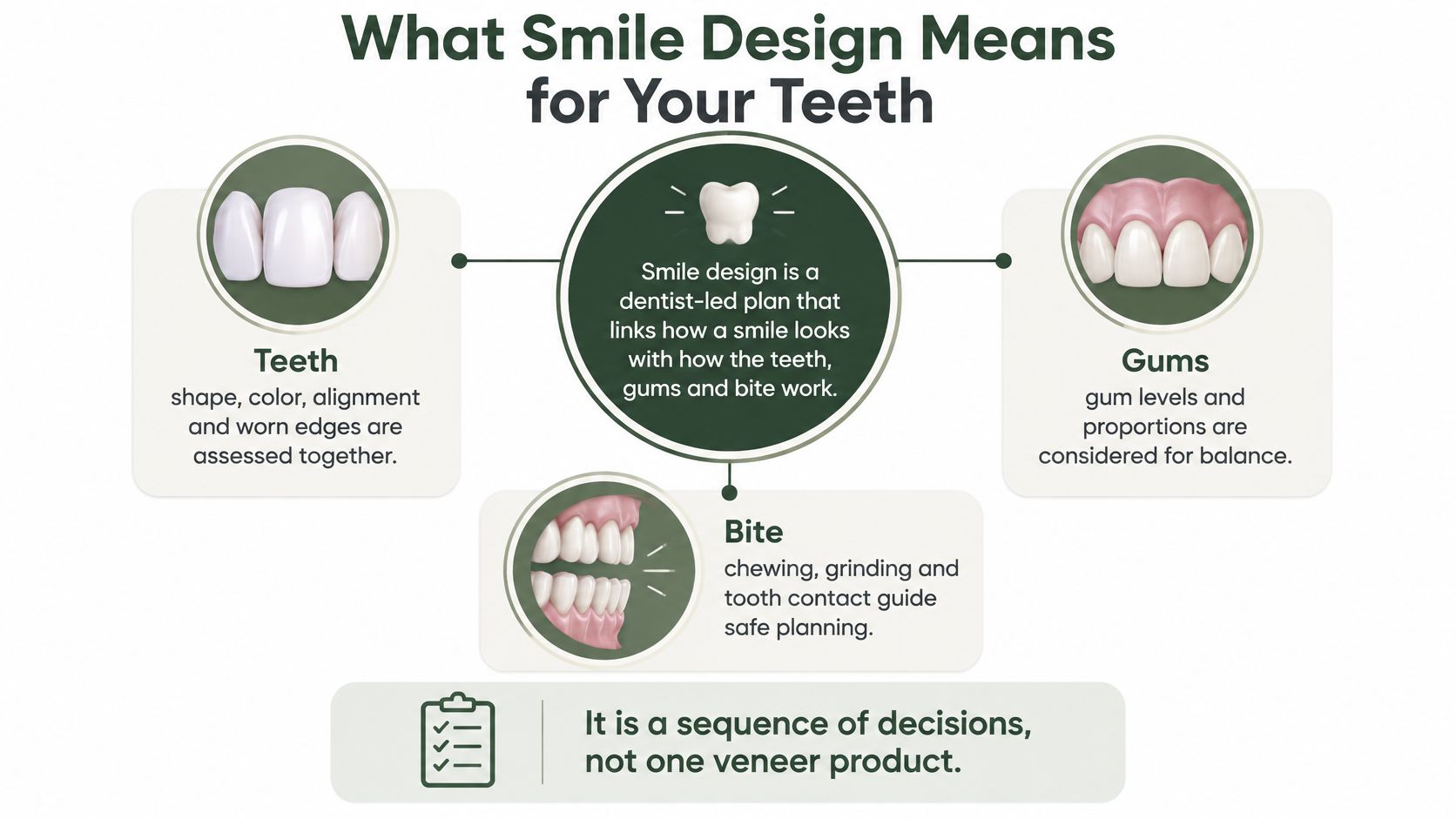
Why the foundation comes first
In a UAE clinical study of 246 patients, dental caries affected 57% overall, including 53.8% of participants aged 15–24 and 63.6% aged 45 or older. These findings describe that clinical sample, but they reinforce a practical point: appearance alone doesn't tell you whether a tooth is ready for elective treatment.
Active decay needs attention before cosmetic work. Inflamed gums may bleed and change shape during healing, while defective fillings can affect colour matching and the surface available for bonding.
Adults in Deira and wider Dubai may consider smile planning for:
- Colour concerns: Teeth that look dark or stained despite regular cleaning.
- Small defects: Chips, uneven edges or localised gaps.
- Tooth position: Crowding or spacing that affects the visible smile.
- Gum balance: Uneven margins or excessive gum display requiring assessment.
Your first decision: Ask whether your mouth is ready for cosmetic treatment, not which cosmetic treatment looks most dramatic.
An examination and appropriate hygiene care establish that starting point. From there, the dentist can compare conservative changes with alignment or restorative treatment, taking your preferences, budget and maintenance needs into account.
How Common Smile Changes Compare
| Option | Main aim | Effect on the tooth | Often considered when | Main limit |
|---|---|---|---|---|
| Professional whitening | Lighten suitable tooth colour | No shape change; enamel stays | Healthy teeth look dark or stained | Doesn't close gaps, repair chips or whiten crowns, veneers or fillings |
| Composite bonding | Repair small chips, edges or gaps | Usually adds resin with little or no drilling | Local defects on otherwise sound teeth | Can chip, stain or need later repair |
| Clear aligners | Improve spacing, crowding or bite | Alignment itself doesn't require elective drilling, although limited enamel reshaping may be proposed | Mild to moderate alignment issues and stable hygiene | Needs daily wear, retainers and won't suit every bite |
| Porcelain veneers | Change front-tooth colour and shape | Enamel is often reduced and that change isn't reversible | Colour and shape concerns remain after simpler care | Needs suitable enamel, a stable bite and future maintenance |
| Crowns | Rebuild a weak or heavily restored tooth | Usually more reduction than a veneer | Cracks, large fillings or root-treated teeth requiring protection | More invasive, with likely replacement over time |
| Gum care or contouring | Stabilise or reshape the gum frame | Targets gums rather than tooth colour | Inflammation, uneven margins or excess gum display | Cosmetic contouring doesn't replace treatment of gum disease |
Match the concern to the treatment
Start with the concern that matters most. If you like your tooth shape but dislike its colour, ask whether cleaning and whitening could be enough. Adding veneers because they're part of a package may introduce unnecessary tooth preparation.
If a small corner is missing, bonding may be appropriate without covering the entire front surface. Resin can often be repaired, although the dentist must check why the corner broke and whether your bite would overload the repair.
For crowded teeth, moving them may preserve more natural structure than reshaping them to look straight. Ceramic braces are an alternative when removable aligners don't suit the bite or your routine. The clinic's comparison of clear aligners and braces can help you prepare questions about wear, cleaning and retention.
Separate cosmetic change from structural repair
A veneer covers the visible front surface of a tooth. A crown surrounds more of it and is usually considered when the tooth needs greater structural protection. Neither should automatically replace a sound tooth surface just to create uniformity.
Gum treatment also needs careful distinction. Treating inflammation protects health; reshaping healthy gum tissue is a separate decision requiring an assessment of the tissues and supporting bone.
Your decision: Identify the smallest change that addresses your main concern before combining treatments. Final suitability depends on examination, radiographs when indicated, bite, enamel thickness and gum health, and no option comes with a promise of painlessness or permanence.
The Checks Behind a Balanced Smile Plan
A smile assessment is a safety gate, not just a photograph session. Each finding can change whether a cosmetic step should proceed, wait or be replaced by another treatment.
Your dentist checks cavities and old fillings because a tooth may need repair before its appearance is altered. Gum bleeding and periodontal pockets, spaces between the teeth and gums, can indicate that supporting tissues need treatment first.
Tooth wear, cracks and jaw discomfort also matter. Lengthening worn teeth without understanding how they contact each other may leave new edges exposed to the same forces that damaged the originals.
What the examination needs to establish
- Tooth condition: Remaining enamel, cracks, large restorations, existing crowns and previous root canal treatment.
- Gum stability: Bleeding, pocketing, recession and gum display during relaxed and full smiles.
- Function: Chewing contacts, tooth wear, grinding history and jaw comfort.
- Useful records: Photographs, models or scans for planning, and radiographs when they can answer a clinical question.
General dentistry manages disease control. Restorative or prosthodontic care rebuilds damaged teeth, orthodontics changes tooth position, and periodontal care treats the gums and supporting tissues.
For persistent jaw symptoms, the Pain and Sleep Therapy Center's explanation of root-cause care for persistent jaw discomfort provides background for a discussion with your clinician. It doesn't replace an individual diagnosis or establish that changing your bite is necessary.
Turn patient rights into practical questions
The Dubai Health Authority outpatient-care requirements support disclosure of costs, the treating professional's qualifications and licence, diagnosis, options and prognosis, alongside participation in decisions, access to records and refusal of treatment after its consequences are explained.
Use those protections during your consultation:
- Evidence: What finding supports this recommendation?
- Reversibility: Will preparation permanently remove tooth structure?
- A limited start: What happens if I choose hygiene care only for now?
- Responsibility: Who diagnoses, performs and reviews each stage?
The clinic's guide to assessing an aesthetic dental clinic can support that conversation, but your entry point should remain a full dental assessment rather than a cosmetic-only offer.
A preview can help you express a preference. It cannot diagnose decay, gum disease or the cause of tooth wear.
Your decision: Don't approve irreversible preparation until you understand the clinical reason and the alternatives.
How the Planning Workflow Unfolds
A useful pathway moves from your concern to a documented plan, with permission to pause along the way. The graphic summarises the broad planning stages.
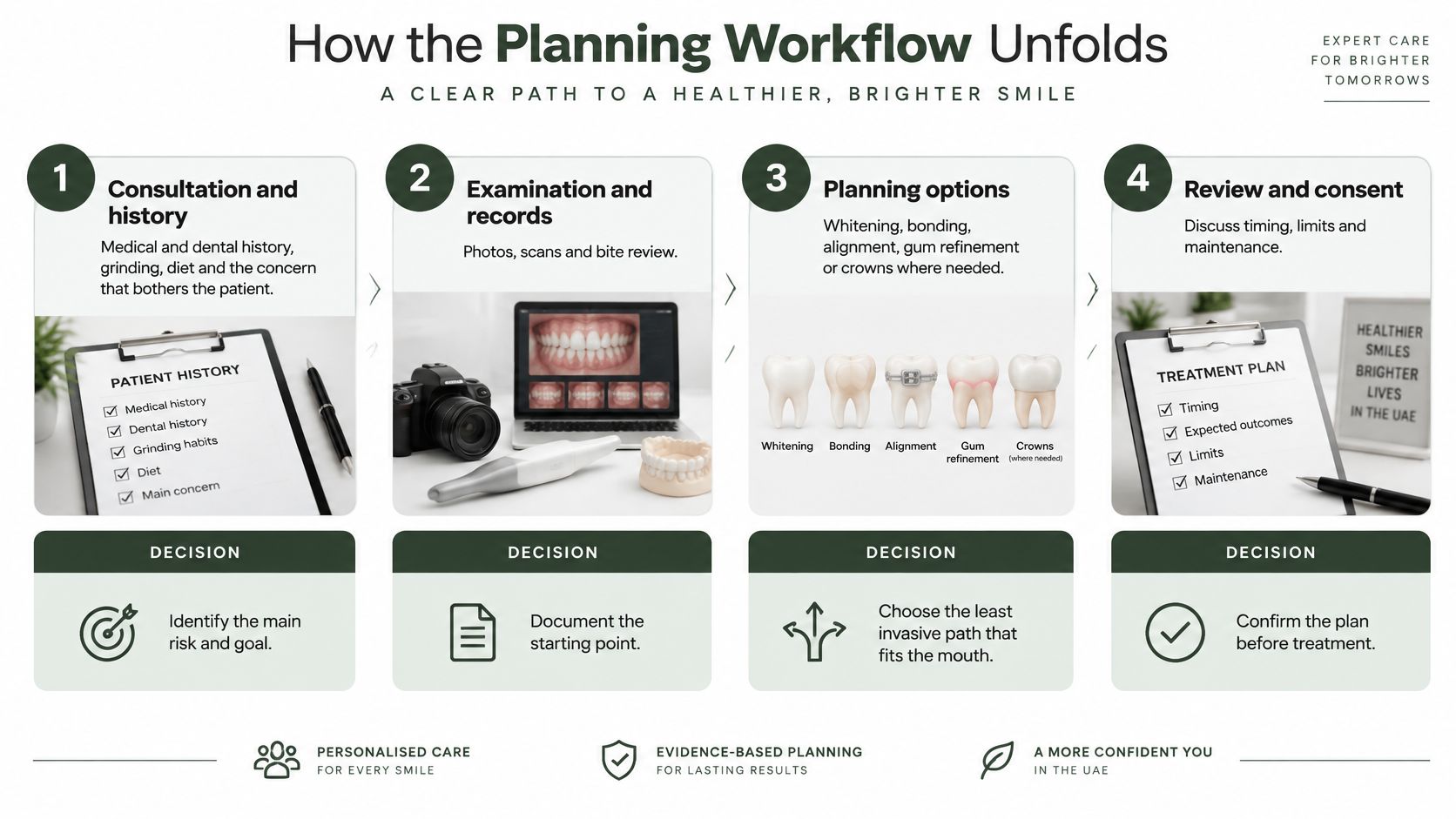
From consultation to consent
Discuss your history and priority. Bring details of medicines, previous dental work, grinding, diet and sensitivity. Decide which concern matters most, rather than agreeing to change everything visible.
The dentist examines your teeth, screens the gums and requests radiographs where indicated. Your decision is whether the findings are clear enough to support a recommendation or whether further assessment is needed.
Stabilise disease first. Cleaning, fluoride advice, fillings or gum treatment may come before elective changes. Agree on what needs to improve before the next stage begins.
Photographs, tooth width and height measurements, bite records and, where useful, a digital or physical mock-up help develop the proposal. Decide whether the suggested shape still looks like your smile.
Compare alternatives. Discuss no cosmetic treatment, conservative options and more extensive care, including their risks and upkeep. Choose according to the problem being treated, not the number of procedures offered.
Review a written sequence, estimate and consent form naming the clinician responsible for each part. Confirm materials, temporary restorations where relevant, emergency contact arrangements and maintenance before committing.
Proceed when the foundation is stable. Active treatment is followed by review and any required retention, repairs or protective measures. Decide whether you're satisfied at that stage before adding another elective procedure.
Understand what a mock-up can prove
A mock-up is a try-on, not a forecast of every detail. It helps you discuss tooth length, shape and gum display, but screen colour and temporary material cannot establish long-term wear, bite comfort or gum response.
The Dubai Health Authority scope guidance requires cosmetic dental procedures to stay within defined professional privileges, with informed consent and disclosure of short- and long-term risks. Ask which parts of your proposed treatment the clinician is authorised to perform.
The following video is an additional visual resource, not a substitute for your own assessment.
Your decision: Agree on the next justified stage only. You can finish after hygiene or alignment if that meets your needs and preserves later choices.
Four Starting Points and Realistic Expectations
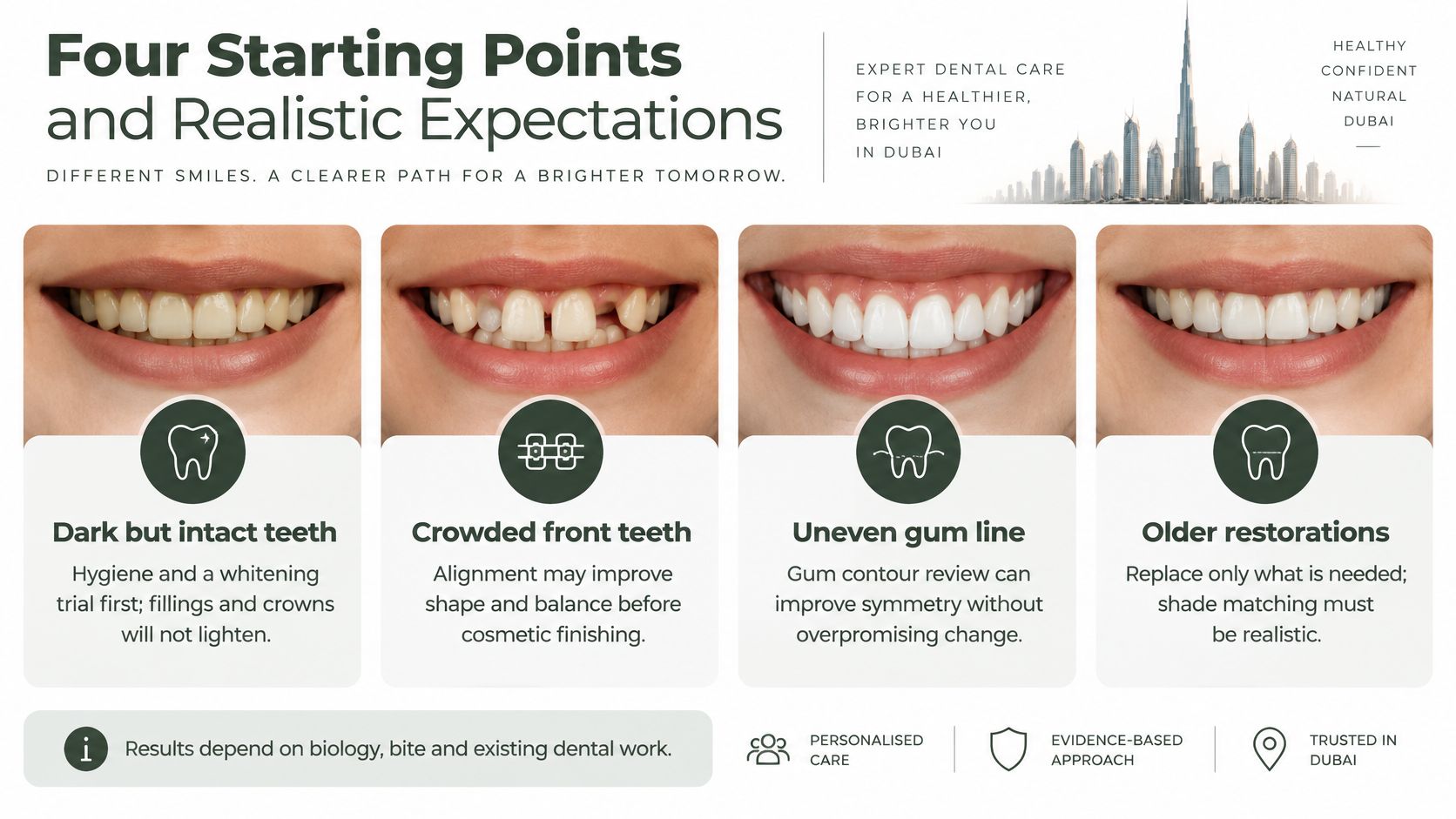
Different starting conditions call for different plans. These scenarios illustrate choices, not predicted before-and-after results.
Dark but intact teeth
You're comfortable with the shape, but the colour bothers you. Start by checking for surface staining and underlying causes of discolouration, then discuss a supervised whitening trial if suitable.
Existing fillings and crowns won't lighten with the natural teeth. Before replacing sound dental work for a shade mismatch, decide whether the mismatch troubles you after whitening has settled.
A chipped incisor edge
A small corner breaks from a front tooth. Bonding may restore it if enough sound structure remains and the bite won't repeatedly strike the repair.
If resin keeps failing, don't progress to a veneer without reassessing the cause. Check the loading on the tooth before choosing a stronger-looking material.
The illustration highlights how starting conditions influence the conversation.
Mild crowding with healthy gums
You want the front teeth to look more even, but they're otherwise sound. Clear aligners or ceramic braces may move them without covering their front surfaces.
Leave decisions about whitening or small bonding changes until the teeth reach their planned positions and retention is established. You may find that less finishing work is needed than you initially expected.
Uneven gums and worn front teeth
Longer-looking teeth or a more level gum line may seem like the obvious solution. However, periodontal stability and an assessment of wear come before contouring, veneers or crowns.
Grinding can fracture new restorations. The first decision is whether the proposed edges and gum changes are compatible with the tissues and chewing forces, not whether they look balanced in a photograph.
Small changes can be enough
In a Dubai smile-perception study involving 150 evaluators, orthodontists favoured lateral-incisor width-to-height proportions of approximately 62–67%, while general dentists and laypeople preferred approximately 67%; preferred gum-height corrections were about −0.5 to −1.0 mm, with edge-length preferences differing between groups.
Those preferences aren't universal treatment targets. A single golden proportion shouldn't be copied onto every face.
Choose a change you can explain in your own words, not a mathematical ideal you've been told to want.
Lighting, tooth thickness and healing affect the lived result. Maintenance visits remain important as your teeth, gums and restorations change with age.
Staging Care So the Budget Stays Honest
There isn't a published single smile-design fee to quote for the clinic here. A meaningful estimate must reflect the number of teeth involved, preliminary disease treatment, laboratory work, alignment duration and future upkeep.
Affordability is a real dental-care issue. A UAE survey discussed by Dental News found that 71% of respondents reported a tooth or gum problem during the preceding year, 55% didn't obtain needed care, nearly two-thirds identified cost as the leading reason, and 89% believed dental care should be included in health insurance.
Staged smile plan and cost questions
| Stage | What it addresses | Urgent or elective | Budget question |
|---|---|---|---|
| Examination and hygiene | Decay risk, plaque and baseline records | Usually the starting point | What's included in the consultation and cleaning fee? |
| Stabilise teeth and gums | Active caries, defective fillings, gum inflammation | Urgent when disease is active | Which items might be insured versus self-funded? |
| Alignment | Crowding, spacing or bite that affects the plan | Elective unless function is affected | What are the duration, retainer costs and consequences of inconsistent wear? |
| Whitening or bonding | Colour or small shape changes on sound teeth | Elective | What upkeep and repairs should I budget for? |
| Veneers or crowns | Larger colour or structural change | Elective for appearance alone; necessary repair may be time-sensitive | How many teeth, what laboratory fees and what replacement horizon? |
| Maintenance | Reviews, hygiene, retainers, night guard if indicated for grinding | Ongoing | What review interval and yearly upkeep are anticipated? |
Compare complete estimates
Urgent disease control shouldn't wait until you can afford a cosmetic package. Ask the dentist to separate necessary treatment from optional enhancement and identify a safe point to pause.
Insurance coverage is policy-specific, and cosmetic items are often excluded. Request an itemised estimate and check authorisation requirements with your insurer before assuming reimbursement.
A low starting fee may leave out temporary restorations, repairs, retainers or a night guard when indicated. The clinic's explanation of dental crown cost factors can help frame questions about materials, laboratory work and supporting treatment.
- Compare contents: Check what each estimate includes rather than comparing package names.
- Plan for upkeep: Ask about reviews, repair arrangements and eventual replacement.
- Protect options: Avoid irreversible work to fit a short-term promotional budget.
Your decision: Choose the stage you can maintain, not just the treatment you can initially purchase. A plan can stop after health care or alignment without making later enhancement compulsory.
Smile Design Questions Patients Ask
Is smile design painful?
Comfort varies by procedure and by patient. Whitening can cause temporary sensitivity, while veneer or crown preparation usually involves local anaesthesia. Ask about expected sensations, pain relief and what symptoms should prompt a call.
How long does it take?
There's no fixed timeline. A whitening course is very different from a plan involving gum treatment, healing and tooth movement. Ask for a sequence with review points rather than a completion date unsupported by examination.
Can veneers be reversed?
Not once enamel has been reduced. Discuss how much preparation is proposed, whether a less invasive alternative could address your concern and how future maintenance or replacement would work.
What should I expect during recovery?
Gum treatment can leave temporary tenderness, and instructions differ between cleaning, periodontal treatment and surgery. Follow the clinician's advice on brushing, food and pain relief rather than treating every procedure as having the same recovery.
- Daily cleaning: Brush with fluoride toothpaste and clean between teeth using the method recommended for your mouth.
- Retention: Wear retainers as prescribed after orthodontic treatment.
- Reviews: Attend checks and report a changed bite, persistent sensitivity or a loose restoration.
Can I start with hygiene care only?
Yes. A hygiene visit and examination can be a sensible limited start, although the dentist may identify disease that also needs treatment. You don't have to approve cosmetic procedures during that appointment.
Does insurance cover smile design?
Ask about individual procedures, not the overall label. Provide the insurer with an itemised plan and confirm exclusions, limits and any approval needed before treatment begins.
Will the result last?
There's no guaranteed lifespan for a smile result. Natural teeth still need care, and restorations may require repairs or replacement.
Before committing: Make sure the plan explains what you'll need to do afterwards, not just what happens in the dental chair.
Book a Smile Design Consultation in Deira
Book a consultation when a colour, chip, gap or gum concern has persisted and you want a reasoned sequence instead of a guess. You don't need to arrive knowing whether whitening, bonding, aligners or veneers suit you; working that out is the appointment's job.
A consultation works like a structural survey before renovation: it shows what is underneath before you decide what to change. The decision this stage asks of you is narrow. Have the mouth examined before any cosmetic step, and accept that the answer may be proceed, wait, or stay with prevention. All three count as a good outcome if they follow an examination.
When dental symptoms come first
Pain, swelling, a loose tooth or a broken tooth that affects eating needs prompt dental assessment before any appearance-led consultation. Rapidly increasing swelling, or difficulty swallowing or breathing, requires emergency care.
If your concern is elective and you're unsure, taking time to consider the recommendation is reasonable. Ask which findings can safely be monitored and which need treatment, so that waiting stays an informed choice rather than a default one.
Bring what helps the discussion
- Your priorities: Describe the feature you'd most like to change and what you'd prefer to keep.
- Previous treatment details: Include past orthodontics, whitening, restorations and any available records.
- Medical information: Bring your medicine list and relevant health history.
- Insurance documents: These help separate potential benefits from self-funded costs.
Dental consultations are available at Yoyime Clinic in central Deira, Dubai, with daily opening from 10:00 to 22:00. An examination can establish suitability, explain alternatives and outline the maintenance your proposed treatment would need.
Start with general dental assessment. Explore veneers or alignment only if the findings and your preferences make them reasonable options, and confirm the scope of treatment directly with the clinic.
A consultation doesn't commit you to veneers. Results vary, comfort is individual, and a prevention-only plan may be the right outcome.
Yoyime Clinic offers dental consultations to assess your teeth, gums and bite before planning changes to your smile. Visit Yoyime Clinic to arrange a consultation in Deira and ask for a written plan that separates necessary care from optional enhancement.