


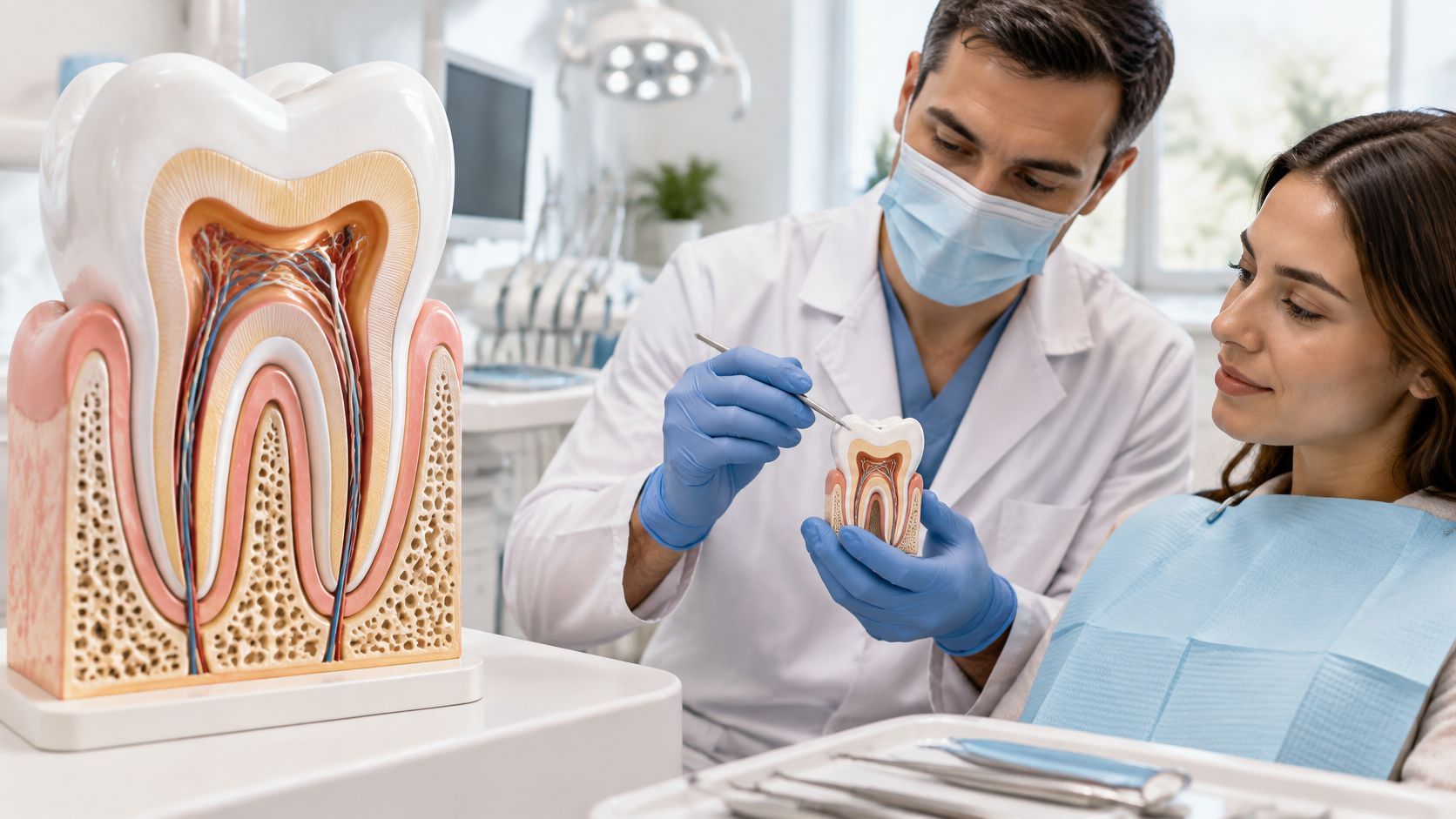
Root canal treatment cleans, disinfects and seals the infected inner canals of a tooth that can still be restored, usually across more than one visit.
Perhaps you've started chewing on the other side, or a cold drink leaves an ache that doesn't settle. Understanding what happens during the appointment helps you make a calmer decision. It also clarifies something patients often miss: a filled canal and a healed, protected tooth are two separate stages of care. In Dubai clinics that follow current clinical standards, the treatment involves isolating the tooth with a dental dam, chemically disinfecting each canal and sealing the system in three dimensions, so knowing the process is also a way of judging the quality of the care on offer.
Table of Contents
- What a Root Canal Visit Is For
- The Root Canal Treatment Procedure in Order
- Why Canal Shape Changes the Plan
- When Antibiotics Are Not the Treatment
- Recovery Crowns and Healing Checks
- Risks Alternatives and Specialist Referral
- Common Questions About Root Canal Treatment
- Book a Root Canal Assessment in Deira
What a Root Canal Visit Is For
The root canal treatment procedure follows a practical sequence: examination and imaging, local anaesthesia, isolation, cleaning and shaping, disinfectant irrigation, canal sealing, then a protective filling or crown. The purpose is to retain a natural tooth that can still be restored, not just to stop it hurting.
Say you're having lunch in Deira and feel pain when you bite on a back tooth. The dentist needs to determine whether the problem comes from decay, a crack, the bite, the gums or inflammation inside the tooth. Symptoms alone don't establish that you need a root canal.
The pulp is the soft tissue inside the tooth, containing nerves and blood vessels. Deep decay, a crack or an injury can inflame it or cause it to die, allowing infection to develop within the canal system.
When keeping the tooth is realistic
Treatment may be suitable when the dentist can address the infection and build a reliable restoration afterwards. The assessment includes:
- Remaining tooth structure: There must be enough sound tooth to support a filling or crown.
- Root and gum support: The tooth needs a reasonable foundation.
- Restorable bite: The finished tooth must tolerate chewing without unsuitable loading.
Many cases require separate appointments because canal disinfection and the final protective restoration are different jobs. Your final plan depends on examination, symptoms, X-rays and medical history.
For help recognising symptoms, DentalHealth.com's explanation of when tooth pain needs a dentist offers useful background. If pain is disrupting eating or sleep, our emergency dental pain management pathway starts with assessing the cause.
Questions about canal shape, antibiotics, crowns and specialist referral are reasonable parts of that conversation. Don't assume every painful tooth needs the same treatment.
The Root Canal Treatment Procedure in Order
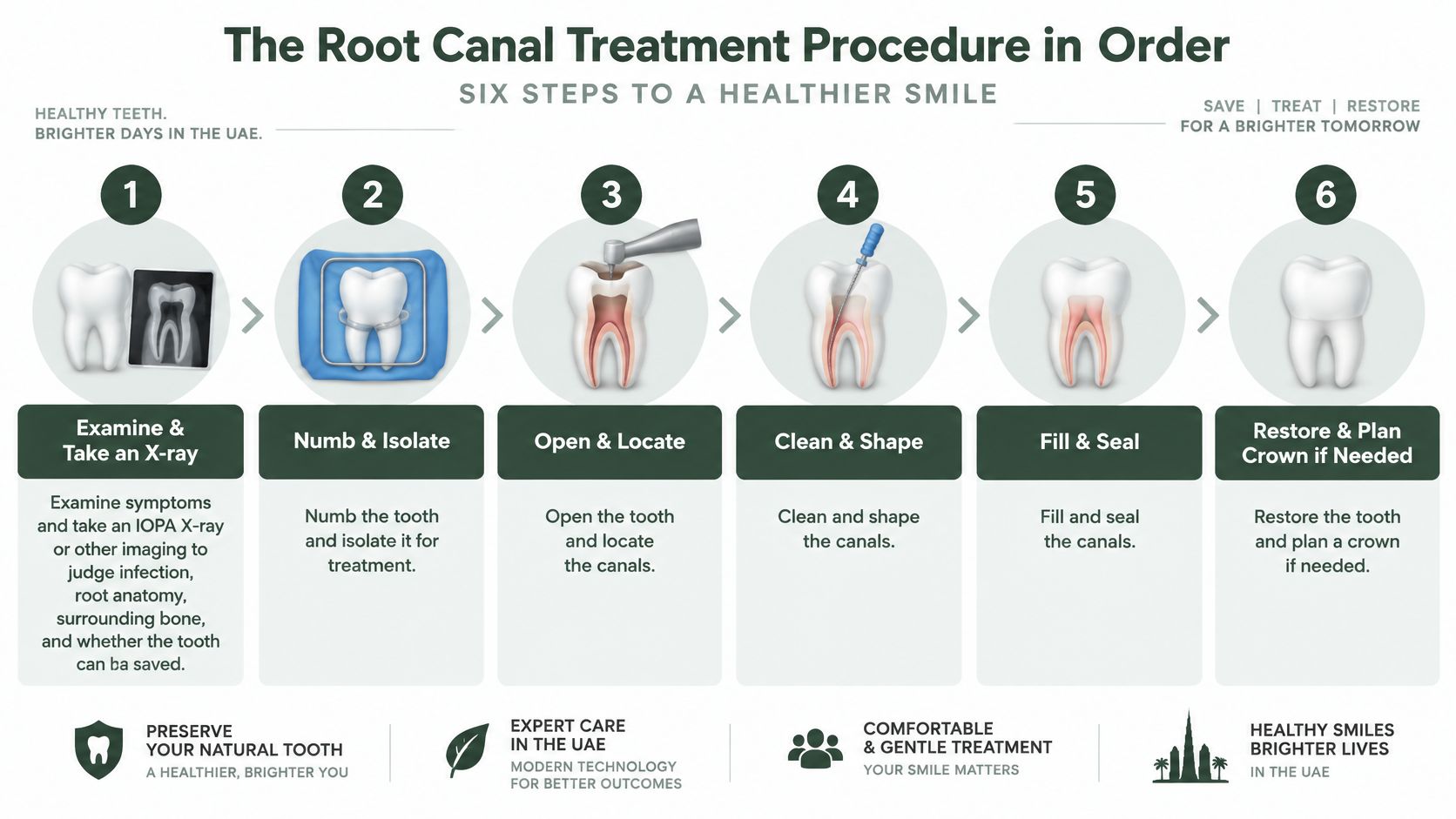
A canal system resembles branching pipes, not a single straight tunnel. The dentist must locate the accessible pathways, clean and disinfect them, then seal them while preserving enough tooth for restoration.
The Dubai Health Authority's Clinical Guidelines for Endodontics describe cleaning and shaping, chemical disinfection and three-dimensional obturation as coordinated objectives, and report primary-treatment success ranging from 47% to 97%. That broad range reflects differences in diagnosis, anatomy, technique, restoration quality and follow-up, not a personal prediction.
The appointment step by step
Examination and imaging
The dentist reviews your symptoms, checks the tooth and assesses whether it can be restored. An IOPA X-ray, a focused dental image, helps evaluate the extent of infection, root anatomy and surrounding bone. Additional imaging may be appropriate if the initial picture doesn't answer an important clinical question.
Local anaesthesia
The dentist numbs the treatment area before working inside the tooth. You may notice pressure, vibration or the sensation of instruments moving, but you should report sharp pain immediately. The clinician can pause and reassess anaesthesia rather than expecting you to tolerate it.
Dental-dam isolation
A dental dam is a protective sheet placed around the tooth. It keeps saliva away from the treatment area and helps prevent instruments or disinfecting solutions from contacting the mouth. This isolation is a required part of Dubai's endodontic guidance, not merely an optional comfort measure.
Access, pulp removal and shaping
The dentist makes an opening through the top of the tooth and locates the canal entrances. Fine instruments remove pulp tissue and shape the canals so disinfectant can reach the prepared spaces. You'll generally hear the handpiece and may feel vibration, even though the tooth is numbed.
Chemical disinfection
Instruments can't contact every recess, so the dentist uses copious sodium hypochlorite irrigation during preparation. The guideline above also describes a final rinse with 5 mL of 17% EDTA for at least 1 minute to remove the inorganic smear layer, the fine residue left by instrumentation. These are clinician-controlled materials, never products to apply yourself.
Drying and three-dimensional sealing
Once appropriate cleaning and disinfection are complete, the canals are dried and filled with root-filling material and sealer. Obturation means filling the prepared canal system. Cold lateral compaction is a practical benchmark technique in the guidance, offering control near the root tip.
Closing the access opening
A temporary or initial filling closes the opening until the definitive restoration is ready. Before you leave, the dentist checks the bite and explains how to protect the tooth between appointments.
This visual groups anaesthesia and isolation together to show the overall treatment flow.
What determines appointment time
The number of canals, their curvature and the condition of the tooth affect how long treatment takes. Your clinician confirms the expected timing after assessment rather than promising a fixed duration before seeing the anatomy.
For another patient-friendly description, Prosth & Co.’s guide to what happens during a root canal explains the visit sequence.
Practical rule: A filled canal isn't the finish line. The tooth also needs a reliable seal against bacteria and protection when you bite.
Why Canal Shape Changes the Plan
Teeth don't share a single canal map. Even teeth with similar-looking crowns can contain different numbers of canals, curves and connections underneath.
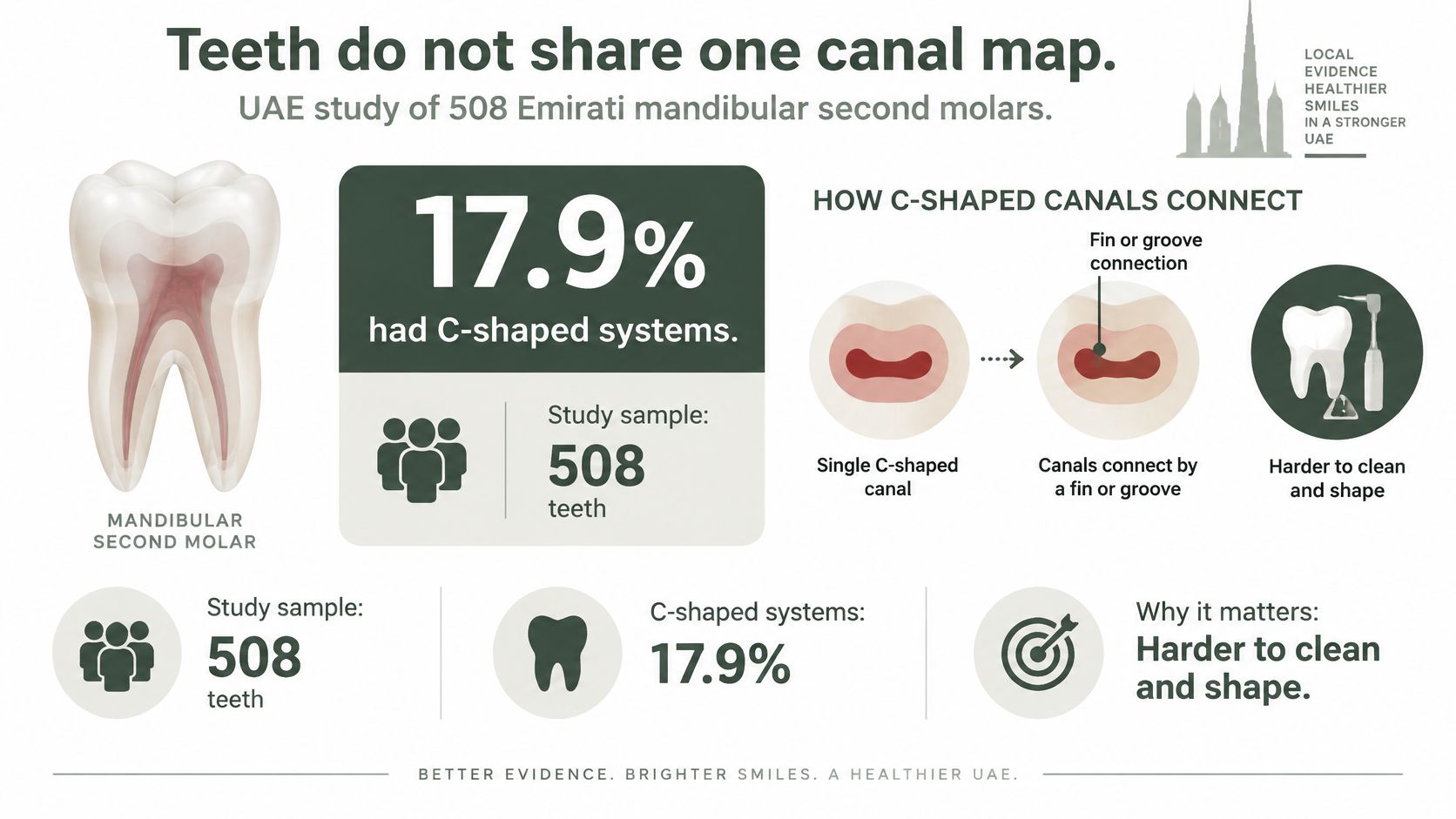
A UAE anatomical study published in Scientific Reports examined 508 Emirati mandibular second molars and found C-shaped canal systems in 17.9%. These are lower second molars, and their connected fins or grooves can make cleaning and sealing more demanding.
Think of adjacent pipes connected by a thin fin-shaped space. Passing an instrument through each main pipe doesn't necessarily clean the connecting area, which is why irrigant delivery and careful preparation matter.
Canal patterns in Emirati mandibular second molars
The same study reported the following anatomical findings.
| Finding | Reported share | What it means for cleaning |
|---|---|---|
| C-shaped canal system | 17.9% of 508 teeth | Connected fins or grooves are harder to clean and seal |
| Two separate roots when not C-shaped | 78.3% | Separate roots still need each canal found |
| Mesial root Vertucci Type II | 46.5% | Two canals that join need both paths shaped |
| Distal root Vertucci Type I | 90.5% | One canal is the common distal pattern |
Vertucci types describe the routes canals take through a root. Type I describes a single canal, while Type II describes two canals that join before reaching the root tip.
The study also found a statistically significant association between C-shaped anatomy and female sex. These findings describe an Emirati sample, not every resident of Dubai, and sex alone can't identify an individual tooth's anatomy.
What this changes for your visit
A front tooth with a relatively straight canal may allow straightforward access and preparation. A curved molar, a C-shaped molar or a previously root-filled tooth may require more investigation, additional treatment time or specialist care.
Preoperative imaging, magnification and careful access help the dentist identify extra or connected canals. A focused X-ray is useful, but overlapping structures can obscure details, so more complex imaging may be selected when it would change the treatment decision.
Our explanation of dental X-ray safety can help you understand why imaging is selected for a particular clinical question. Anatomy is also a sound reason for an initial estimate of visits to change after examination.
When Antibiotics Are Not the Treatment
A prescription can't replace cleaning an infected canal. Antibiotics travel through the bloodstream, but they don't reliably sterilise the space left by dead pulp. When the source remains inside the tooth, medication alone doesn't remove it.
A survey of 174 UAE dentists found that 38.5% prescribed antibiotics at least monthly, with some reporting prescriptions for irreversible pulpitis, necrotic pulps without systemic involvement or sinus tracts. Those situations require attention to the local dental cause rather than an assumption that antibiotics will resolve it.
Dubai's endodontic guidance doesn't recommend systemic antibiotics alone for a localised endodontic infection or an asymptomatic infected tooth. A local procedure, such as removing inflamed pulp tissue or draining infection, is the central treatment.
Tooth infection symptoms and the first response
| What you notice | Main response | Role of antibiotics |
|---|---|---|
| Lingering pain or bite pain without swelling | Examination and root canal treatment or pulpotomy | Not a substitute for local treatment |
| Localised swelling or a draining gum pimple | Drainage and canal treatment | Alone, not recommended for localised infection |
| Fever, spreading facial swelling or feeling very unwell | Urgent dental and medical assessment | May be added, never a reason to delay care |
| Penicillin allergy | Tell the dentist before any prescription | An alternative is considered only if antibiotics are indicated |
A pulpotomy removes inflamed pulp tissue from the crown portion of the tooth. A dentist may use it to manage an urgent problem, with the next stage determined by the diagnosis.
Three situations that need different decisions
Night pain from irreversible pulpitis, inflammation that won't recover, may lead to an urgent appointment for local treatment. Pain intensity alone doesn't establish a need for antibiotics.
A small gum pimple may be a sinus tract, a drainage route from an infected tooth. It can release pressure and make the tooth feel less painful, but that doesn't mean the underlying infection has resolved.
Rapidly spreading facial swelling needs urgent assessment, particularly with fever or marked illness. Difficulty swallowing or breathing requires emergency medical help.
Tell the dentist about penicillin allergy, previous medicine reactions and current medicines before any prescription is considered. Don't take leftover antibiotics or choose a substitute yourself.
Antibiotics may support treatment when infection is spreading. They should never become a reason to postpone definitive dental care.
Recovery Crowns and Healing Checks
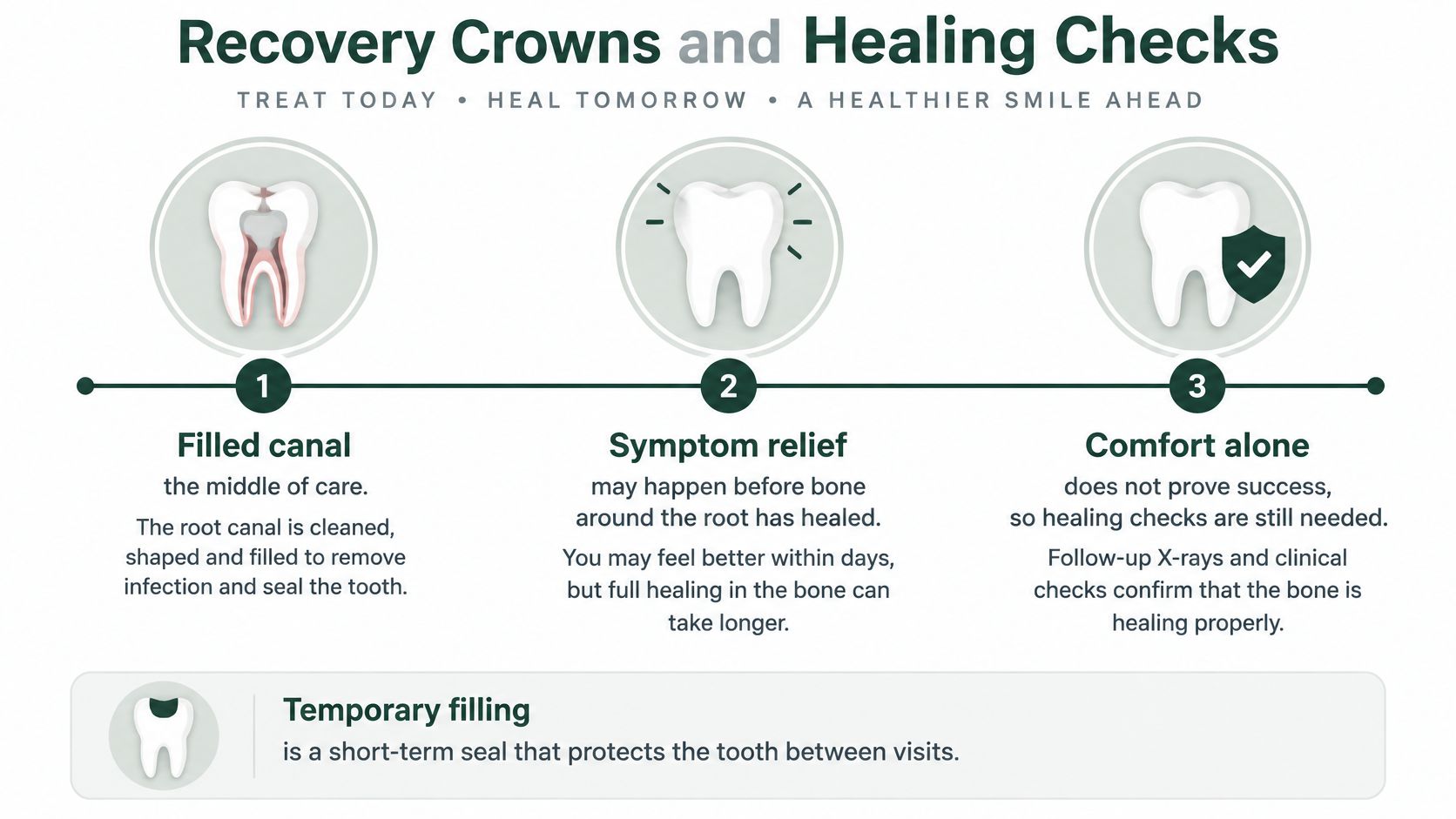
A tooth can become comfortable before the bone around its root has healed. Symptom relief and proven healing aren't the same thing, so the absence of pain doesn't remove the need for review.
Dubai restorative guidance recommends follow-up at 1, 3 and 6 months, while quality monitoring includes retreatment of the same tooth within 12 months, as described in the Dubai Health Authority restorative-care guidance. These are review and outcome measures, not a prediction that you'll need further treatment.
Protect the tooth between visits
A temporary filling is a short-term cover. Avoid hard, sticky or crunchy food on that side, and don't test the tooth by repeatedly biting firmly on it.
Numbness usually fades over hours, and biting tenderness may last several days. Avoid chewing while you're numb so you don't bite your cheek or tongue, and use pain relief only as advised, taking account of your medical history and other medicines.
- Keep it clean: Brush gently around the tooth and maintain your normal oral hygiene.
- Protect the seal: Contact the clinic if the temporary filling cracks, loosens or comes out.
- Check the bite: Report a tooth that feels higher than the others rather than waiting for it to settle.
The sequence below separates immediate comfort from the later confirmation of healing.
Why a crown may be recommended
A back tooth that has lost substantial structure may need a crown or another cuspal-coverage restoration. Covering weakened biting surfaces can reduce fracture risk, while a well-fitting restoration helps prevent bacterial leakage.
Not every root-treated tooth needs the same restoration. The dentist considers the remaining walls, cracks, existing fillings, and biting forces, rather than recommending a crown just because the nerve has been removed.
Our guide to dental crown types explains the restorative options in plain language.
At our clinic, completing root canal treatment and permanently cementing a laboratory-made crown typically requires two to three visits. The root canal and PFM crown placement can't be completed in a single appointment because the laboratory needs time to craft the porcelain-fused-to-metal crown.
Know when to return sooner
Don't wait for a scheduled review if you develop:
- Worsening pain: Particularly pain that increases after initial improvement.
- Swelling or drainage: Including a returning gum pimple.
- Restoration problems: A loose filling or crown, or an uneven bite.
Clinical examination and X-rays help the dentist judge healing. Persistent disease calls for reassessment, and sometimes retreatment, rather than an automatic decision to extract the tooth.
Risks Alternatives and Specialist Referral
Root canal treatment has limits. A canal can be missed, an instrument can separate, a root can be perforated, or infection can persist despite treatment. A crack discovered during assessment or treatment may also make the tooth unrestorable.
The clinician's role includes recognising when the difficulty exceeds routine care.
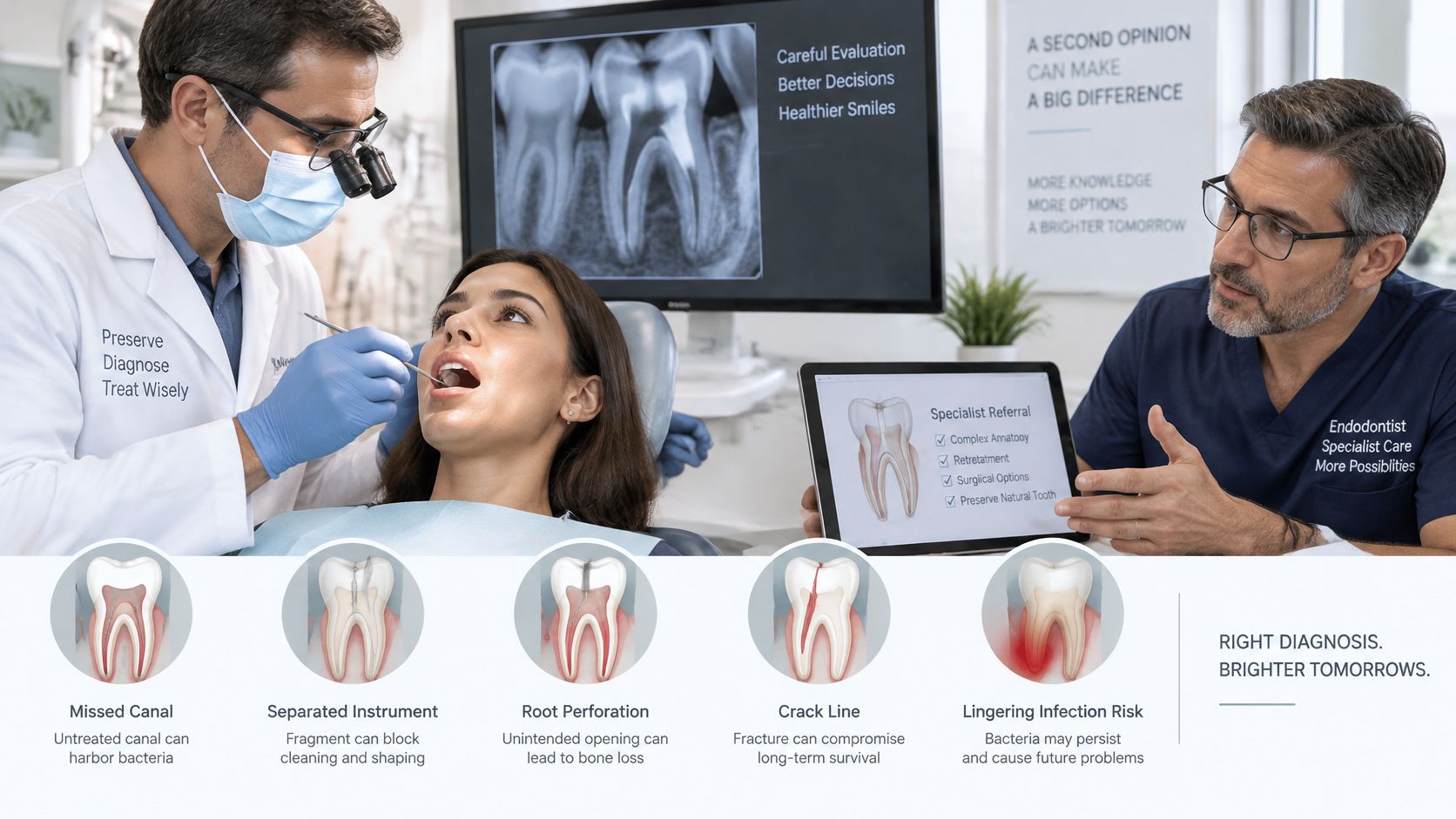
Routine care or an endodontist
The Dubai Health Authority scope-of-practice document limits general dentists to simple, low-difficulty root canal cases. Unusual anatomy, developmental anomalies, previous-treatment complications, cysts, combined gum-and-root lesions and other dentoalveolar complications warrant evaluation for advanced endodontic care.
An endodontist is the specialist for higher-difficulty canal treatment. Strongly curved or narrow canals, persistent infection and a tooth requiring coordinated bite rehabilitation can also influence referral.
Referral doesn't necessarily mean the tooth can't be saved. It means the case needs an appropriate level of assessment, skill or treatment planning.
The following video can support a discussion with your clinician.
Choosing among the treatment paths
When the tooth is restorable, completing canal treatment and protecting the tooth may preserve useful natural structure. When a deep crack or extensive loss of tooth structure prevents a reliable restoration, extraction may be more appropriate, followed by a separate discussion about replacement.
Monitoring is an option only when a dentist confirms that urgent treatment isn't required. It isn't a safe substitute for treating an established infection just because symptoms have eased.
Delaying care for deep decay or infection can allow it to spread and may lead to permanent tooth loss. The appropriate response still depends on what the examination finds.
Bring the following to your assessment:
- Symptom timeline: When pain began, its triggers and any swelling.
- Medical information: Conditions, current medicines and relevant treatment.
- Medicine allergies: What you took and what reaction occurred.
- Previous dental images: Any available X-rays and details of earlier treatment.
No webpage can determine whether your tooth is restorable. That decision needs an examination and appropriate imaging.
Common Questions About Root Canal Treatment
Is a root canal painful?
Local anaesthesia is used, so you may feel pressure or vibration rather than sharp pain. Some patients find the original toothache more distressing than treatment, but nobody should promise zero discomfort. Tell the dentist immediately if something feels sharp or painful so they can pause and reassess.
Does diabetes affect healing?
A UAE study of 100 adults available through the MBRU repository found that participants with uncontrolled diabetes, defined as HbA1c of at least 8%, had a mean pretreatment Periapical Index score of 3.3, compared with 2.3 in matched non-diabetic controls. This X-ray score reflects inflammation around the root.
Treatment reduced lesion size across the study groups. Share your diabetes status and recent blood sugar control so the dental and medical aspects of care can be considered together.
Will the dentist use a rubber dam?
Dubai guidance requires dental-dam isolation for endodontic treatment. A UAE survey of private dental practices found that reported use wasn't universal, although that survey doesn't establish current practice at every clinic.
It's reasonable to ask how the tooth will be isolated before treatment begins. Understanding the protective sheet can also make it feel less unfamiliar during the appointment.
Can a treated tooth become infected again?
Yes. Persistent or returning infection is possible, including when bacteria remain in inaccessible anatomy or re-enter through a damaged restoration.
The dentist assesses symptoms, the restoration and imaging before recommending the next step. Retreatment is a considered clinical decision, not an automatic consequence of an uncomfortable tooth, and extraction isn't the only possible response.
Book a Root Canal Assessment in Deira
If painkillers, a prescription or a temporary filling are getting you through the day, book an assessment instead of assuming the tooth has settled. The visit should answer three plain questions: what is causing the symptoms, can the tooth be saved, and how will it be protected afterward.
Yoyimé Clinic is in central Deira, Dubai, with clinic hours from 10:00 to 22:00. Its doctor-led restorative dentistry includes fillings, root canal treatment, inlays and onlays, and crowns and bridges.
What we assess with you
The dentist examines the tooth, reviews your symptom timeline and medical history, and decides whether imaging is needed. An IOPA X-ray can show the extent of infection, the root anatomy and the surrounding bone, which helps the dentist judge whether treatment is suitable in the clinic or whether specialist endodontic input is advisable. Our team includes Dr. Rama Krishnam Raju, Specialist Endodontist, with 15+ years in dentistry.
- Treatment scope: Dent Shield combines a dental consultation, IOPA X-ray, root canal treatment and a durable PFM crown.
- Restorative choices: Precision Restore includes root canal therapy with a choice of Zirconia or E-max crowns.
- Questions to ask: how the tooth will be isolated, disinfected and sealed, which crown is planned, and what review visits are included.
A filled canal or a finished antibiotic course does not by itself prove the tooth is healed and protected. Bring your symptom timeline, medical details, medicine allergies and any previous dental X-rays so the plan can cover cleaning and sealing the canals as well as the restoration that protects the result.
Yoyimé Clinic offers dental assessment, root canal treatment and restorative care to help patients understand whether an affected tooth can be preserved and protected. Visit Yoyime Clinic to arrange a consultation in Deira, and bring your symptom history and any previous dental images so we can discuss an appropriate plan with you.