



Which tells you more about a dental practice in Dubai: the length of its cosmetic menu, or the first three questions its dentist asks? Many who compare clinics start with the menu, because that's what the pages put in front of them. The questions come later, often after a deposit.
This guide reverses that order. It sets out the main cosmetic dental options by what they change and what they cost you in natural tooth, then spends the rest of the article on the checks that decide whether those options are safe to accept: DHA licensing, who is qualified to perform each step, what a real assessment covers, what consent should look like, and how infection control is handled.
Search for an aesthetic clinic Dubai and you'll get device lists, package prices and before-and-after grids. None of that tells you whether the clinic holds a licence for the procedure you're considering, or whether the person holding the handpiece is trained for it. Those are the questions worth answering first.
Table of Contents
- Cosmetic Dental Options at a Glance
- How to Verify Doctor-Led Care in Dubai
- What a Dental Consultation Should Cover
- How Cosmetic Treatment Progresses From Plan to Aftercare
- Consent, Costs and Changing Treatment Plans
- Infection Control and Safety Questions to Ask
- Frequently Asked Questions About Dental Cosmetic Options
- Book a Dental Consultation in Deira
Cosmetic Dental Options at a Glance
Patients rarely arrive asking for a named technique. They arrive with a concern: a chipped incisor, a shade they've stopped liking in photographs, a gap that shows when they laugh. The useful question is narrower than "which treatment is best". It's "which option changes the thing I dislike, and how much natural tooth do I give up for it?"
Dubai's menus are long because the market supports length. Dentistry accounted for nearly 46% of treatments undertaken by medical tourists in 2018, followed by orthopaedics at 18% and dermatology at 10%, according to the Dubai Health Authority investment guide. A city with that much cross-border dental demand will list every option it can offer. A menu is not a diagnosis.
| Option | What it changes | Usually suits | Main limitation |
|---|---|---|---|
| Professional teeth whitening | Shade of natural teeth | Teeth with healthy enamel and no untreated decay | Sensitivity can occur; results vary and fade over time |
| Cosmetic bonding | Small chips, gaps and minor shape | Small areas with healthy tooth structure | Composite can stain and may need repair over the years |
| Porcelain veneers | Shape, colour and spacing of front teeth | Healthy teeth with enough enamel to bond a thin shell | Removes a thin layer of enamel; generally considered irreversible |
| Clear aligners | Gradual tooth alignment | Mild to moderate alignment concerns, confirmed by examination | Needs consistent daily wear; complex cases may need other treatment |
| Smile design (combined plan) | Shape, shade and proportion across several teeth | Patients wanting several changes planned together | Scope and cost vary by plan; confirm after examination |
Reading the options by concern
Three quick reads show how the table behaves in practice.
- A single chipped front tooth: cosmetic bonding usually fits, because the surrounding enamel is healthy and the repair is built directly onto the tooth in one visit. It's also the most forgiving choice on the list if you change your mind later.
- An overall yellow shade with firm, healthy gums: professional teeth whitening addresses colour only. It won't alter shape, close a gap or straighten anything, and the result fades with time and staining foods.
- Several front teeth needing shape, colour and spacing work: porcelain veneers, or a planned smile design that sequences veneers alongside other treatment. This is the option that removes enamel, so it deserves the longest conversation and the most questions.
None of these reads replaces an examination. Suitability and the final plan depend on clinical examination and individual patient needs: enamel thickness, gum health, bite forces, existing fillings and what you want the result to do. Treat the table as a list of questions rather than an answer, and bring it with you.
How to Verify Doctor-Led Care in Dubai
A laser, a scanner or a curing light doesn't hold a licence. The person using it does, and their authorisation is specific to the procedure. That distinction is where most clinic comparisons fall apart, because equipment is visible in marketing and qualifications usually aren't.
Start with two separate checks, not one. The facility needs a Dubai Health Authority licence for dental care, and the individual dentist needs a licence covering the procedure you're being offered. Scale puts that in context: Dubai recorded 5,372 licensed healthcare facilities in 2024, and multi-specialty clinics formed the largest category at 1,665 facilities, or 31% of the total, per the DHA statistical yearbook. Licensing is the floor every one of those facilities stands on. It isn't a differentiator, and no clinic should present it as one.
Scope of practice is the next layer, and it's simpler than it sounds. Each treatment belongs to a clinician trained and licensed for it. Fillings, root canals and crowns sit with restorative work. Veneers, bonding and whitening sit with cosmetic dentistry. Aligners sit with orthodontics, extractions with oral surgery. A dentist can be excellent and still not be the right person for a particular step, which is why a referral is a sign of good practice rather than a gap in it.
| Check | What to confirm | Who or where to ask |
|---|---|---|
| Facility licence | Clinic operates under Dubai Health Authority licensing | Reception or the clinic manager |
| Clinician licence | Treating dentist is DHA-licensed for the proposed treatment | The treating dentist, by name |
| Specialty fit | Restorative, cosmetic or specialist training matches the treatment | The treating dentist |
| Who performs each step | Named clinician for consultation, procedure and follow-up | The clinic team before booking |
| Referral route | Clear plan if a specialist or second opinion is needed | The treating dentist |
Why the consultation decides more than the price list
A doctor-led consultation establishes four things before anything is booked: whether treatment is indicated at all, what would make it unsafe for you, which alternatives exist including doing nothing for now, and who should perform each stage. That's a clinical conversation, and it takes longer than a sales conversation.
The reasoning behind it sits in our guide to doctor-led aesthetic clinic care and treatment options. Yoyime Clinic operates under the licensing and regulation of the Dubai Health Authority, and our dentists and specialists are DHA-licensed and trained to international clinical standards, with 15+ years of combined clinical experience across the team.
Before you agree to a plan, write down the clinician's full name, their licence status for that specific procedure, and who covers follow-up. Confirm those details with reception directly rather than trusting a website badge or a social media bio.
What a Dental Consultation Should Cover
A good consultation is an assessment, and it happens before anyone mentions a package. Cosmetic goals belong inside that assessment rather than in place of it: the shape of your smile and the state of your gums are two parts of one plan.
The scope is wider than most patients expect. DHA oral and maxillofacial guidance lists what a clinical and radiographic assessment should consider before treatment, including patient motivation and education, fluoride application, chlorhexidine rinses, tooth mobility, periodontal disease, retained root fragments, caries, disease around tooth roots, missing teeth and denture stability, as detailed in the DHA oral and maxillofacial guidance. A visit built only around the tooth that currently hurts misses most of that list.
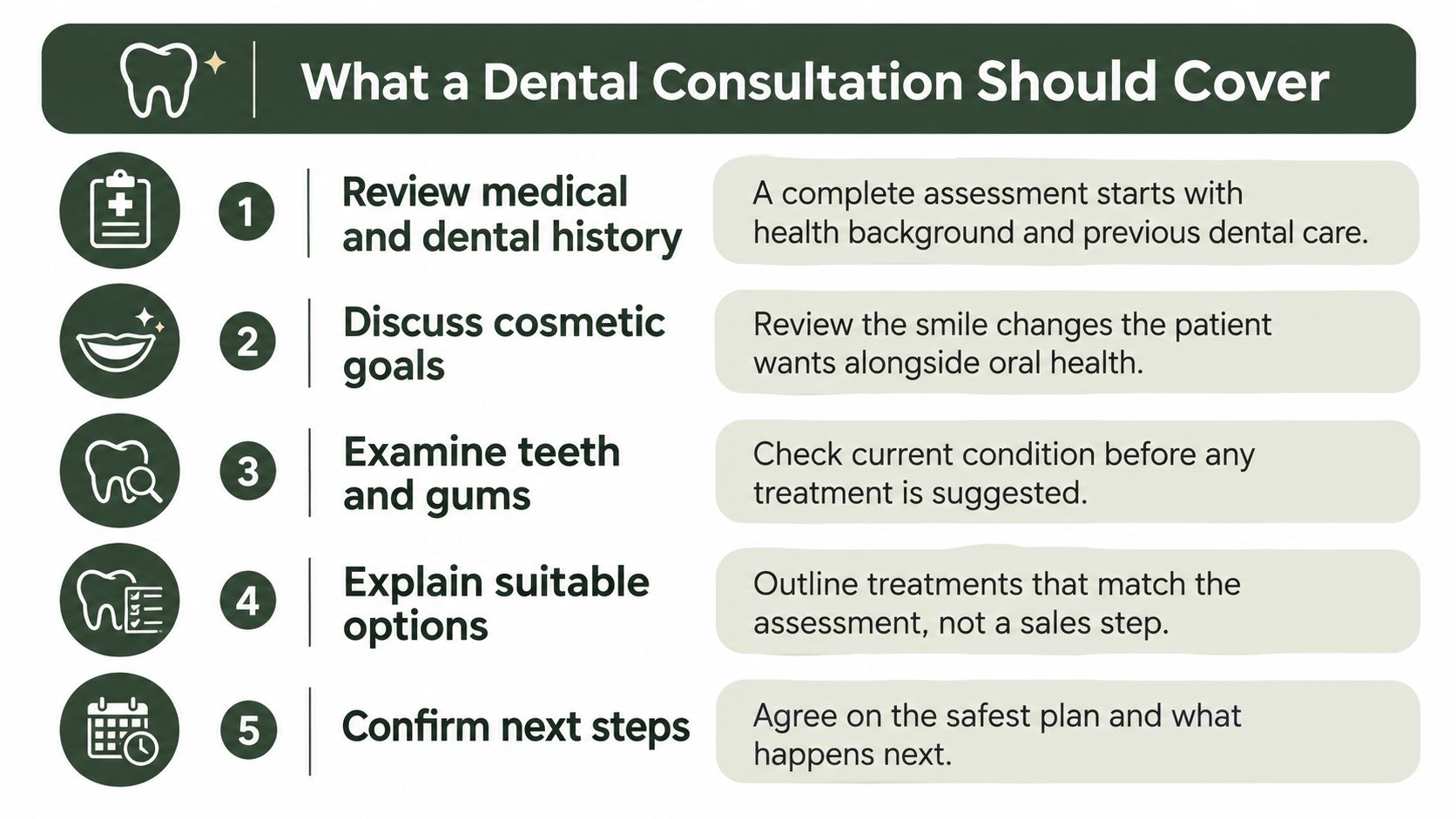
- Review medical and dental history. Medications, allergies, smoking and previous dental work all change what's safe. Blood thinners and uncontrolled diabetes affect healing and timing, and the common slip is treating the medical form as paperwork instead of clinical information.
- Examine teeth, bite and existing work. Old fillings crack, crowns loosen, and teeth become mobile without hurting. Wear patterns also show whether grinding is likely to stress anything placed later.
- Check the gums and look for decay. Gum inflammation and hidden decay often need treatment before cosmetic work, because a veneer bonded over active disease is a predictable failure. Skipping this because the complaint is "only about shade" is the most frequent shortcut.
- Take radiographs when they're needed. X-rays are recommended when the dentist needs information that can't be seen by eye, such as bone levels, root anatomy, infection around a tooth or decay between teeth. They aren't routine decoration, and they aren't always necessary.
- Discuss goals and motivation. Separate functional concerns, like pain or chewing, from cosmetic ones. Both matter, but they follow a different order of priority, and the plan should reflect that order.
- Present options with the full picture. Benefits, risks, alternatives, expected maintenance, and what happens if you do nothing for now.
- Agree a written plan. Sequence, timeline, review visits, and who to call if something feels wrong.
The five-step checklist below is the minimum any consultation should cover, even when the appointment is short.
Where several front teeth are involved, the planning sequence behind a coordinated change is covered in smile and design, including how shape and proportion are agreed before any tooth is prepared.
Before you arrive
- Write your goals in priority order. Colour, shape, spacing and function don't always rank the same way, and it helps the dentist to know which one you'd protect if a trade-off appeared.
- Bring a current medication list. Include supplements and anything you take occasionally.
- Note your questions. Cost, number of visits, what happens if the plan changes, and who handles problems out of hours.
- Mention previous cosmetic work. Old bonding, whitening or orthodontics changes what's safe to do next.
How Cosmetic Treatment Progresses From Plan to Aftercare
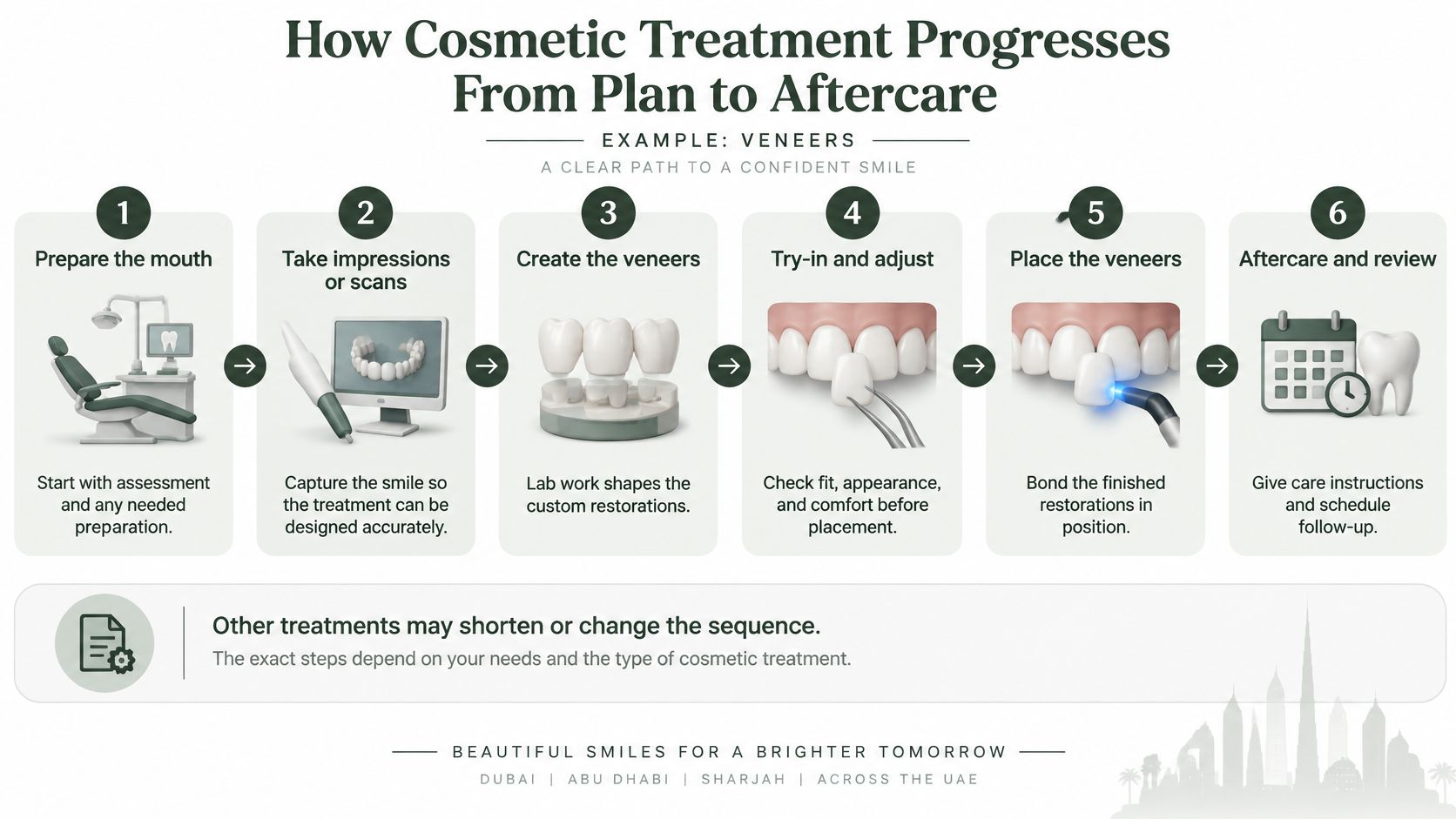
Veneers involve more steps than anything else in cosmetic dentistry, so they make the clearest worked example. Whitening, bonding and aligners follow the same logic with fewer stages.
- Prepare the mouth first. Professional cleaning, then treatment for any gum inflammation or decay. Cosmetic work should sit on healthy tissue, and this is the stage a rushed plan skips.
- Record the starting point. Photographs, measurements, scans or impressions, plus a shade record, so the final colour is matched to the teeth you have rather than to a shade chart.
- Preview where previewing is offered. A trial or mock-up lets you see shape and colour before anything is final. Use it to say plainly what you don't like.
- Prepare the teeth and fit temporaries. Only the amount of enamel the plan requires comes off. Temporary restorations protect the teeth in between and let you test the bite before the final work.
- Place the final restorations. The dentist checks the bite, adjusts contacts and polishes the surfaces. A high spot feels like a nuisance on day one and becomes a fracture later.
- Attend the review visit. Fit, comfort, gum response and bite are checked once everything has settled, usually a short appointment that catches small problems early.
- Follow aftercare. Daily brushing and flossing, regular dental checks, and a night guard if grinding shows up.
The six-stage version below is the same path, simplified for the version most patients experience.
Recovery, and what warrants a call
- Numbness after local anaesthetic: wears off within a few hours. Avoid hot drinks and hard food until sensation returns, because a numb mouth is how people bite their own cheek.
- Sensitivity after preparation or whitening: common, and it usually settles over days. A desensitising toothpaste helps, and so does spacing treatment out.
- Mild soreness at the gum line: expected for a short period after placement or a cleaning appointment.
- Call the clinic promptly for: pain that worsens instead of easing, a restoration that feels loose or high, swelling, bleeding that doesn't stop, or any reaction you don't recognise.
Comfort varies between patients, and no dental treatment is completely painless. Ask about pain control before the appointment rather than during it, and say so if a previous visit was uncomfortable.
Consent, Costs and Changing Treatment Plans
Minimally invasive sounds like it comes with minimal obligation. It doesn't. Cosmetic dentistry can involve less drilling than a crown and still carries screening, consent, aftercare and follow-up, all of which someone has to organise and document.
Dubai's standards here are more specific than most patients assume. DHA standards require a face-to-face consultation and assessment before a non-surgical cosmetic procedure, clear written consent before treatment, and reconfirmation of that consent on the treatment day, as set out in the DHA standards for non-surgical cosmetic procedures. Consent has to be understandable: Dubai's patient-consent guidance says patients should be able to read the form, or have it explained to them, in a language they understand, with their questions answered.
Four questions are worth asking out loud before you sign anything.
Can I withdraw consent after signing, and how? What happens if the recommended approach changes once treatment starts? Who manages a problem after hours or at the weekend? If the diagnosis changes, is the package refundable or transferable?
Nothing about "non-surgical" removes the possibility that a plan needs staging or stops partway. That's normal clinical life, and the clinic should have a stated answer instead of an improvised one.
Cost factors repeat from case to case, even though totals don't:
- Number of teeth involved, which drives both chair time and laboratory cost.
- Material choice, since composite, ceramic and pressed options sit at different price points.
- Laboratory work and shade matching, where the technician's time is a real line item.
- Radiographs and diagnostic records, only where they're needed.
- Any gum or decay treatment first, which has to happen before cosmetic work.
- Number of visits, and whether review appointments are included.
- Long-term maintenance, such as replacing worn bonding or a night guard.
Ask for an itemised quote rather than a package total, so each line is visible. Where the change is large or irreversible, a second opinion is reasonable, and our guide to porcelain veneers Dubai explains what that preparation involves so you can compare like with like.
Infection Control and Safety Questions to Ask
The question to ask at reception isn't whether the clinic sterilises instruments. Every licensed clinic will say yes. The better question is what happens between patients, from the chair to the waterlines to the waste bins, because infection control is a system rather than a single step.
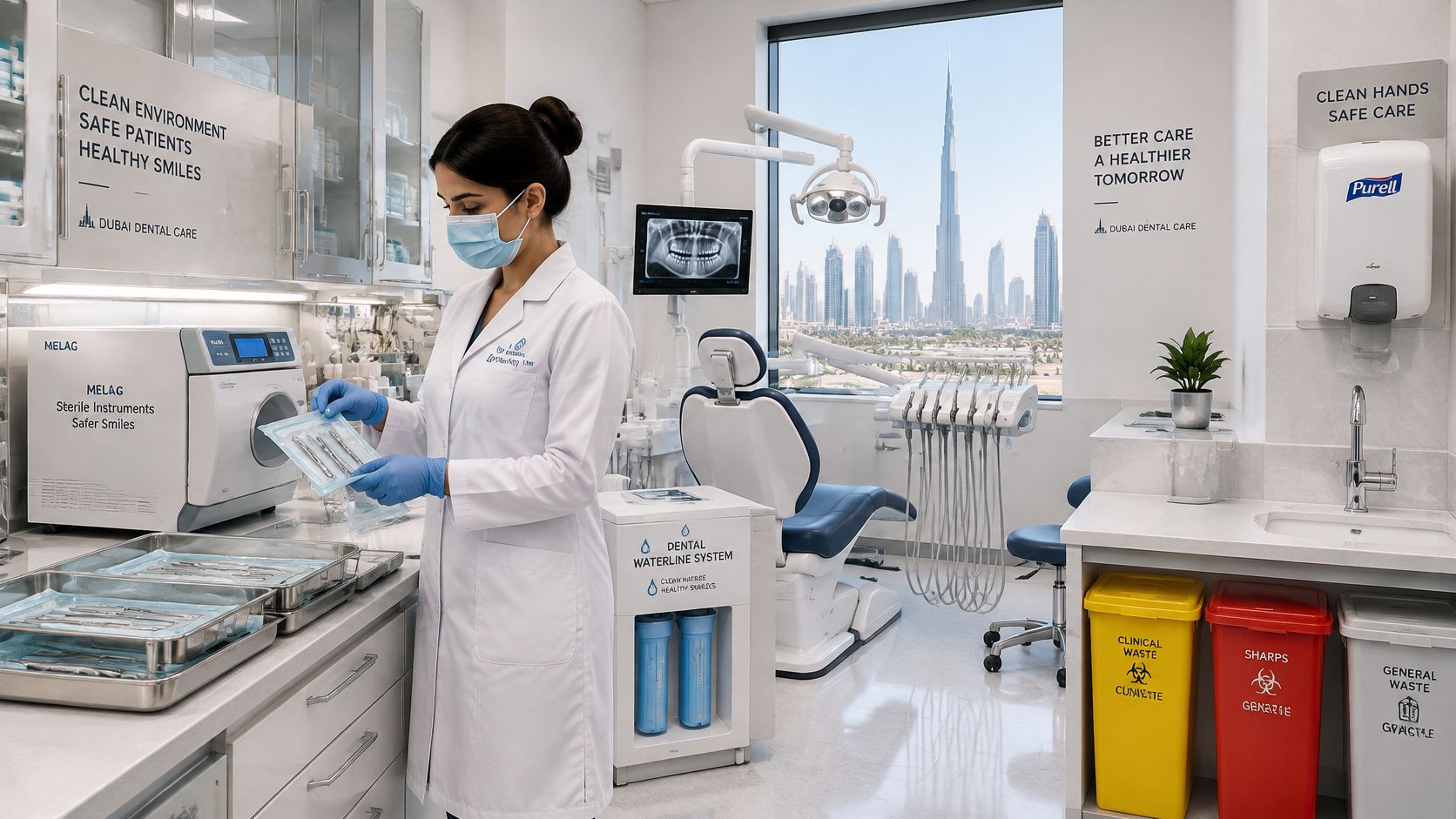
DHA requires licensed dental clinics in Dubai to apply infection-prevention measures covering standard precautions, hand hygiene, appropriate personal protective equipment, sterilisation and disinfection of patient-care items, environmental infection control, medical-waste management, and controls for dental-unit waterlines, biofilm, water quality, handpieces and other devices connected to air or water lines, according to the DHA infection-prevention requirements. The same regulation states that following these precautions reduces the risk of disease transmission to patients and healthcare workers.
Drilling, suction and bleeding generate spray, which is why guidance goes further for aerosol-generating procedures. Dubai dental guidance recommends rubber-dam isolation together with high-volume suction when such procedures begin, cleaning and sterilisation or disinfection of the treatment chair and instruments before each patient, disposal of surface barriers after each patient, single-use devices where possible, and handpieces with anti-retraction function, as described in the DHA dental aerosol guidance. A rubber dam is a thin sheet that isolates the treated tooth from the rest of the mouth; high-volume suction removes water, saliva and debris at the working area.
Ask these directly, and listen for specifics rather than reassurance:
- Reusable instruments: how are they cleaned, sterilised and checked, and is there a record?
- Between appointments: are the chair and treatment surfaces disinfected, and are barriers and single-use items replaced?
- Waterlines: how is dental-unit water quality maintained and monitored?
- Handpieces: do they have anti-retraction function?
- Waste: how is clinical waste segregated and removed?
Our sterilisation and strict infection-control procedures apply consistently across the clinic's departments, not only in the dental rooms. A good answer is specific, documented and easy to explain. Vague confidence is the one reply worth questioning.
Frequently Asked Questions About Dental Cosmetic Options
Is professional teeth whitening suitable for everyone? No. Untreated decay, gum inflammation and existing restorations need assessment first, and sensitivity can occur during or after treatment.
Do porcelain veneers hurt? Comfort varies between patients. Local anaesthetic is usually discussed beforehand, and no dental treatment is completely painless.
How long do cosmetic results last? It depends on the option, your oral hygiene, diet, habits such as grinding, and regular checks. No responsible clinic guarantees a duration.
Can whitening and veneers be combined? Sometimes. The dentist decides the sequence, because shade selection for veneers is often planned after whitening has settled.
Can I have cosmetic work while my gums are inflamed? Usually not straight away. Gum inflammation is treated first, because cosmetic work placed over active disease tends to fail early.
Do I always need an X-ray before a cosmetic consultation? Not always. Radiographs are recommended when the dentist needs information that can't be seen by eye, such as decay between teeth or bone levels.
Is the cheapest package the best value? Not necessarily. Compare itemised quotes covering visits, materials, follow-up and maintenance, and ask what happens if the plan changes.
Book a Dental Consultation in Deira
You already have the preparation list, the credential checks, the consent questions and the infection-control questions. The step that follows is a dental consultation, where examination comes first, radiographs if needed come second, and a written plan comes before any treatment decision.
Yoyime Clinic is at Ground Floor, Exit 1, Salah Al Din Metro Station, 106 Salah Al Din St, Deira, Dubai. Patients travel to us from Al Rigga, Port Saeed, Abu Hail and the surrounding communities. Call +971 4 884 3396 or +971 50 225 7535 to book, and ask for a dental consultation so that assessment happens before a cosmetic plan is chosen.
Our dentistry services cover preventive and restorative care, and cosmetic dentistry covers whitening, bonding, veneers and smile design for patients who want the change planned rather than rushed.
One practical note for anyone booking around a busy schedule: a clinic whose front desk is fielding calls while you're in the chair tends to hurry the appointment itself. Practices that handle heavy booking volumes can explore aesthetic clinic receptionist solutions built for appointment-led clinics, and patients feel the difference in how unhurried a consultation feels.
A consultation is the right place to find out whether a cosmetic change suits your teeth and gums, and whether the timing is right. Nothing has to be decided on the day.
Status: draft awaiting Yoyime clinical review before publication.
Yoyime Clinic brings dentistry, aesthetics and advanced laser care together under one roof in Deira, and every pathway starts with a specialist consultation rather than a package. If you're weighing veneers, whitening, bonding or clear aligners, our team will examine your teeth and gums first, explain what each option can and cannot do, and give you a written plan you can question line by line. Visit Yoyime Clinic to see how consultations are structured, or call us to book a dental assessment.