


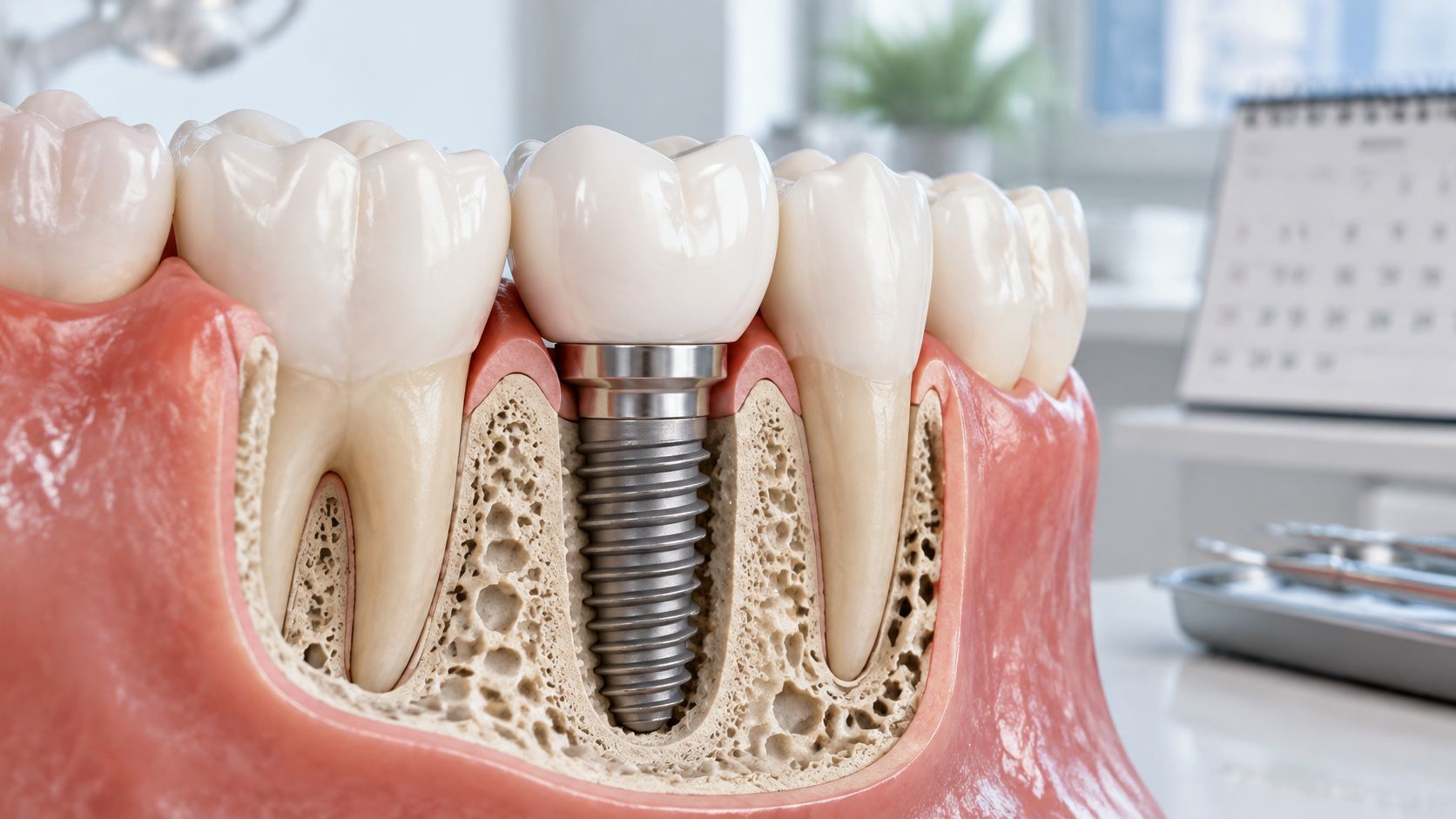
A well-placed, well-maintained dental implant often remains functional for ten years or longer. In a Dubai Health Authority study, 96.1% of 1,673 implants were still functioning at follow-up. The crown or bridge may need repair or replacement sooner, so these figures describe likelihood, not a guarantee.
The useful question is which part are you asking about? The titanium fixture, the visible replacement tooth and the surrounding gum tissue can develop problems on different timelines. Separating their lifespans helps you plan for maintenance and distinguish a restoration repair from implant failure.
Table of Contents
- How Long Dental Implants Last in Numbers
- Why Parts Age and Need Replacement
- Factors That Shape Implant Lifespan
- Daily Care, Recall Visits and Warning Signs
- Frequently Asked Questions
- Book a Consultation for a Personal Lifespan Estimate
How Long Dental Implants Last in Numbers
The strongest local starting point is a Dubai Health Authority retrospective study: among 1,673 evaluated implants placed between 2009 and 2016, 96.1% were functioning at follow-up, 0.8% had been removed, 3.1% required a prosthetic remake, and 83% had no recorded complication. The same paper discusses reported survival of single implant-supported crowns of 94.5% at five years and 89.4% at ten years, and implant-supported fixed prostheses of 86.7% at ten years.
Those findings answer different questions. An implant remaining functional doesn't necessarily mean that its crown has never been repaired, or that its supporting tissues have always been free of inflammation.
Reported implant survival by restoration type and time point
| Measure | Time point | Reported survival |
|---|---|---|
| Single implant-supported crown | 5 years | 94.5% |
| Single implant-supported crown | 10 years | 89.4% |
| Implant-supported fixed prosthesis | 10 years | 86.7% |
| Cement-retained implant restoration | 5 years | 96.0% |
| Screw-retained implant restoration | 5 years | 95.6% |
| Complete-arch zirconia prosthesis (Dubai laboratory study) | 5 years | 91.67% |
The crown and fixed-prosthesis estimates are discussed in the DHA paper. The cement-retained, screw-retained and complete-arch figures come from the Dubai restoration studies discussed below.
These are probabilities over an observation period, not expiry dates. A restoration doesn't automatically need replacement when it reaches the stated follow-up point. Equally, an apparently reassuring survival percentage doesn't promise that an individual patient will avoid complications.
What survival does and doesn't tell you
A survival figure is most useful when you know what the investigators counted. Implant survival concerns the fixture in the jawbone, whereas prosthesis survival concerns the attached crown or bridge. Neither should automatically be read as a measure of perfect gum health.
That distinction changes how you interpret maintenance. Replacing a damaged crown while retaining a stable fixture is different from removing an implant because it has lost support.
Practical rule: Match the result to the part being measured before using it to judge your own treatment.
Start with the row that resembles your proposed restoration, then check the time point. A single-tooth crown isn't directly comparable with a complete-arch bridge, and a shorter follow-up result can't establish what will happen much later.
For a patient in Dubai, the sensible conclusion is encouraging but conditional: implants can provide durable tooth replacement, while examination, cleaning and occasional restorative work remain part of long-term care.
Why Parts Age and Need Replacement
The titanium implant is the foundation in the jawbone. The crown, bridge or implant-supported denture is the part that meets food and opposing teeth, rather like a car engine and its tyres having different maintenance needs.
The model below helps distinguish the supporting implant from the visible replacement teeth.
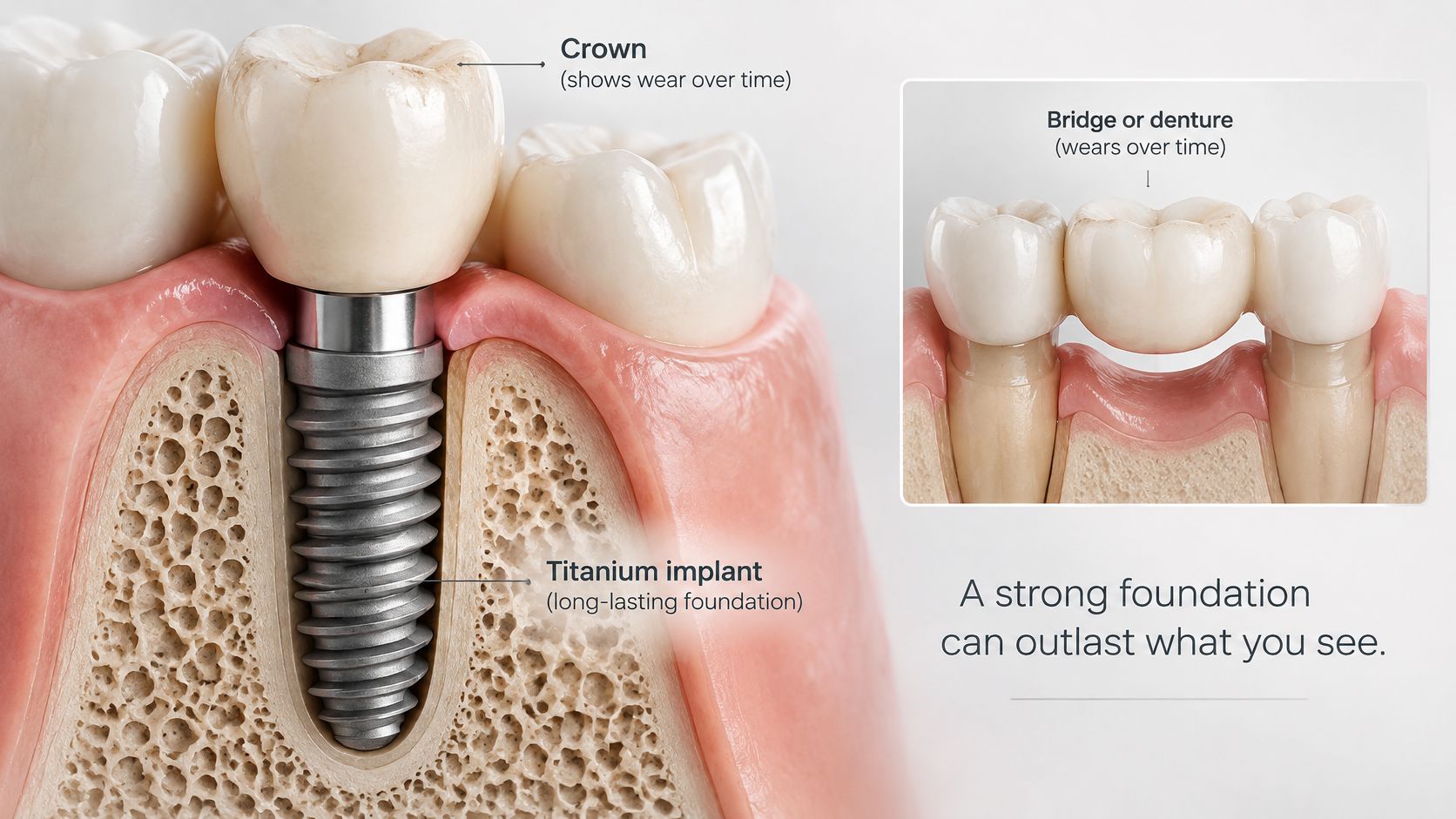
A Dubai-based survey of prosthodontists reported five-year survival of 96.0% for cement-retained restorations and 95.6% for screw-retained restorations, a difference of 0.4 percentage points. These results concern the restoration attached to the implant, not necessarily the fixture embedded in bone.
That small difference doesn't establish a universally better attachment method. Your dentist must consider implant position, available space, appearance, chewing forces, control of excess cement and whether the restoration can be accessed for maintenance.
The crown and connection need their own plan
A screw-retained restoration can provide access through a screw channel. A cement-retained restoration relies on cement to hold the restoration onto its supporting component. The clinical question is which design suits the position and allows appropriate cleaning and repair.
The abutment, the connector between implant and restoration, also matters. A loose connection can feel like a failed implant even when the fixture remains stable, so a dentist needs to identify exactly what is moving.
For an explanation of restoration materials, our guide to dental crown types provides useful context. Material choice is part of the decision, but it can't compensate for an unsuitable bite or poor cleaning access.
What complete-arch results actually measure
A Dubai laboratory-based retrospective study of 3,300 complete-arch zirconia prostheses reported the following cumulative survival and annual event counts, reaching 91.67% survival at five years.
Events and survival by year in the complete-arch zirconia study
| Year of follow-up | Cumulative survival | Events recorded that year |
|---|---|---|
| Year 1 | 99.77% | 2 |
| Year 2 | 98.86% | 7 |
| Year 3 | 97.23% | 12 |
| Year 4 | 94.73% | 13 |
| Year 5 | 91.67% | 14 |
These are complete-arch prosthesis results, not single-tooth implant predictions. A full-arch restoration includes a larger structure, implant connections and screws, each of which needs assessment when something changes.
The event counts also shouldn't be treated as percentages of the entire original sample. Cumulative survival comes from the study's life-table analysis, not from dividing an annual event count by all restorations initially recorded.
The accompanying video provides another visual reference for discussing implant treatment.
Repair doesn't always mean starting again
The response should match the fault. A dentist may tighten or replace a screw, re-cement an appropriate restoration, repair damage or replace a worn component after checking the underlying cause.
A full remake becomes relevant when the restoration can't be repaired reliably or its fit and function are no longer acceptable. Report looseness, chipping or a change in fit early, and don't try to tighten or glue a restoration yourself.
Factors That Shape Implant Lifespan
Placement results are reassuring when care follows an organised protocol. A UAE implantology training-program study followed 516 implants in 249 subjects and reported 96.0% survival for 299 implants placed by an experienced prosthodontist, compared with 93.5% for 217 implants placed by dentists in structured training; the difference wasn't statistically significant.
That finding doesn't mean that experience is irrelevant. It means this study didn't demonstrate a statistically significant difference between those groups within its clinical setting and observation period.
Healing failure and functional failure are different
Before a restoration is attached and used for chewing, the fixture must establish adequate stability in bone. Dentists call connecting the implant to a functioning restoration loading.
Failure before loading concerns the healing stage. Failure after loading concerns an implant that has entered function, where tissue health, maintenance and chewing forces remain relevant.
These aren't interchangeable outcomes. A long-term functional estimate shouldn't be presented as though it also guarantees uncomplicated healing immediately after surgery.
Risk factors that affect implant lifespan and what helps
| Factor | Effect on lifespan | What helps |
|---|---|---|
| Smoking | Identified as a risk factor for peri-implant disease | Reduce or stop, and tell your dentist before surgery |
| History of treated periodontitis | Linked with implant failure and peri-implantitis | Regular periodontal maintenance visits |
| Irregular dental attendance | Associated with implant failure | Keep recall visits on schedule |
| Previous implant failure | Linked with further failure | Full diagnosis before any new implant |
| Inadequate peri-implant maintenance | Identified as a risk factor for peri-implant disease | Daily home cleaning plus professional care |
| Diabetes control | Affects healing and tissue response | Keep blood sugar managed with your physician |
| Bone quality and volume | Affects initial stability and healing | Assessment on imaging before surgery |
| Bite forces | Add load to the crown and implant | Bite assessment and adjustment when your dentist advises it |
The practical response isn't to count risk factors and assume a fixed outcome. A patient with previously treated gum disease who attends maintenance has a different care situation from someone with ongoing inflammation and irregular attendance.
Share your medication list, diabetes history, smoking habits and previous implant problems before treatment planning. Don't stop prescribed medicines or change diabetes treatment without medical advice.
Our overview of dental implant types can help you understand treatment terminology, but the implant design alone doesn't determine longevity. The most useful estimate combines the proposed restoration with your bone, gum health, bite and ability to maintain it.
Daily Care, Recall Visits and Warning Signs
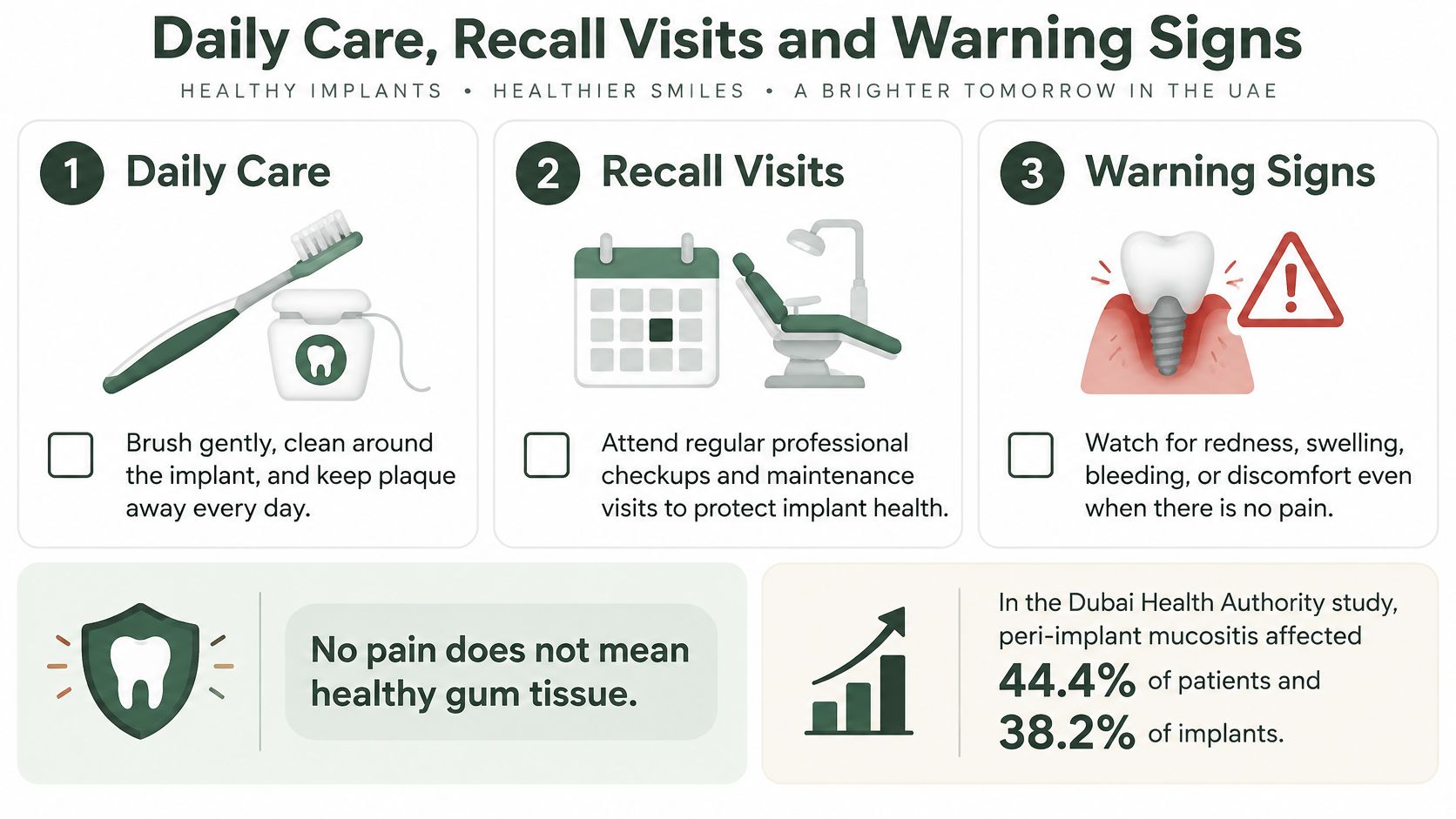
No pain does not mean healthy gum tissue. In a Dubai Health Authority study of peri-implant health, peri-implant mucositis affected 44.4% of patients and 38.2% of implants, while peri-implantitis affected 5.6% of patients and 4.0% of implants; smoking, a history of treated periodontitis and inadequate maintenance were identified as risk factors.
Peri-implant mucositis means inflammation of the gum around an implant. Peri-implantitis involves inflammation with loss of supporting bone, so the distinction matters even if both initially seem like minor gum irritation.
The checklist below highlights the daily habits and review appointments that deserve attention.
A practical home-care routine
Brush twice daily with fluoride toothpaste for two minutes. Use a soft toothbrush and clean gently where the restoration meets the gum. The purpose is to remove plaque, not scrub harder; fluoride toothpaste also protects your remaining natural teeth.
Clean the spaces your toothbrush can't reach. Use an interdental brush sized by your dental team, or a water flosser where recommended. Ask for a demonstration around your actual crown or bridge, because the direction of access matters as much as the tool.
Leave metal picks and improvised tools out of the routine. Don't scrape exposed implant surfaces or force an object beneath a bridge. If food repeatedly collects in the same place, have the area assessed rather than repeatedly digging at it.
Attend professional cleaning and examination at your prescribed interval. Smokers and people with previous gum disease may need closer monitoring. Professional care complements home cleaning; it doesn't replace it.
Have radiographs when your clinician advises them. These help assess bone around the fixture when clinically indicated. Imaging should answer a clinical question, not follow an identical timetable for every patient.
After surgery, your immediate recovery instructions may temporarily differ from your established cleaning routine. Follow the treating clinician's directions about brushing the surgical site, eating and attending healing reviews rather than applying long-term maintenance advice to a fresh wound.
What a recall appointment should assess
A useful implant review considers the tissue and the restoration together. Your clinician can check bleeding, swelling, plaque accumulation, the stability of components and whether your bite has changed.
Tell the dental team about food trapping, difficulty reaching beneath a bridge or a cleaning tool that causes persistent discomfort. Those details can reveal that your routine or the restoration's access needs adjustment.
A maintenance interval should reflect your current risk, not just the date of your last cleaning.
Keep a record of the recommended return date and arrange the visit before leaving where possible. If you move between clinics, bring available implant records, previous radiographs and details of past repairs.
Our guide to professional teeth cleaning and oral longevity explains how professional maintenance fits alongside daily care. An implant review also needs attention to the implant-specific tissues and components.
Warning signs, possible causes and the action to take
Bleeding and swelling are easy to dismiss when chewing still feels normal. Any of these changes warrants a review rather than waiting for the next routine recall, and only an examination can establish the cause.
| Sign | What it may indicate | Action |
|---|---|---|
| Bleeding when brushing or flossing around the implant | Possible inflammation of the gum around the implant | Book an assessment soon |
| Swelling or discharge around the implant | Possible peri-implantitis or another infection | Contact the clinic promptly |
| Persistent bad taste or odour | Possible infection around the implant or prosthesis | Book a review soon |
| Loose crown, abutment or implant | Component loosening or implant instability | Contact the clinic the same day |
| Change in bite or discomfort when chewing | Possible prosthesis fit problem or excess load | Book a bite review |
| Gum recession exposing the implant surface | Possible loss of supporting tissue | Book an assessment soon |
| Pain with no visible sign | Could still be inflammation or a fracture | Arrange an examination |
Until a loose restoration has been assessed, avoid chewing on it and don't repeatedly test its movement. The priority is to identify whether the problem is mechanical, biological or a combination of both.
Frequently Asked Questions
Does an implant last forever?
No implant comes with a guaranteed lifespan. A durable result still requires review, and a warranty, if offered, isn't the same as a biological guarantee that an implant will remain healthy.
Can an implant fail without pain?
Yes. Don't use comfort as your only test of implant health. Keep maintenance appointments even when the implant feels normal, and report bleeding or changes in fit.
Does smoking shorten implant life?
Smoking is a recognised risk factor for peri-implant disease. Discuss stopping or reducing smoking before surgery, and be open about your current use so the clinician can plan appropriate care and monitoring.
Is the crown replaced before the implant?
The visible restoration may need repair or replacement while the fixture remains usable. However, there's no fixed replacement order for every patient, and a dentist must check the supporting tissues before deciding to retain the implant.
If an implant fails, do I need a new one?
Not automatically. The clinician needs to establish why it failed, assess remaining bone and gum health, and decide whether another implant, a bridge or a removable denture is more appropriate.
Is implant treatment in Dubai different?
Local care should include diagnosis, suitability assessment and documented planning within the relevant regulatory framework. Ask how your examination findings affect the proposed restoration and maintenance plan, rather than judging treatment by a headline lifespan alone.
Before agreeing to treatment: Make sure you understand what happens if healing is unsuccessful, what future repairs may involve and which alternatives remain available.
Book a Consultation for a Personal Lifespan Estimate
Dubai Health Authority guidance on implant dentistry says implant placement should follow a thorough examination and accurate diagnosis. A useful longevity discussion starts with your oral and medical health, not a promise of a particular number of years.
The assessment considers the missing-tooth area, available bone, gum condition, bite, neighbouring teeth and radiographic findings. These details help determine whether you can proceed directly, need gum treatment first, may require bone augmentation, or would be better served by another replacement option. They also help distinguish the expected service life of the implant from that of its crown or bridge and the surrounding gum tissue.
Bring the information that changes planning
- Current medicines and medical history: Include your diabetes status and relevant ongoing treatment.
- Smoking habits: Give an accurate account so risks can be discussed realistically.
- Previous dental treatment: Mention extractions, earlier implants, implant failures and gum treatment.
- Existing records: Bring available radiographs and implant or restoration documents.
At Yoyimé Clinic, Dr. Aliveni Sowjanya is a Specialist Prosthodontist with 13+ years in prosthodontics. The clinic is located in central Deira, Dubai.
What to clarify during the consultation
Ask how the proposed restoration will be supported, which risks can be modified and what remains uncertain. A personal estimate should also set out a suggested maintenance interval and discuss alternatives, including bridges or removable dentures where appropriate.
Suitability and the final treatment plan depend on clinical examination and individual needs. Ask what preparation and healing reviews may involve, and what long-term care will be needed. The goal is a realistic plan for your circumstances, rather than a lifespan figure treated as a guarantee.
Yoyimé Clinic offers dental consultations to assess missing teeth, gum health and restorative options, with attention to factors that influence implant longevity. Visit Yoyime Clinic to arrange a consultation in Deira and discuss a personalised treatment and maintenance plan.