


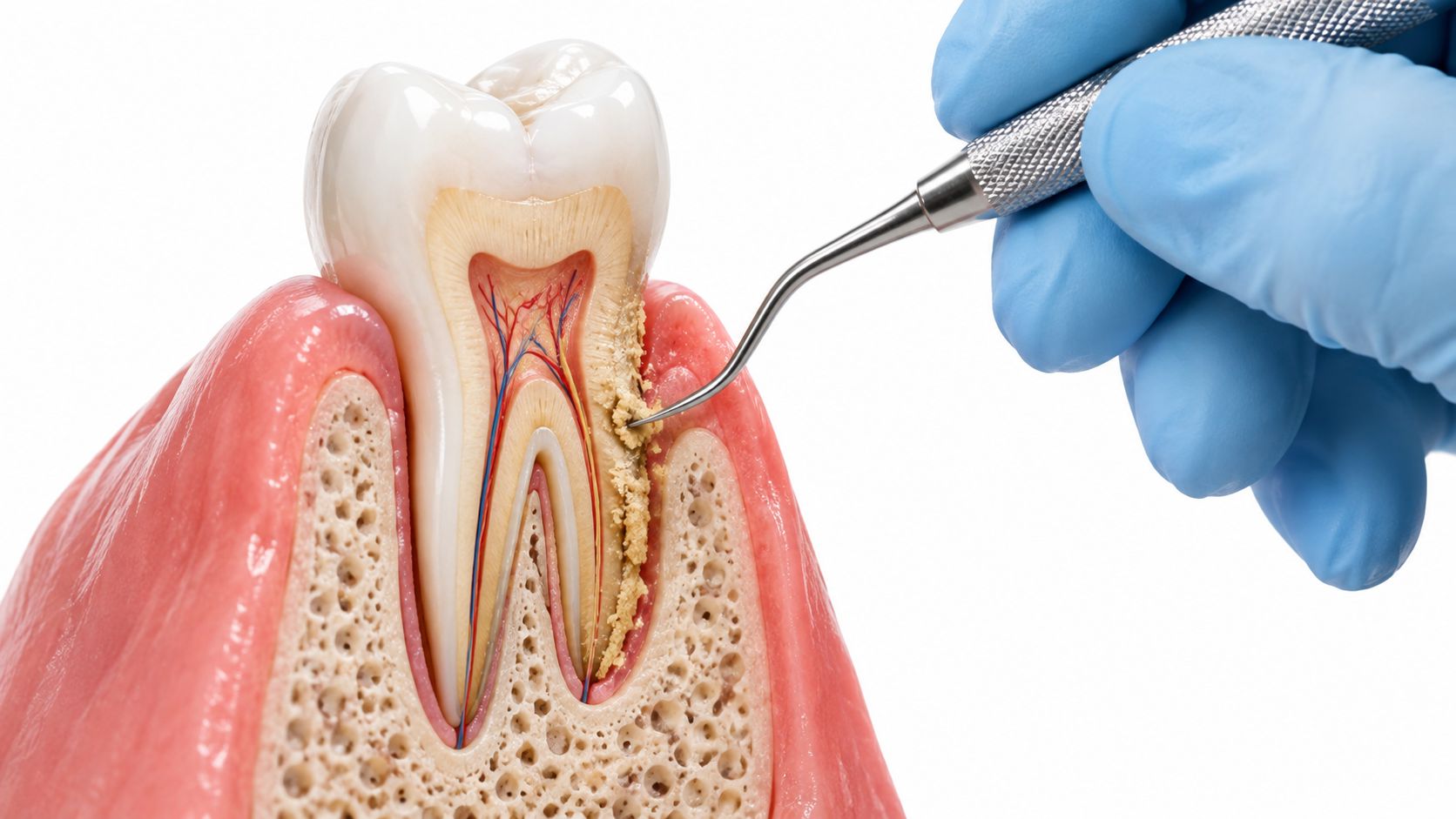
If your gums bleed but don't hurt, do you really need treatment below the gumline, or will a regular cleaning be enough? That question exposes the main confusion around periodontal treatment root planing. It's not a stronger polish or a cosmetic clean. It's a measured, non-surgical treatment for gum disease, planned after your dentist records pocket depths, attachment loss, bleeding, and (where needed) X-rays.
For patients in Dubai, the useful question isn't only what happens during the appointment. It's how your dentist decides you need it, how success will be measured afterwards, and what should happen if deep pockets remain. This guide explains that pathway in plain language, step by step.
Table of Contents
- What Is Periodontal Treatment Root Planing
- Who Needs Root Planing and Why
- What Happens During the Procedure
- Expected Outcomes After Root Planing
- Recovery and Aftercare
- Maintenance and Long-Term Follow-Up
- Frequently Asked Questions About Root Planing
What Is Periodontal Treatment Root Planing
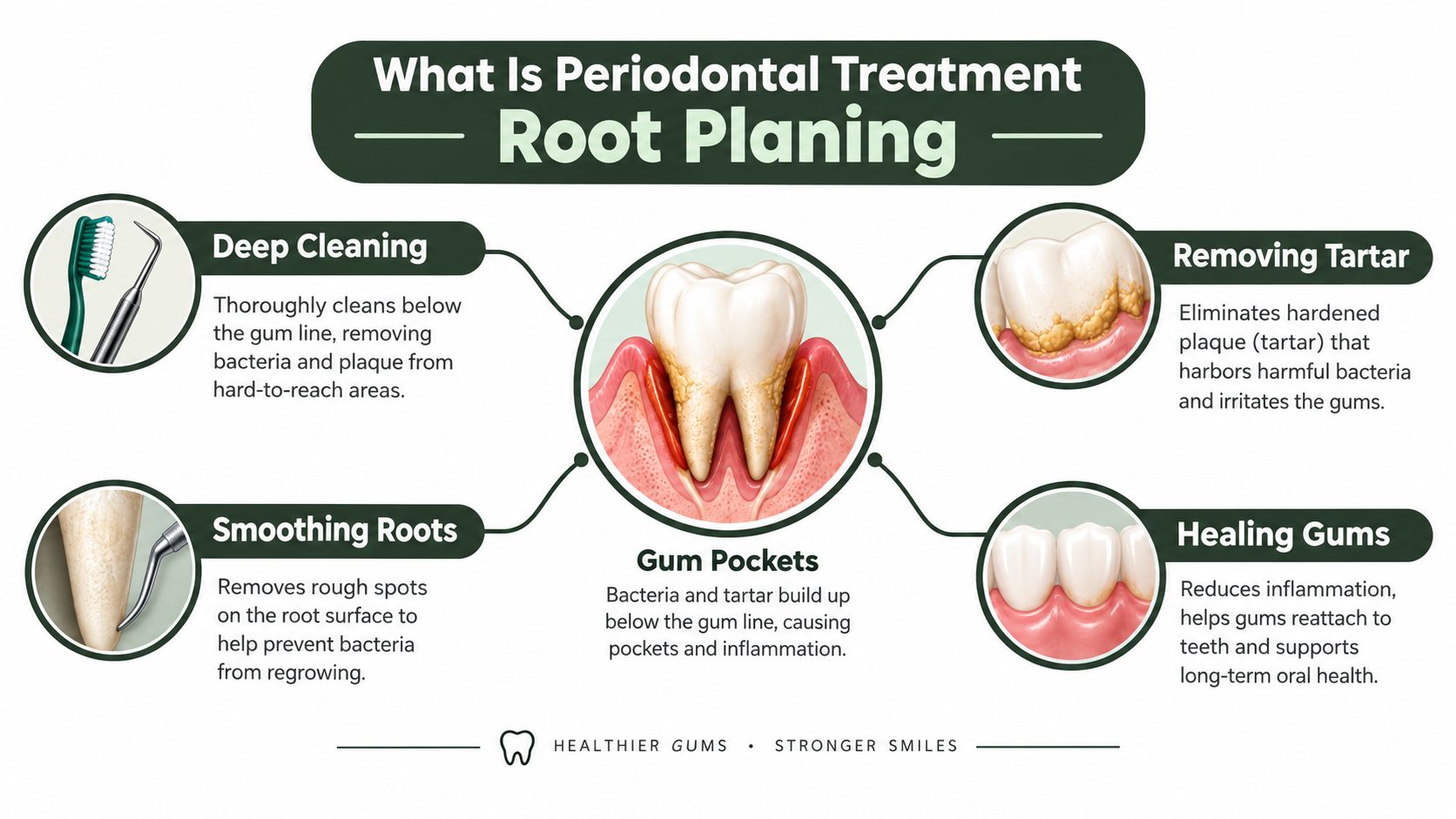
Root planing is the part of scaling and root planing, often called SRP, that cleans and smooths the root surfaces of teeth below the gumline. Scaling removes plaque and hardened calculus, also called tartar, from above and below the gumline. Root planing then smooths rough areas on the root where bacteria collect more easily.
A routine professional cleaning is different. It mainly cleans the visible crown of the tooth and just at the gumline, and it suits healthy gums or mild, reversible gum inflammation. If you want to compare that preventive approach first, our page on professional teeth cleaning explains what a standard clean covers. Root planing goes deeper because the problem is deeper.
Think of an inflamed gum pocket like a small wound with grit trapped inside it. You wouldn't expect skin to heal well if debris stayed in the wound. In the same way, gum tissue struggles to settle against a root that's coated with calculus and bacterial biofilm. Removing that material doesn't guarantee healing, but it removes a major obstacle to it.
Why Bacteria Below the Gumline Matter
Plaque is a sticky biofilm, a structured community of bacteria, not just loose food debris. When it stays below the gumline, it can harden into calculus and keep irritating the pocket lining. Your toothbrush and floss can't reliably reach the base of a deeper pocket, which is why professional instrumentation becomes necessary.
UAE microbiome evidence has linked periodontitis with shifts in the subgingival microbial community, including the bacterial phyla Fusobacteria and Firmicutes, as described in UAE research on the subgingival microbiome in periodontitis. That finding supports the logic of root planing. Disrupting calculus-associated biofilm reduces the local microbial burden and the inflammatory stimulus against the gum.
If you're reading patient explanations from other regions, a guide to deep cleaning for gum disease in Chattanooga uses similar plain language about cleaning below the gumline. The terminology travels, but your treatment decision in Dubai should still rest on your own charting and diagnosis.
Root planing is therapeutic, not cosmetic. Your dentist recommends it to control disease in specific pockets, not simply to make teeth feel cleaner.
That distinction matters for expectations. A routine clean maintains health. Periodontal treatment root planing aims to reduce inflammation, help pockets become shallower, and create root surfaces that are easier for you and your dental team to keep clean. It doesn't rebuild bone that's already been lost, and it doesn't replace daily plaque control. Think of it as resetting the conditions around the root so healing and maintenance have a realistic chance.
Who Needs Root Planing and Why
You can't reliably decide this from symptoms alone. Gum disease often progresses without pain, so you may feel fine while pockets deepen and attachment is lost. Bleeding gums don't automatically mean you need root planing everywhere either. Your dentist has to measure.
During a periodontal assessment, the clinician uses a fine probe to record probing pocket depth around each tooth. They also check bleeding on probing, gum recession, mobility, and clinical attachment loss, which means loss of the tissue attachment that supports the tooth. The probe works like a dipstick for your gums, giving a millimetre reading at six points per tooth rather than a vague sense of "healthy" or "unhealthy." X-rays, where indicated, help assess bone levels and other problems that affect the plan.

What the UAE Evidence Shows
A UAE-based study of Emirati adults aged 18 to 65 with periodontal disease found that 84% had mild clinical attachment loss and 54% had probing pocket depths of 3.5 to 5.5 mm, according to the Emirati periodontal health status study. Those figures describe a defined clinical population, not a national prevalence estimate for the UAE. They still show why individual charting matters more than a generic label.
The same Emirati periodontal health study cited above found moderate attachment loss in 30.8% of participants with diabetes mellitus and hypertension, compared with 10.8% of those without a reported medical history. Clinically, it means your medical history isn't paperwork. Diabetes and hypertension can change how carefully your dentist monitors severity and healing, and they can shift when root planing is recommended relative to other steps.
Regional context points in the same direction. A Saudi Arabian systematic review of 15 studies reported a pooled periodontal disease prevalence of 51%, with a 95% confidence interval of 35.99% to 73.05%, in its meta-analysis of 6,596 individuals. Saudi data can't be applied directly to Dubai, but it shows substantial regional need and wide variation between populations.
That's another reason not to rely on a one-size-fits-all claim.
Signs That Should Prompt an Assessment
Ask for a periodontal check if you notice any of the following, even without pain:
- Bleeding when you brush or floss: Healthy gums shouldn't bleed regularly, although bleeding alone doesn't prove you need SRP.
- Persistent bad breath or a bad taste: Biofilm in deeper pockets can contribute, but other causes also need thorough examination.
- Gums pulling away or teeth looking longer: Recession can accompany attachment loss and root exposure.
- Loose, shifting, or tender teeth: These signs need prompt assessment because support may already be reduced.
- Calculus you can feel behind lower front teeth: Visible tartar above the gumline sometimes coexists with deposits below it.
If those findings lead to a diagnosis of periodontitis, gum disease treatment may include root planing for affected sites, oral hygiene instruction, and maintenance. Suitability depends on clinical examination, radiographs where indicated, medical history, and whether each tooth is restorable. A responsible plan names which teeth and pockets need treatment, and why.
What Happens During the Procedure
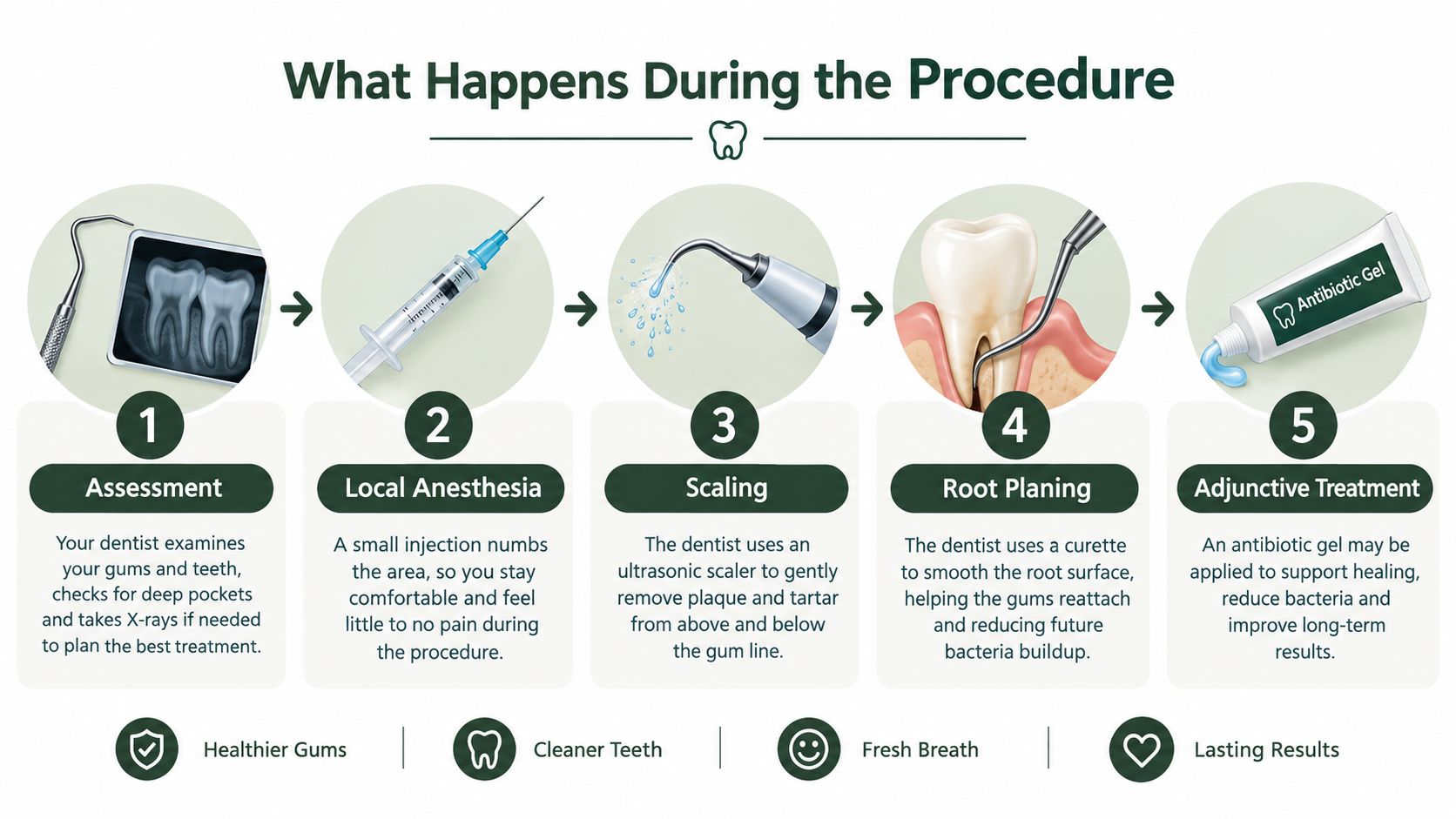
Your appointment should start with confirmation of the charting, not with instruments. The dentist or hygienist reviews which quadrants and teeth are being treated, your medical history, medicines, allergies, and any anxiety about anaesthesia. If that plan hasn't been explained, ask which pockets are being treated and how they'll be reassessed.
Local anaesthesia is commonly used because instrumentation below the gumline can be uncomfortable on inflamed tissue. It doesn't make treatment completely sensation-free for everyone. You'll usually feel pressure, vibration, water spray, and scraping sounds rather than sharp pain, and you should tell the clinician if you feel pain so they can pause and adjust.
The Instrumentation Step by Step
Scaling often combines an ultrasonic instrument, which vibrates and irrigates to break up calculus, with hand instruments called curettes for finer root surfaces and tight areas. The clinician works to the base of the pocket, tooth by tooth. Root planing follows on the same surfaces, smoothing irregularities so biofilm has fewer sheltered spots to re-form.
Treatment is often staged by quadrant, meaning one quarter of the mouth, or by side. Staging can keep appointments manageable, limit the area that's numb, and allow thorough work where deposits are heavy. It isn't a sign that something has gone wrong. Your clinician may also record which teeth were treated so billing, reassessment, and maintenance match the disease distribution.
For another patient-focused walkthrough of staging and comfort measures, see this explanation of non-surgical gum disease treatment Wesley Chapel. Use it as background reading, then compare it with the specific plan and measurements your Dubai dentist gives you.
A short visual explanation can make the instrument movements easier to picture before you attend.
Where Lasers and Surgery Fit
You may hear about adjunctive diode lasers. In a Dubai Dental Hospital randomised study, 24 adults with unstable generalised stage III to IV, grade B or C periodontitis received subgingival instrumentation with or without diode laser, and 22 completed six months of follow-up, as reported in the Dubai Dental Hospital clinical trial. Both groups improved, but the between-group difference wasn't statistically significant. Thorough mechanical debridement therefore remains the foundation, and a laser shouldn't be presented as reliably superior without a patient-specific reason.
Root planing is non-surgical. Dubai Health Authority's scope document places mechanical scaling and root planing, including periodontal curettage, within non-surgical periodontal management, while separately listing procedures such as open-flap debridement and guided tissue regeneration as surgical care, in the DHA dentist scope of practice document. If pockets stay deep or access is poor after healing, reassessment may lead to specialist or surgical options rather than endless repeated cleaning.
Expected Outcomes After Root Planing
Feeling cleaner is a poor measure of success. Your dentist should judge periodontal treatment root planing by repeat measurements after the tissues have had time to heal. Those measurements include probing depths, bleeding on probing, plaque scores, and the number of residual deeper pockets.
That measurement-based approach is central to Dubai care. Dubai's periodontics guideline requires clinical and radiographic examination, including pocket depth, attachment loss, bone loss, restorability, and possible endodontic problems before treatment planning, according to Dubai's periodontics clinical guideline. The same logic applies afterwards. You compare new charting with baseline charting, site by site.
What Improvement Looks Like
A favourable response usually means less bleeding, firmer and less swollen gums, and some reduction in probing depths as inflammation settles. Teeth may feel sensitive at first because calculus that covered part of the root has been removed. Sensitivity doesn't automatically mean damage, but persistent, worsening, or heat-triggered pain needs review.
Some sites respond well and move into maintenance. Others improve but remain too deep to clean predictably. A few may not respond because of root shape, deep defects, furcation involvement between roots, smoking, uncontrolled diabetes, or plaque that keeps returning. Naming those sites is useful, because the next step differs. Options can include targeted retreatment, closer maintenance, specialist review, or surgery.
Practical rule: Ask for your before and after pocket numbers. If nobody plans to re-measure, nobody can tell you objectively whether treatment worked.
Typical Healing Timeline After Root Planing
| Timeframe | What to Expect | What to Do |
|---|---|---|
| First day | Numbness wears off, mild soreness or tenderness may appear | Eat soft foods, avoid chewing on numb areas, follow pain-relief advice from your dentist |
| First few days | Minor bleeding on brushing, gum tenderness, cold sensitivity | Brush gently with a soft brush, keep cleaning, avoid very hot, spicy, or crunchy foods |
| Following weeks | Gums should look less swollen, sensitivity usually eases gradually | Use the interdental cleaning method you've been shown, every day |
| Reassessment stage | Your clinician re-probes pockets and compares bleeding and plaque scores | Ask which sites improved, which remain deep, and what happens next |
No timeline can promise a particular pocket reduction for you. Baseline severity, anatomy, home care, smoking status, and systemic health all influence healing. What you should expect is a clear endpoint for reassessment and an honest discussion if residual pockets remain. That conversation is part of treatment, not an optional extra.
Recovery and Aftercare
Recovery is active. Root planing removes deposits and disrupts biofilm, but bacteria begin recolonising root surfaces again if plaque control slips. Your home care in the first days needs to be gentle enough for tender tissue and thorough enough to stop a new biofilm maturing.
Wait until numbness has worn off before eating properly, so you don't bite your cheek or tongue. Start with soft, lukewarm foods such as soup, yoghurt, eggs, or mashed vegetables. Avoid sharp, crunchy, very spicy, or very hot foods while the treated area feels sore, and avoid tobacco because it impairs healing and worsens periodontal risk.
Cleaning Without Being Rough
Don't stop brushing the treated area unless your dentist specifically tells you to. Use a soft brush with light pressure and small movements at the gumline. If floss pulls or snaps painfully, ask whether interdental brushes, soft picks, or a water flosser suit your spaces better. The best tool is the one that fits the gap and that you'll use daily.
Warm saltwater rinses can feel soothing for some people, but they don't replace mechanical plaque removal. Use any prescribed rinse exactly as directed and for the stated duration. If sensitivity to cold is troublesome, a desensitising toothpaste may help, and your dentist can advise whether an in-clinic desensitising measure is appropriate.
- Do keep the area clean: Gentle, consistent brushing supports healing better than avoiding the area.
- Do take pain relief only as advised: Check suitability if you have kidney, liver, stomach, or other medical concerns.
- Do sleep and hydrate normally: General recovery habits help, although they're not a substitute for plaque control.
- Don't probe the pocket with objects: You'll irritate tissue and introduce bacteria.
- Don't smoke or vape during healing: Nicotine and smoke exposure work against gum recovery.
- Don't ignore worsening symptoms: Increasing pain, swelling, pus, fever, or bleeding that doesn't settle needs clinical advice.
When to Contact Your Dentist
Mild soreness, slight bleeding when brushing, and short-lived sensitivity are common early experiences. Contact your clinic promptly if pain keeps getting worse instead of easing, swelling spreads, you see discharge, a tooth develops lingering throbbing pain, or a bite suddenly feels wrong. Those features aren't part of simple healing and may point to infection, a tooth-nerve problem, or another issue.
Bring a short note of what you've felt and which tooth is involved. Specific information helps the clinician decide whether you need reassurance, an earlier review, or treatment. Don't wait for a routine maintenance visit if symptoms are escalating.
Maintenance and Long-Term Follow-Up
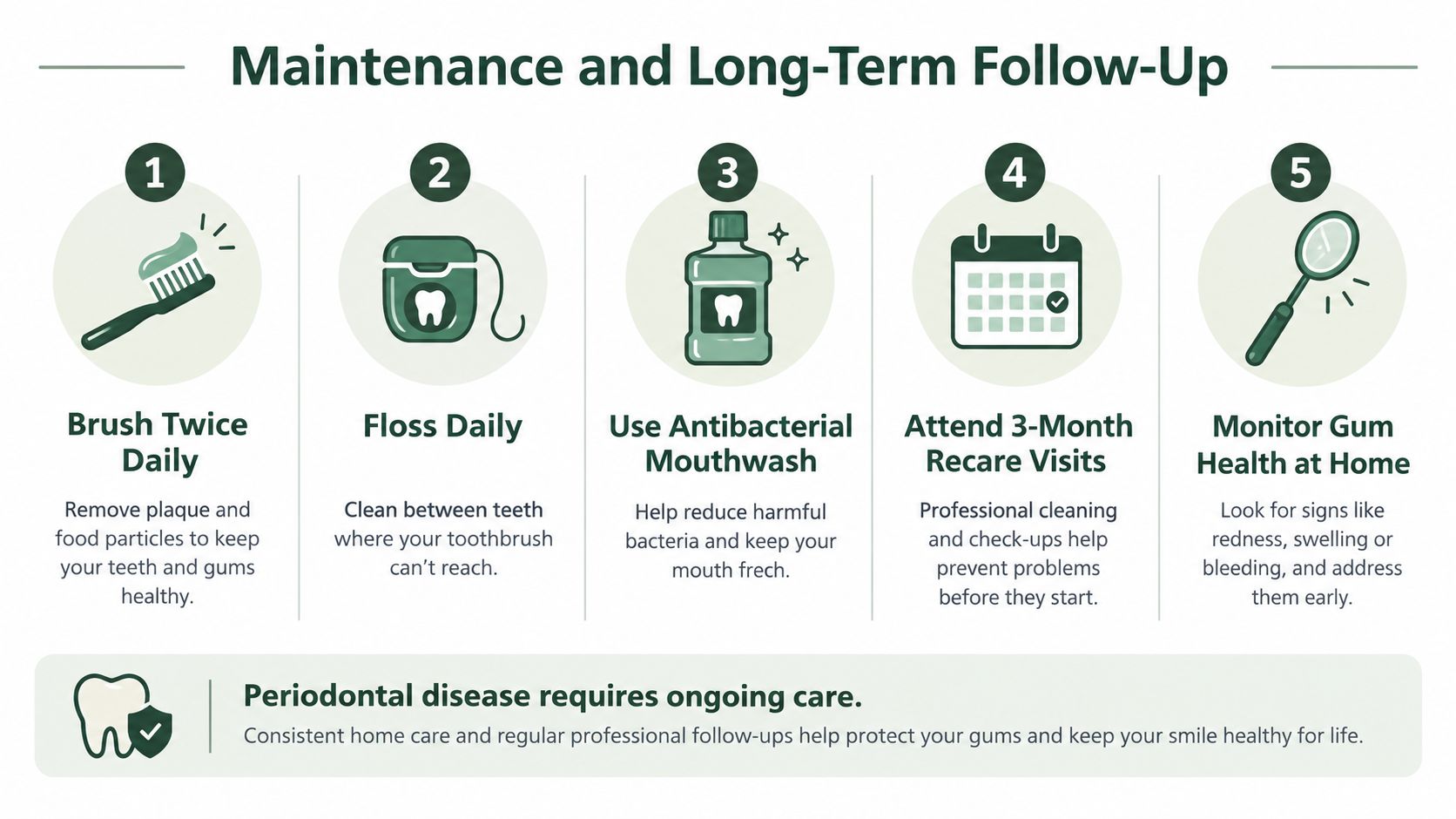
Periodontitis is managed, not cured in one visit. After root planing, supportive periodontal therapy keeps pockets under surveillance, removes new deposits, reinforces home care, and identifies sites that are breaking down again. Skipping maintenance because your mouth feels comfortable is one of the easiest ways to lose the benefit.
Recall timing shouldn't be identical for everyone. Your dentist should tailor it to baseline severity, residual pockets, bleeding, plaque control, smoking, diabetes, dry mouth, and how quickly calculus forms on your teeth. A stable patient with shallow, non-bleeding pockets needs a different plan from someone with residual deep sites and diabetes.
Why Postponed Care Becomes a Problem
UAE research during the COVID-19 period found 34.2% of surveyed residents had pending dental treatment, while 35.5% experienced oral pain and 18.6% said postponed care severely affected their oral health, according to UAE research on pending dental treatment. Those data weren't specific to root planing. They still illustrate a familiar pattern in Dubai life. Work, cost concerns, fear, and scheduling push care back until symptoms force the issue.
For gum disease, waiting for pain is a weak strategy because pain often arrives late. Maintenance visits are shorter and more predictable when pockets stay stable. If you know travel or work will interrupt your schedule, tell your clinic early so reassessment and recall dates can be planned realistically.
At a maintenance visit, expect updated medical history, plaque and bleeding checks, selected or full re-probing as indicated, removal of new plaque and calculus, and coaching on the exact sites you're missing. Some patients ask whether polishing technologies can help with surface stain and biofilm at maintenance, and this overview of an air polish dental cleaning service explains that type of cleaning. Polishing doesn't replace subgingival instrumentation where pockets and calculus remain.
Our page on periodic periodontal maintenance outlines how ongoing supportive care fits after active treatment. The key point is escalation when numbers demand it. If bleeding persists, pockets deepen again, or a tooth becomes mobile, your clinician should investigate the cause, consider targeted retreatment or specialist input, and discuss surgery where access or defects make non-surgical care insufficient.
Maintenance is where root planing results are protected. Without it, you're relying on a single cleaning episode to control a chronic, bacteria-driven condition.
Frequently Asked Questions About Root Planing
How Much Does Root Planing Cost in Dubai
We can't give a reliable fee without examining how many teeth and quadrants are affected. Dubai's dental billing rules separate scaling and root planing for one to three teeth per quadrant from four or more teeth per quadrant, as set out in Dubai's dental billing rules. Ask for a written plan that lists quadrants, teeth, reassessment, and maintenance separately.
Will Insurance Ask for Records
It may. The same billing framework indicates documentation can be requested when more than two quadrants are treated in one visit, including charting, radiographs, and the treatment plan. Coverage varies by policy, so confirm approval requirements before treatment rather than assuming reimbursement.
Is Root Planing Painful
Local anaesthesia is used to improve comfort, but treatment shouldn't be described as completely painless for everyone. Pressure and vibration are common during the visit, and mild soreness or sensitivity can follow. Tell your clinician during treatment if you feel sharp pain.
Can I Delay If My Gums Don't Hurt
You can discuss timing, staging, and cost, but absence of pain doesn't mean disease is inactive. Delay allows biofilm and calculus to remain in pockets that home care can't reach. If you postpone, agree on a review date and warning signs.
Does Root Planing Mean I'll Never Need Gum Surgery
No. Root planing is usually the first active phase because many sites improve without surgery. Persistent deep pockets, complex root anatomy, or bone defects may still need specialist reassessment. That's determined by repeat charting after healing, not by guesswork at the first visit.
How Is It Different From a Regular Clean in Practical Terms
A regular clean mainly addresses surfaces above or just at the gumline for prevention and maintenance of healthy gums. Periodontal treatment root planing treats diagnosed pockets below the gumline, usually with anaesthesia, quadrant planning, and formal reassessment.
If you've been told you have bleeding gums, deep pockets, or calculus below the gumline, book a periodontal assessment at Yoyime Clinic so your pocket depths, attachment levels, X-ray findings, and medical history can be reviewed before any root planing is planned. The clinic is at Ground Floor, Exit 1, Salah Al Din Metro Station, Deira, Dubai, and your visit can clarify whether you need SRP, routine cleaning, maintenance, or specialist escalation.