


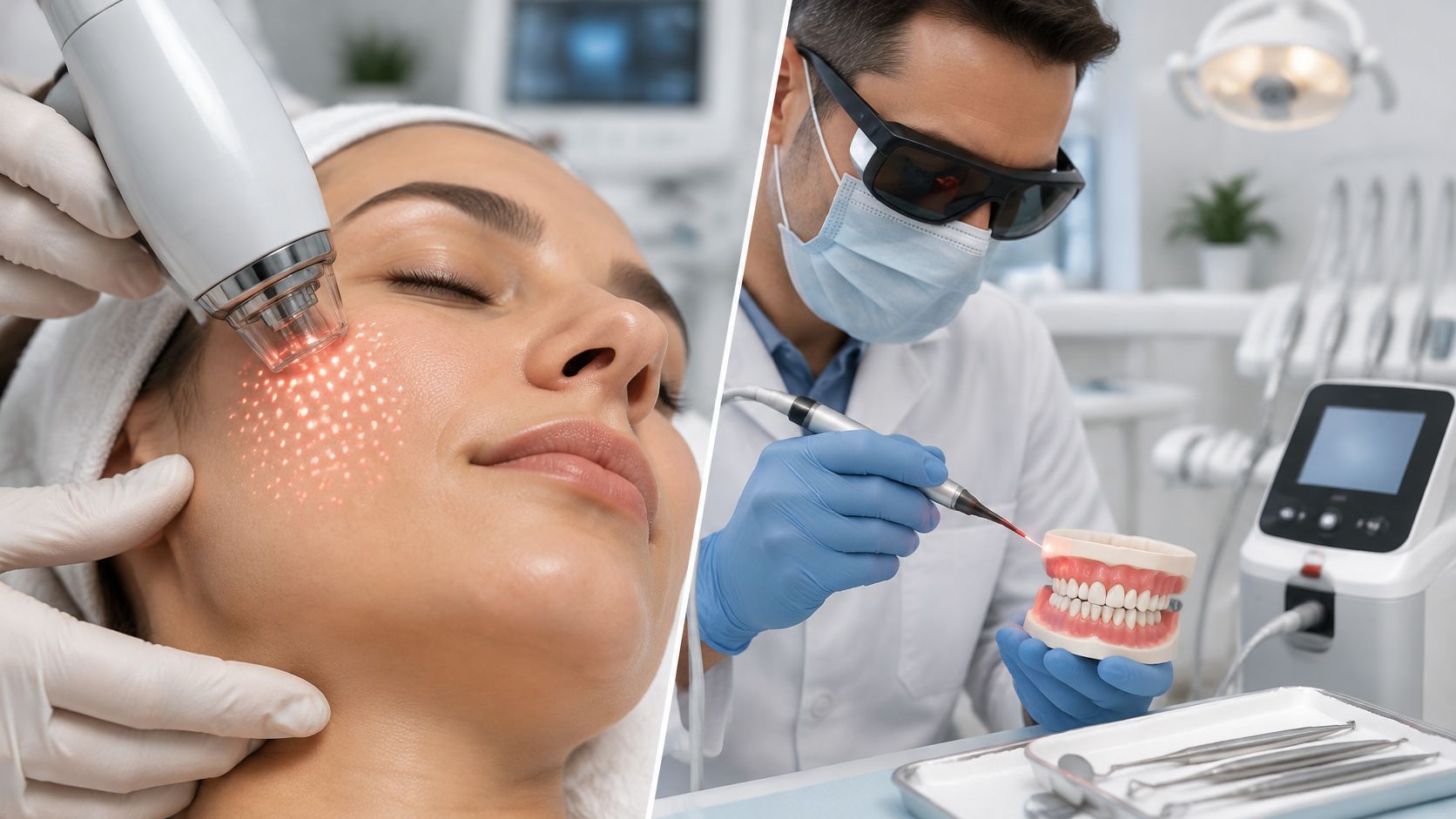
Could a fractional laser treat a gum problem? Fractional laser treatment refers to skin resurfacing, where a device treats tiny areas of skin while leaving nearby tissue untouched. Dental lasers are a separate technology used on gum tissue or, for some procedures, tooth structure. The similar name can be confusing, but the treatment site and purpose are different.
For a gum pocket that is not settling, a skin-resurfacing device is not the relevant treatment. A dentist assesses the gum and decides whether laser-assisted care is suitable; a laser does not automatically replace other dental treatment. Training, consent and follow-up also differ between skin and dental procedures.
Dental laser use in Dubai is governed by Dubai Health Authority standards, including its guidance on postgraduate laser-dentistry training and its dental laser room checklist. These standards address dental practice, not fractional skin resurfacing.
Table of Contents
- Fractional Laser Explained and Where Lasers Fit in Dentistry
- How Laser Energy Interacts With Gum and Tooth Tissue
- Who May Be Suitable for Laser-Assisted Gum Care
- Benefits, Limits and Alternatives Compared
- What Happens Before, During and After Laser Gum Care
- Safety Checks and Questions to Ask Before You Agree
- Frequently Asked Questions About Laser Gum Care
- Confirm Costs and Book a Dental Assessment
Fractional Laser Explained and Where Lasers Fit in Dentistry
What does “fractional” mean when people encounter it in cosmetic skin care? Fractional laser treatment refers to treating skin in a pattern of tiny columns, leaving the surrounding skin untreated. A stamp with solid areas and small holes makes a clearer comparison: the solid areas touch the paper, while the holes leave gaps. In fractional treatment, the laser affects selected columns and leaves untreated skin between them.
That pattern describes skin resurfacing. Healing at the skin surface is different from healing in a gum pocket, so the term does not describe a dental treatment.
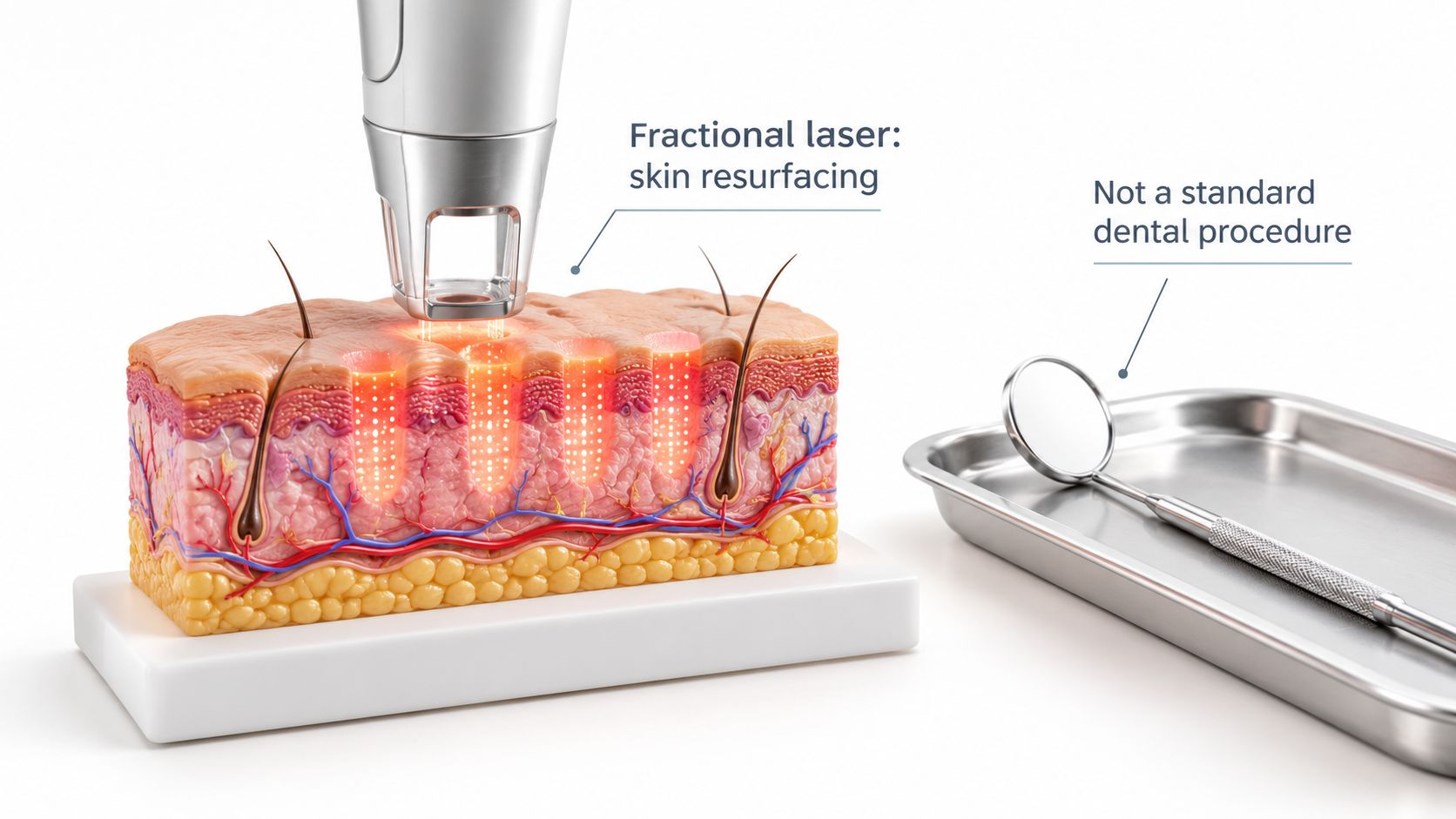
Dental lasers are designed for oral tissues. Depending on the device, they may be used on gum tissue or, for selected procedures, tooth structure. Skin and dental laser platforms are not interchangeable: their intended tissues and uses differ. An overview of modern dental care for Katy families may discuss dental technology, but it does not make a skin-resurfacing device suitable for treating teeth or gums.
Where each laser type is used
| Laser type | Tissue it works on | Main use | Who performs it |
|---|---|---|---|
| Fractional skin laser | Skin surface and dermis, in microscopic columns | Skin texture and scarring concerns, not dental | Dermatology clinics |
| Diode-type dental laser | Gum (soft) tissue | Laser-assisted gum care | Licensed dentist with DHA laser-dentistry privilege |
| Erbium-type dental laser | Enamel and dentine (hard tissue) | Selected tooth procedures | Licensed dentist with DHA laser-dentistry privilege |
A diode-type device is commonly discussed for soft gum tissue. An erbium-type device can interact with enamel and dentine, making it an option for selected tooth procedures. Neither is a skin-resurfacing session adapted for the mouth.
If you are asking about care for your teeth or gums, focus on the dental device, its intended use, and the dentist's qualifications. Those are separate from the meaning of “fractional” in skin treatment.
How Laser Energy Interacts With Gum and Tooth Tissue
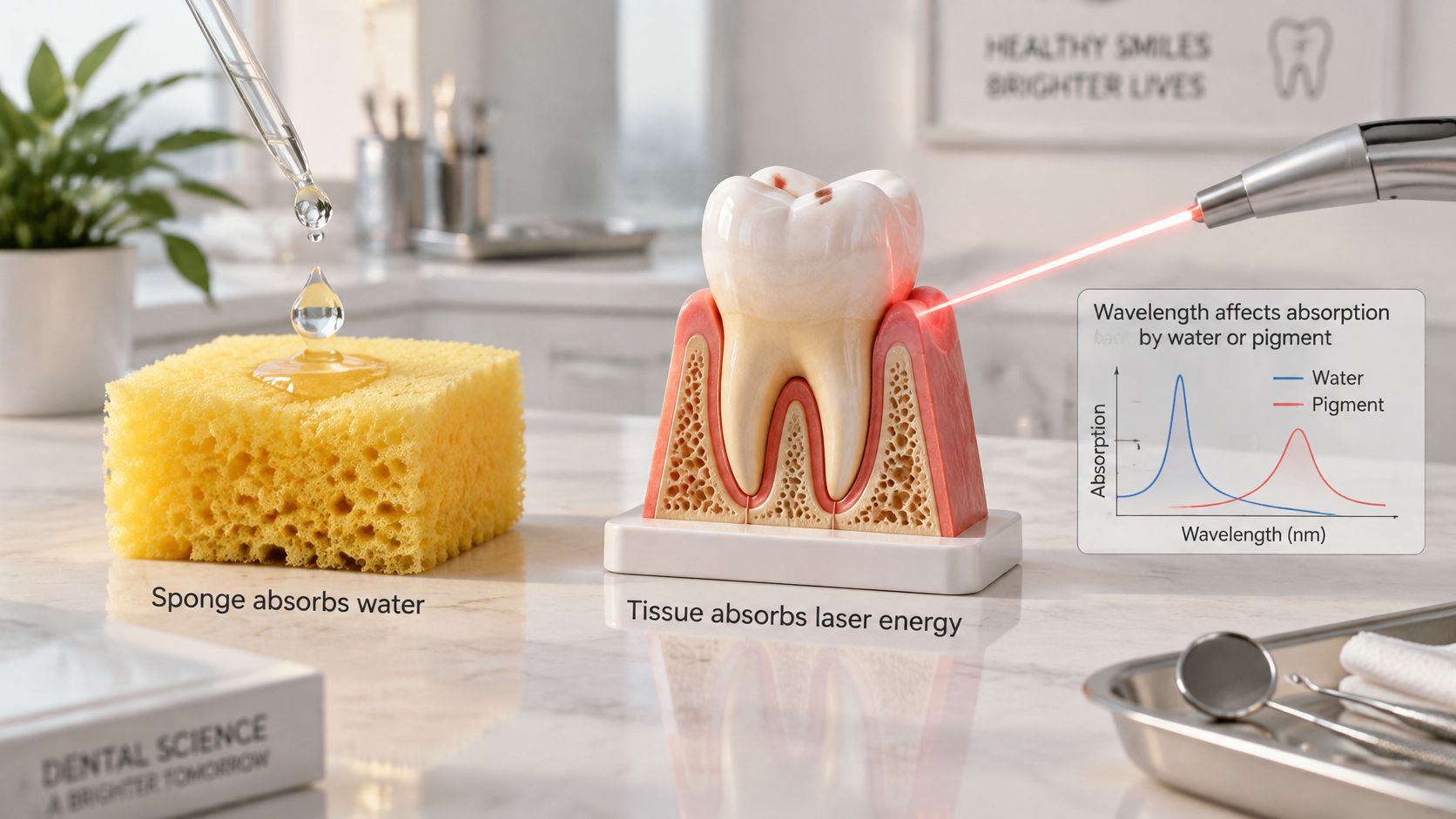
Have you seen “fractional laser” in a skin-treatment advert and wondered whether the same idea applies to gums? In dentistry, the key question is how a laser's wavelength interacts with the tissue it reaches.
Each wavelength is absorbed most strongly by particular targets. In soft tissue, those targets can include water and pigment. In hard tooth tissue, such as enamel and dentine, mineral is an important target. The laser's energy is therefore taken up differently by gum and tooth, so a device suited to one is not automatically suited to the other.
The pocket, not the whole mouth
For gum care, the intended target may be the periodontal pocket, the narrow space between tooth and gum where plaque and tartar can collect. If its lining is inflamed, a dentist may direct the laser at that area rather than passing it over healthy gum for a cosmetic effect.
The clinician sets power, pulse, and exposure time according to the tissue and treatment area. Pocket depth, bleeding, and tooth shape can vary, so similar symptoms do not necessarily call for identical settings.
Laser energy applied to the pocket can help reduce bacteria there and seal small blood vessels. This may mean less bleeding during the visit. The laser does not, by itself, remove deposits from the root.
Practical rule: Laser care may be used alongside professional cleaning. Cleaning is still needed to remove plaque and tartar from the root surface.
During pocket treatment, the dentist places the handpiece near the affected gum tissue and applies energy to the targeted area. The precise method depends on the device and the clinician's assessment.
A laser is a focused tool, not a treatment category defined by skin-marketing language. Its effects depend on wavelength, settings, and the clinician's skill.
Who May Be Suitable for Laser-Assisted Gum Care
Bleeding gums don't necessarily call for a specialised device. Mild inflammation often settles with professional cleaning plus steadier brushing and flossing at home. Suitability for laser-assisted care is decided only after a full examination.
A typical candidate is an adult with localised deeper pockets that haven't settled after cleaning, or someone who needs a targeted approach around particular teeth. A general tender gum line, by itself, isn't that picture.
Factors that shape suitability for laser-assisted gum care
| Factor | Why it matters | What your dentist checks |
|---|---|---|
| Pocket depth and location | Deeper, localised pockets are where targeted treatment is considered | Depths charted at several points per tooth |
| Bleeding on gentle probing | Shows active inflammation | Gum examination at each visit |
| Bone level on X-ray | Shapes the long-term plan | Radiographs and periodontal charting |
| Medicines that affect clotting | Changes bleeding risk | Full medication history |
| Smoking | Can slow healing and reduce response | Smoking history and support to stop |
| Response to earlier gum care | Shows whether a further step is needed | Re-assessment after initial cleaning |
| Pregnancy or medical conditions | May change timing or approach | Medical history review |
Charting matters because one tooth can have a deep site on one surface and a shallow site on another. An X-ray shows bone level, which changes whether the plan stays nonsurgical. Medicines such as blood thinners change bleeding risk even when the pocket looks straightforward.
Smoking can slow healing and blunt the response, so it belongs in the conversation before any device is switched on. If an earlier cleaning already calmed the pocket, another technology may not be the next step. Pregnancy and other medical conditions can change timing even when the gums clearly need care. Paths for gum disease treatment start from that examination, not from a device menu.
The dentist may advise a different route first when:
- Inflammation is early. Plaque control and a professional clean are the sensible start.
- Deposits are still on the root. Cleaning has to happen before any adjunct.
- Disease is advanced. Direct surgical access may be safer than a limited pocket approach.
- Healing risks are high. Uncontrolled medical issues or heavy smoking may need attention first.
The right candidate is defined by the chart, not by a wish to avoid a longer visit.
Benefits, Limits and Alternatives Compared
“Fractional laser” often describes cosmetic skin resurfacing, but gum care is a different use of laser technology. The Dubai Health Authority's dental scope-of-practice document discusses dental laser use and its potential advantages. These are possibilities, not guarantees: results depend on the diagnosis, tissue, wavelength, settings, and the clinician's training.
What laser gum care doesn't do
- It isn't a cure on its own. Gum disease still requires plaque control and daily home care.
- One visit may not finish the job. Some cases need further treatment or a review.
- It doesn't reach every pocket equally. Tooth shape and pocket depth affect access.
- It isn't suitable for every case. A laser may be an adjunct for selected pockets, while other approaches may fit the diagnosis better.
Gum treatment options compared
| Option | Best suited for | Main limitation |
|---|---|---|
| Professional cleaning | Early gum inflammation and plaque build-up | Doesn't reach deep pockets on its own |
| Scaling and root planing | Established pockets requiring deep cleaning | May need local anaesthetic and more than one visit |
| Laser-assisted gum care | Selected pockets, as an adjunct to cleaning | Benefit depends on diagnosis and settings, and it isn't a stand-alone cure |
| Surgical gum treatment | Advanced disease needing direct access | More invasive and involves a longer recovery |
The table helps separate what each option is meant to address from its limits. For a clearer explanation of periodontal treatment and root planing, consider how this established cleaning approach compares with laser-assisted care. You can also compare nonsurgical gum disease treatments as general background, then ask your Dubai dentist which options fit your examination and why.
At your appointment, use the table to ask what problem the recommended option targets, whether it is used alone or alongside cleaning, and what might lead the dentist to choose another approach. This makes the comparison practical without treating a device name as a diagnosis.
What Happens Before, During and After Laser Gum Care
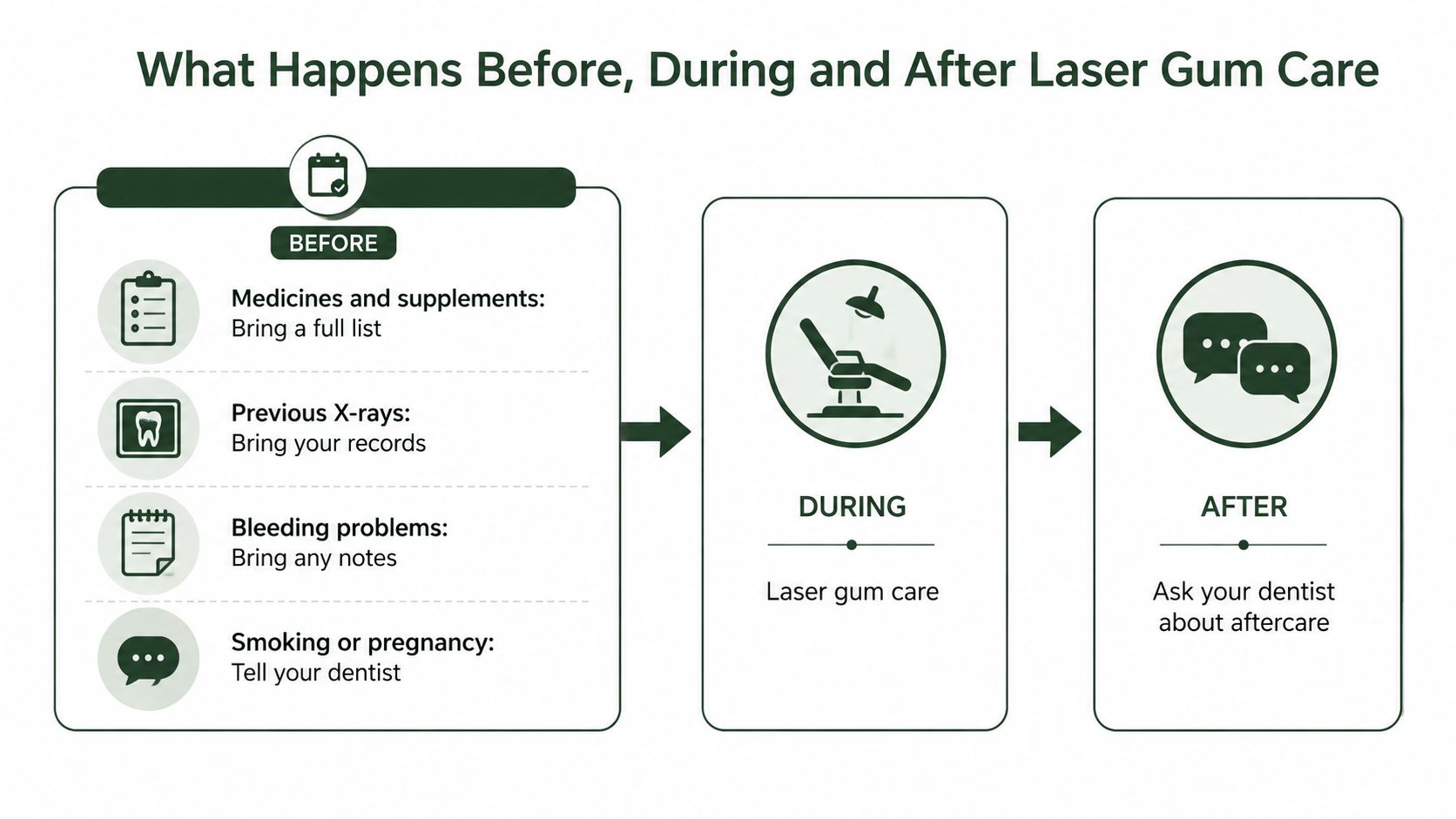
Bring a full list of medicines and supplements, any previous X-rays, and notes about bleeding problems. Tell the dentist if you smoke or if you are pregnant. Those details change anaesthetic choices, healing, and whether today is the right day to treat.
The visit in order
- Examination and gum charting. Pockets and bleeding are measured so treatment isn't based on a quick look.
- Diagnosis, options, and consent. Risks and alternatives are explained, and you get time for questions.
- Local anaesthetic when needed. The dentist uses it for comfort. No dental visit can be promised pain-free.
- Eye protection and site preparation. You and the team wear protective eyewear before the laser is activated.
- Targeted treatment. Affected pockets are treated, usually together with cleaning, not instead of it.
- A check and written instructions. You leave with aftercare in writing, not only a verbal reminder.
- A review visit. Healing is rechecked, and the dentist decides whether more care is needed.
Recovery and warning signs
Mild soreness, tooth sensitivity, or some swelling is common and usually eases over several days. Follow the advice you were given on brushing, eating, and any prescribed medicines. Some discomfort is normal and isn't a sign that the plan failed.
Patients reading about laser periodontal treatment recovery and results still need their own dentist's instructions, because pocket depth and settings change the next few days.
Call the clinic promptly if you notice:
- Bleeding that doesn't settle after the time your dentist described.
- Pain or swelling that increases instead of easing.
- Fever, or difficulty swallowing.
Don't wait those symptoms out over a weekend if they are worsening.
Safety Checks and Questions to Ask Before You Agree
Does “fractional laser” mean the same thing in skin care and dentistry? No. The term usually describes skin resurfacing, while dental laser care involves a different use of laser energy. In Dubai, ask how the proposed dental procedure is regulated and whether the dentist and facility have the appropriate DHA licensing and laser privileges. The Standards for the Use of Laser in Dentistry are a useful document to discuss with the clinic.
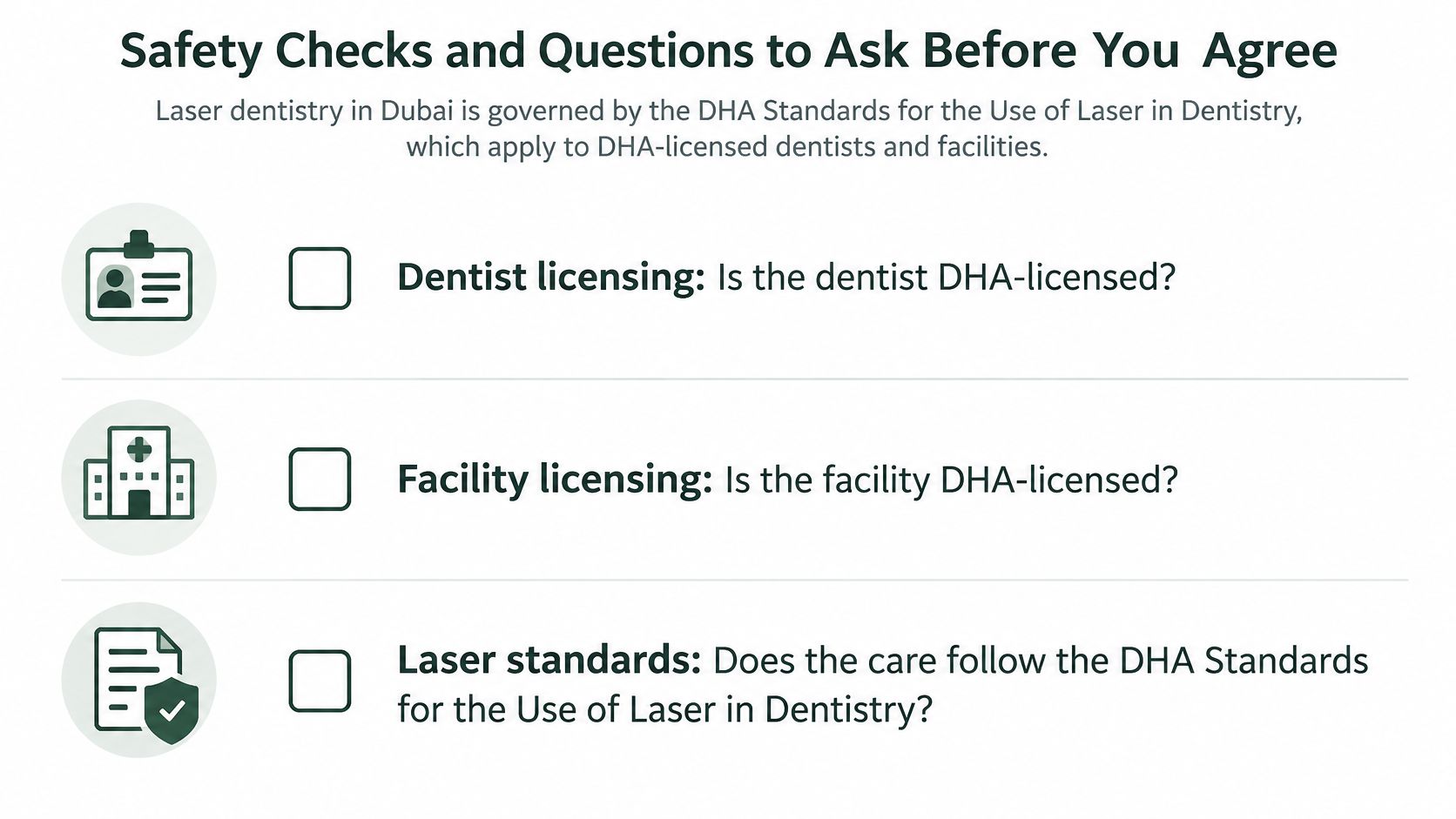
Before agreeing, ask for clear answers to these questions:
- Is the dentist licensed and authorised to use a dental laser? Ask to see proof of the dentist's licensing and relevant laser privileges.
- Which laser and wavelength will be used? The dentist should name the device and explain why it is appropriate for the tissue being treated.
- How will the treatment area be protected? Ask about access controls, warning signs, and protective eyewear for you and the clinical team.
- What follow-up will I need? Confirm what aftercare you will receive and how your response to treatment will be reviewed.
- What is the plan if a problem occurs? You should know whom to contact and how the clinic handles urgent concerns.
A routine dental examination can help establish whether laser-assisted care is suitable before a treatment visit is scheduled.
Ask the dentist to explain the alternatives, possible limits, and whether treatment could be irreversible. Laser procedures may require more than one visit, and no result can be guaranteed. Read the consent information and raise any questions before you agree.
Frequently Asked Questions About Laser Gum Care
Is fractional laser a dental procedure?
No. The term describes skin resurfacing. Dental laser gum care is a separate category used on gum and, in selected cases, tooth tissue. An examination confirms which category, if any, applies to you.
Does laser gum care hurt?
Most patients feel some discomfort. Local anaesthetic is used when the dentist judges it necessary. No dental procedure can be promised to be pain-free, even when the visit is shorter than surgery.
Does the laser remove tartar?
Not on its own. It works alongside professional cleaning, which removes deposits from the root surface. Skipping that cleaning leaves the cause of the pocket in place.
How many visits are needed?
It depends on pocket depth and how the gums respond. A re-assessment is usually planned afterward, and some people need more than one treatment visit.
Can smokers have laser gum care?
Smoking can slow healing and reduce the response, so the dentist will discuss it before any treatment. Stopping, even for a period around care, is part of that talk.
Will gum disease come back?
It can. Long-term stability depends on home brushing, cleaning between the teeth, and regular check-ups. A laser visit doesn't lock in a permanent result.
Is it suitable during pregnancy?
Timing is discussed after a full medical history review. Some gum care can wait, and some shouldn't, so the decision is individual rather than automatic.
Confirm Costs and Book a Dental Assessment
There is no single reliable price for laser gum care. The cost can depend on the areas treated, the diagnosis, whether X-rays are needed, the number of visits, what follow-up includes, and whether another treatment should come first. Ask for a written estimate after the dentist examines you, with the included services listed. A quote given before your gums are assessed may not reflect the treatment you need.
A dental assessment helps establish the diagnosis and suitable options. The dentist examines your gums, reviews your health history, and discusses whether laser-assisted care or another approach is appropriate. Yoyime Clinic is at Ground Floor, Exit 1, Salah Al Din Metro Station, Deira, Dubai. Suitability and the final plan depend on your examination and individual needs.
To prepare, bring your medicines list and any previous X-rays. Book a dental assessment through Yoyime Clinic, and bring your questions about costs and treatment options.