


You've got an event in three weeks, a dull patch on your cheek that won't shift, and forty minutes of scrolling behind you. Every clinic in Dubai offers a facial, the price lists look similar, and the names, HydraFacial, Hollywood peel, carbon laser, microneedling, brightening IPL, tell you nothing about which one suits your skin. So the decision gets made on price, or on what a friend recommended last summer.
The reframe that makes this simpler: a facial is a clinical decision, not a menu choice. The name of a treatment describes the method, not the result. What decides whether your skin improves is whether the method matches your concern, whether your skin is currently in a state that can tolerate it, and whether the person holding the device has assessed you face to face and has a plan if your pigment flares.
Table of Contents
- Facial Treatments in Dubai at a Glance
- Matching a Facial to Your Skin Concern
- When a Facial Should Wait or Go to a Dermatologist
- Verifying a Clinic and What Happens at Your Visit
- Aftercare Timeline and Sun Protection
- What Shapes Facial Prices in Dubai
- Common Questions About Facials in Dubai
- Book a Skin Consultation at Yoyimé Clinic
Facial Treatments in Dubai at a Glance
Two different things share the word facial in this city. One is a spa treatment: cleansing, massage, a mask, a warm towel and an hour of genuine rest. The other is a clinic treatment built around a specific skin problem, where the choice of acid, needle depth or light wavelength is the entire point. Both are legitimate. They answer different needs, and confusing them is how people end up disappointed, or worse, with a pigment flare.
The medical case for taking the clinic version seriously here is straightforward. A regional dermatology review reports an estimated acne prevalence of 64.8% in the UAE, meaning roughly two-thirds of the population may deal with breakouts and their aftermath at some point (regional dermatology review). When a concern is that common, a facial stops being a treat and becomes part of skin management.
The table below sorts the options by what they do. Read each row across: the concern it targets, the method in plain terms, and the kind of skin it generally suits.
| Treatment | Typical concern | How it works | Generally suits |
|---|---|---|---|
| Relaxing spa facial | Tiredness, dehydration, general pampering | Cleansing, massage, masks and hydration with no active correction | Occasional pampering; not a substitute for treating a skin condition |
| Hydradermabrasion facial | Dullness, congestion, mild texture | Cleansing, gentle exfoliation, extraction and hydration in one session | Dull or congested skin without active inflammation |
| Deep cleansing facial | Blocked pores and blackheads | Cleansing and extraction, manual or device-assisted | Congested skin without active breakouts |
| Superficial chemical peel | Dullness, mild pigmentation, uneven tone | Acid solution applied for a set time, then neutralised | Stable skin, with no active acne and no recent sun exposure |
| Microneedling | Acne scars, fine lines, enlarged pores | Fine needles create controlled micro-injuries that stimulate collagen | Skin that is not actively inflamed, after clinical assessment |
| Light-based brightening (IPL or laser) | Sun spots, pigmentation, redness | Light energy targets melanin or blood vessels | Skin assessed in person; darker skin needs extra caution for pigment change |
The rows run from the gentlest surface work down to treatments that deliberately provoke a healing response or use light energy, so you can locate roughly where your own skin sits. If you're weighing a vortex-style hydradermabrasion against an acid peel, Hydrafacial vs chemical peel differences from ProMD Health is a fair, plain-language comparison to read before your consultation.
Two conclusions follow. First, the name tells you the method and never the result. A "brightening facial" describes an intention, not a promise about your melasma. Second, the same option that suits a 28-year-old with congested skin can be the wrong choice for someone with active inflammation.
What the table can't do is decide for you. The final plan follows an examination in the clinic, not a selection from a list.
Your realistic goal after reading this is a shortlist of two or three options that match your concern, plus one honest question: does my skin need calming before it needs resurfacing?
Matching a Facial to Your Skin Concern
Think of a facial as a tool and your concern as the job. Nobody reasonable picks a hammer first and then looks for something to hit. Yet that's roughly what happens when someone books a brightening facial while running active acne, or books a strong peel for skin that's inflamed this week.
Acne is a sensible place to start, because it's the most common reason people walk into a skin clinic here. A retrospective study of 5,969 patient visits to a dermatology outpatient clinic in Dubai found that acne accounted for 1,050 visits, or 17.6% of the total, ahead of unspecified dermatitis at 9.9%, atopic dermatitis at 5.5% and viral warts at 4.5% (Dermatology and Therapy study). Women made up 76.7% of acne-related visits. If you're booking a facial for breakouts, that's the cue to start with an assessment rather than a generic deep-cleansing routine.
| Skin concern | Options discussed | Watch out for |
|---|---|---|
| Dullness and tiredness | Hydradermabrasion facial, superficial peel | Over-exfoliation can cause irritation and rebound redness |
| Active acne | Gentle cleansing; clinician-selected peel only once inflammation is controlled | Picking, aggressive exfoliation or resurfacing during flare-ups |
| Acne marks and pigmentation | Superficial peel, tone-focused IPL or laser, daily sun protection | Heat and UV can darken pigment; test areas may be advised |
| Enlarged pores and uneven texture | Microneedling, fractional laser, peel | Requires stable skin; downtime varies by device and settings |
| Fine lines and loss of firmness | Microneedling, energy-based tightening | Changes are gradual and vary; no single session can be guaranteed |
| Melasma | Gentle peels, clinician-directed devices, long-term photoprotection | Heat, friction and sun exposure can trigger flare-ups |
| Sensitive or dehydrated skin | Hydrating facial and a barrier-repair plan | Any new active product or device may cause irritation |
Pigmentation is where the tool-and-job idea earns its keep. Skin that marks easily responds to heat, friction and inflammation by producing more pigment. A treatment that helps dullness, such as warm steam, an aggressive scrub or a hot device, can deepen a brown patch that was already fading. On darker Fitzpatrick skin types, that principle means conservative settings and a small test area matter far more than intensity.
Combination plans are normal, and the order is the treatment. A clinician might calm inflammation for a few weeks, move to a superficial peel, then introduce a tone-focused laser later. Two sessions in the right sequence beat one aggressive session chosen for speed. For dullness and congestion, hydradermabrasion is usually the gentlest starting point, and we offer HydraFacial at our Deira clinic, a vortex-fusion treatment with customisable boosters adjusted to what your skin can tolerate that day.
Bring four things to the consultation: your main concern in one sentence, a list of past reactions to products or treatments, photos of your skin at its worst and at its best, and the names of everything you currently use, including prescription creams. Photos beat memory here, because skin changes week to week and your worst day is often the most informative one.
When a Facial Should Wait or Go to a Dermatologist
The most common booking mistake in Dubai isn't the wrong facial. It's the right facial at the wrong time. Someone has a flare-up, an event on Friday, and books the strongest resurfacing option on the list to clear it. Heat, acids and needles on inflamed skin tend to produce more inflammation, not less.
The regional evidence shows why this matters so much here. In a prospective, non-interventional study of 262 acne patients consulting dermatologists across the Middle East, including investigators based in Dubai, post-inflammatory hyperpigmentation was present in 87.2% of participants. Just over half, 52.6%, said the pigmentation had lasted at least a year, and 69.0% admitted picking at their lesions (Journal of Dermatological Treatment study). Picking and uncontrolled inflammation drive the discolouration that outlasts the breakout itself.
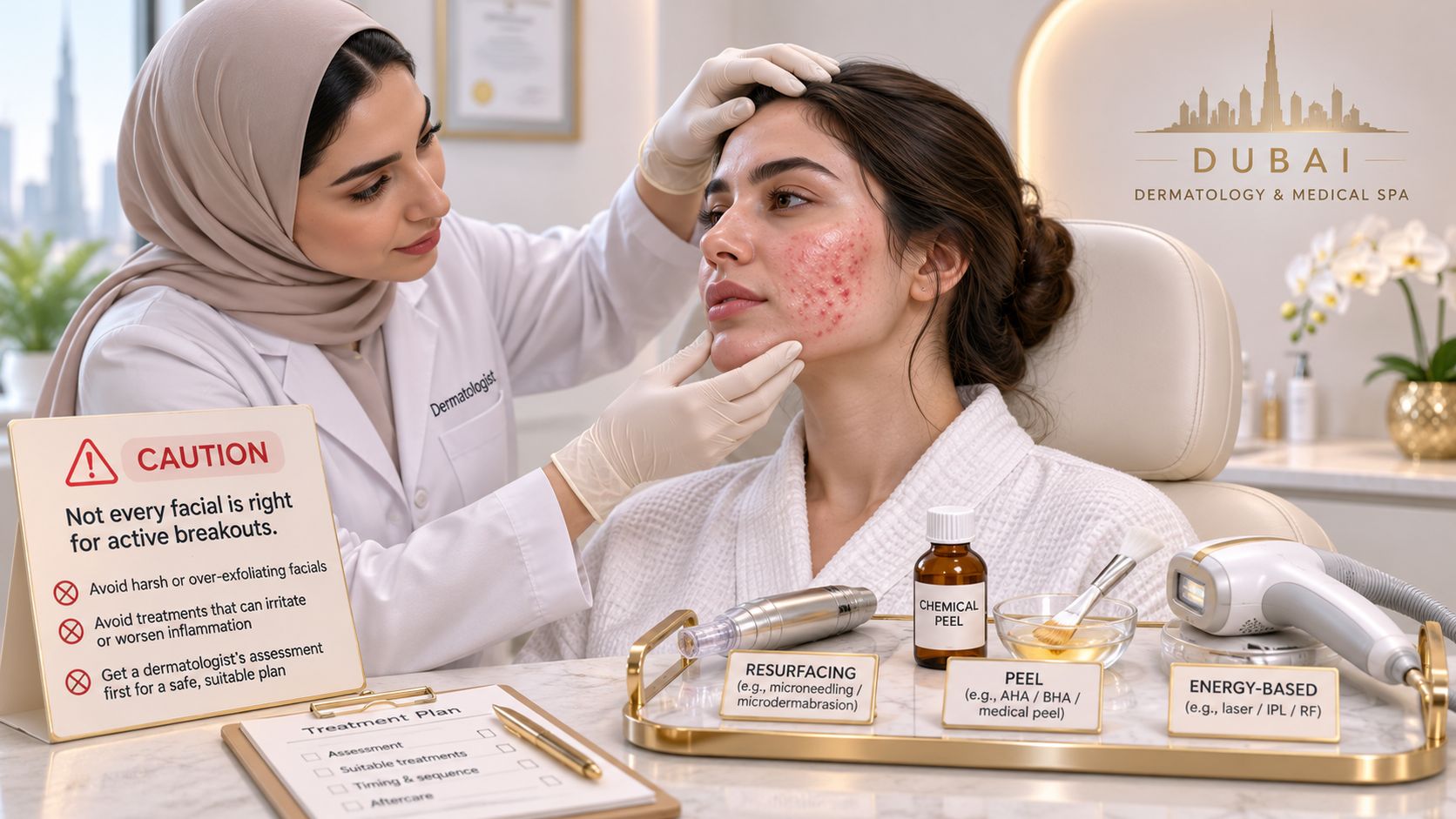
So the list of reasons to postpone is longer than many expect:
- Active or inflamed breakouts: calm the skin first, then consider resurfacing.
- Recent sun exposure or tanning: freshly tanned skin carries a higher pigment risk.
- Melasma or a history of dark patches after injury: heat and energy devices need caution.
- Recent isotretinoin: clinicians ask about this before any resurfacing, because healing and scarring risk change.
- Pregnancy: many active treatments are postponed rather than adapted.
- Broken skin, cold sores near the treatment area, or a recent reaction: wait until the skin settles.
- Strong prescription creams started in the last few weeks: tell the clinician the exact name and strength.
A good sign, not a wasted visit: being asked to come back in three weeks with calmer skin is often the most useful outcome of a consultation.
Some signals need a dermatologist rather than a facialist: spreading redness, pus or fever, a spot that bleeds or changes shape, pigment that's spreading quickly, or a reaction that followed a previous facial. If you want a structured way to think about which concerns belong with a specialist, our guide to skin concerns and specialist care walks through the categories. A postponed appointment is often the best care you'll receive that month.
Verifying a Clinic and What Happens at Your Visit
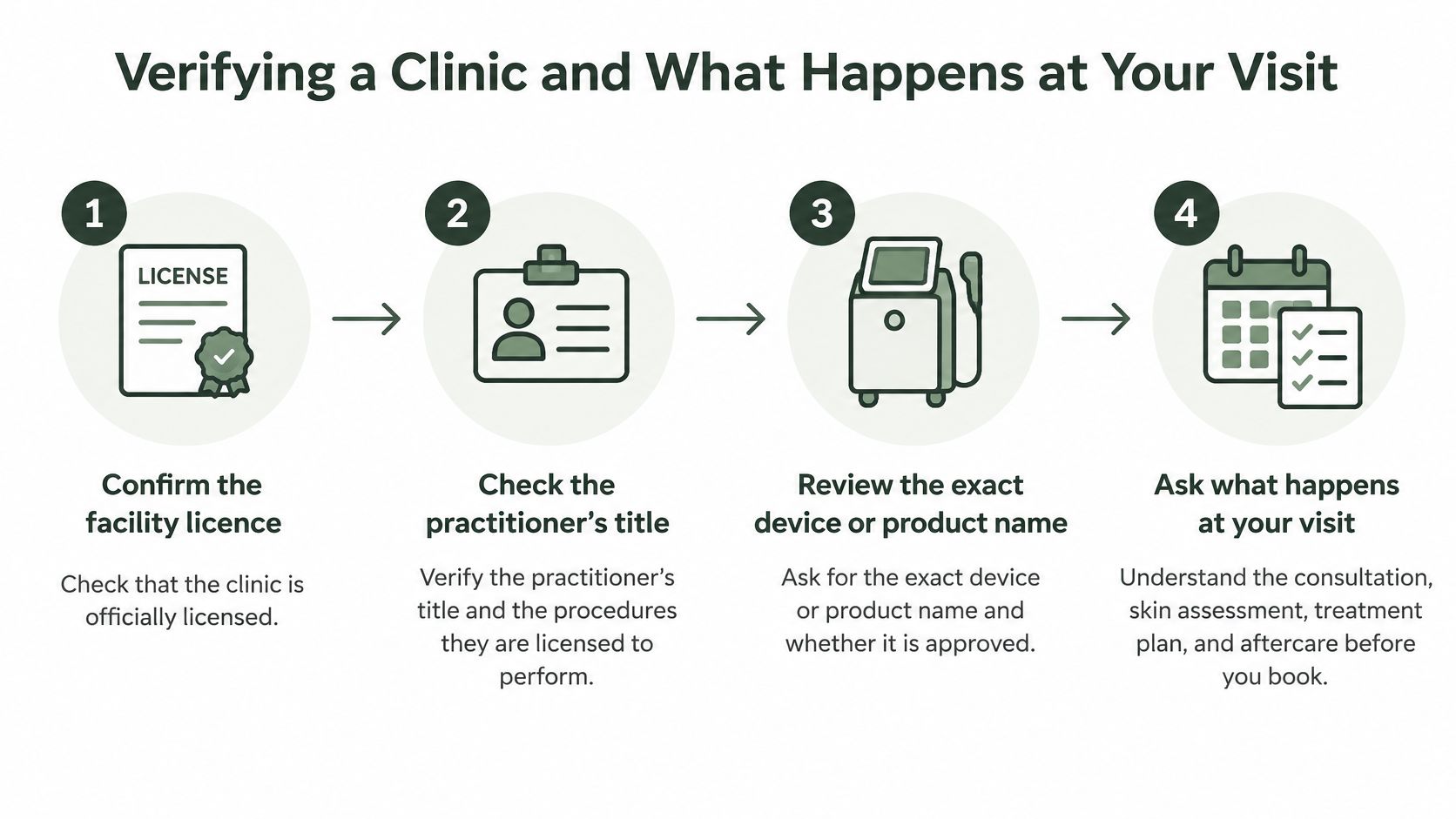
You may find a facial described as a relaxing spa treatment or as a clinical procedure. Before booking, check who will perform it, what it involves, and whether the clinic can explain the risks and alternatives. Those details matter more than a treatment's name.
The checks worth making before you book
- The facility and treatment. Ask which authority licenses the clinic and whether the treatment you're considering is within its scope. Yoyimé Clinic operates under the licensing and regulation of the Dubai Health Authority (DHA).
- The practitioner's qualifications and role. Aesthetician, laser technician, nurse and dermatologist are different roles. Ask who will assess you and perform the treatment.
- The device or product. Ask for its name and, where relevant, the device model or product strength. Clear answers help you understand what will be used on your skin.
- The follow-up plan. Find out whom to contact if you have a concern and whether a review can be arranged.
DHA guidance and requirements for non-surgical cosmetic services can help patients understand why provider qualifications, treatment scope and safe practice matter. The rules can vary by procedure, so ask the clinic to explain who is qualified to perform the treatment you're considering. DHA circular on non-surgical cosmetic procedures
What a compliant visit looks like
At Yoyimé Clinic, doctors and specialists are DHA-licensed and trained to international clinical standards across dentistry, dermatology and aesthetics. A consultation should help you understand whether a treatment fits your concern, not steer you toward a popular option.
- Assessment with the practitioner. For a non-surgical cosmetic procedure, ask how your suitability will be assessed and whether you'll meet the practitioner who will treat you. DHA standards describe requirements for these services; the clinic should explain how they apply to your appointment. DHA standards for non-surgical cosmetic procedures
- Relevant health information. Share your medical history, medicines and previous treatments. These details can affect which options are appropriate.
- Skin assessment. The practitioner should consider your skin and the concern you want addressed before recommending a treatment.
- Benefits, limits and alternatives. Ask what the treatment may help with, what side effects or downtime are possible, and whether waiting or doing nothing is also reasonable.
- Consent and aftercare. Make sure you understand the plan and have instructions for caring for your skin afterward.
For laser or IPL, ask how the clinic checks equipment and protects your eyes during treatment. DHA's checklist covers safety considerations for non-surgical cosmetic services; the clinic should be able to explain how its room and procedures address them. DHA non-surgical cosmetic services checklist
A spa facial and a clinical skin treatment are not interchangeable. A spa facial may focus on cleansing and comfort, while a clinical treatment uses a defined procedure that needs suitability assessment and clear consent. If you're comparing settings, this guide to choosing an aesthetic clinic in Dubai can help you focus on the provider, treatment and consultation rather than the menu alone.
Aftercare Timeline and Sun Protection
The procedure sets the direction. The two weeks after it decide how much you keep. Most disappointing outcomes trace back to the same handful of days, and the culprits are usually sun, heat, picking, or a strong acid restarted too early.
| Treatment | First 48 hours | Days 3 to 7 | Sun protection |
|---|---|---|---|
| Relaxing or hydradermabrasion facial | Mild pinkness, usually settling within hours | Normal routine resumes | Daily broad-spectrum SPF 30 or higher |
| Deep cleansing facial | Mild redness; avoid picking the skin | Normal routine resumes | Daily broad-spectrum SPF 30 or higher |
| Superficial chemical peel | Redness and tightness; avoid strong actives | Flaking or peeling in many cases | Strict daily SPF; avoid sun exposure until the skin settles |
| Microneedling | Redness and swelling; avoid makeup and heat for about 24 hours | Redness typically fades over several days | Daily mineral SPF; avoid direct sun during healing |
| Light-based brightening (IPL or laser) | Warmth and redness; spots may darken before they flake | Spots may flake; skin may stay sensitive | Strict daily SPF; avoid tanning for the period the clinician advises |
These timelines are general patterns, not rules. The clinician's written plan overrides them, because it's based on what was done to your skin that day.
Why sunscreen sits inside the treatment, not beside it
In a multicentre observational study of 1,785 adults with Fitzpatrick phototypes IV to VI and acne-associated pigmentation, including participants from the United Arab Emirates, two months of daily anti-acne dermocosmetic care plus tinted SPF 50 sunscreen improved acne severity, with 84.9% of participants showing improvement and a 28.8% reduction in the post-acne hyperpigmentation index after 56 days (Journal of Cosmetic Dermatology study). No device produced that change. Daily protection and consistent home care did.
That reframes how you read your own results. A tone-focused facial can underperform, or trigger rebound pigment, if you return to lunchtime sun and a skipped morning SPF. Practical rules that hold for most treatments:
- Broad-spectrum SPF every morning, reapplied through the day when you're outdoors.
- Skip saunas, steam rooms and hot yoga for the period advised after active treatments.
- Don't pick or peel flaking skin, even on day four, because it lifts pigment risk.
- Hold new strong actives such as retinoids or acids until the clinic clears them.
- Call the clinic for increasing pain, blistering, pus, or pigment that keeps darkening and spreading.
Keep a short log for the review visit: what you used, how much time you spent outdoors, how the skin felt. Adherence is easier to judge from notes than from memory. For a day-by-day routine, our chemical peel aftercare guide walks through each stage, and these post-facial care tips from Skinsation Aesthetics are a practical second read for the first week.
What Shapes Facial Prices in Dubai
No clinic can quote a facial without seeing your skin, so treat any single figure you find online as a starting point rather than a total. What moves the number is predictable, and knowing the factors makes a quote easier to read.
- The treatment itself. A relaxing spa facial and a clinician-led peel with a prescribed aftercare plan are different products with different costs to deliver.
- The device or product. Registered, approved equipment and named products cost more to run than unbranded alternatives, and the difference often shows in consistency between sessions.
- The area and scope. Full face versus a single concern, and whether the neck or décolletage is included.
- The number of sessions. Pigmentation and texture rarely resolve in one visit, so a plan spanning several months is usual.
- The consultation, included in the package or charged separately.
- Who performs it. Doctor-led assessment and a therapist-led session carry different overheads and different scopes of practice.
- Home care. Sunscreen, cleanser and aftercare products are part of the cost of the result, not an optional extra.
- Reviews and follow-up. A check-in after a reaction or pigment change should be planned in advance, not treated as an emergency.
A lower price can mean a treatment that doesn't match your concern. A higher one doesn't guarantee a better result. Ask for an itemised written quote covering the consultation, each session, products and follow-up, and ask for current pricing before you book. If you're budgeting for a series rather than a single visit, this guide to budgeting for advanced facial sessions from ProMD Health Bethesda sets out the same logic in more detail.
Common Questions About Facials in Dubai
- How many sessions will I need? It depends on the concern and the plan the clinician sets. One session rarely changes a long-standing concern on its own.
- Does a facial hurt? Sensations vary between people, and no treatment is painless for everyone. Tell the clinician your comfort level early, and ask for adjustments rather than tolerating discomfort.
- Can I wear makeup afterwards? It depends on the treatment. The written aftercare plan overrides any general timeline you've read online, including the ones in this article.
- Can I have a facial during pregnancy? Ask the clinician first. Many active treatments are postponed during pregnancy rather than adapted.
- How often can I repeat a treatment? The interval depends on the treatment type and how your skin responds at review, which is why the review appointment matters as much as the session.
- Can I keep my usual skincare? Ask before adding strong actives such as retinoids or acids in the weeks around a treatment, and bring the product names with you.
A consultation answers the questions that are specific to you: your skin type, your history, your pigment risk and your timeline. Suitability always depends on clinical examination, and a good clinician will happily tell you which treatment to skip.
Book a Skin Consultation at Yoyimé Clinic
A useful consultation begins with clear information about your skin and health. Bring your current medicines and supplements, skincare product names, details of recent treatments, and notes about any past reactions. Photos taken in good daylight can help show how the concern changes over time.
Yoyimé Clinic is at 106 Salah Al Din St, Deira, Dubai, and is open daily from 10:00 to 22:00. Call +971 4 884 3396 or +971 50 225 7535 to arrange an assessment.
The clinic's DHA-licensed team offers Hydrafacial and clinic-based facial planning, alongside dermatology and aesthetic treatments. Suitability depends on a clinical examination and your individual needs, so ask how the proposed treatment addresses your concern and what limitations to expect. No outcome is guaranteed, and comfort varies from person to person.
Book a skin consultation at Yoyime Clinic to discuss your concerns and treatment options.