


Are you choosing a chemical peel by its brand name, or by its depth, your skin type and who is qualified to perform it? For chemical peel treatment in Dubai, the better starting point is your diagnosis and how easily you can limit sun exposure during recovery. There is no single best chemical peel in Dubai for everyone.
A peel uses a controlled chemical solution to exfoliate skin at a selected depth. It may help with dullness, acne marks, uneven tone and early fine lines, but the wrong depth can cause irritation or unwanted pigmentation. The practical choice is whether the proposed treatment matches your concern and falls within the practitioner's Dubai Health Authority-licensed scope.
A consultation should establish that before anyone recommends a product, strength or package.
Table of Contents
- Chemical Peel Types and Strengths Compared
- Which Skin Concerns Peels Treat Best
- Why Dubai Sun and Skin Type Change Peel Depth
- Who Is a Good Candidate and Who Should Wait
- How to Check a Clinic and Practitioner in Dubai
- Recovery, Aftercare and Safety Limits
- Book a Consultation Before Your First Peel
- Frequently Asked Questions About Chemical Peels in Dubai
Chemical Peel Types and Strengths Compared
Peels are grouped by how deep they work, and that depth matters more than the name of the acid on the label. Superficial peels act mainly within the outer skin layer. Medium-depth peels reach further into the skin, while deep peels are specialist procedures reserved for carefully selected, more severe concerns.
Each acid behaves a little differently within that depth. Glycolic acid loosens the bonds between surface skin cells so they shed evenly. Salicylic acid is oil-soluble, so it can move into oily follicles, which makes it useful when blackheads and blocked pores are part of the problem.
The Doctors Clinic Dubai pigmentation guide lists superficial glycolic acid at approximately 30–50%, salicylic acid at approximately 20–30%, repeat intervals of 2–4 weeks, and medium-depth TCA formulations of roughly 15–35% that need longer recovery and carry greater pigment-change risk. These figures are clinical reference ranges for supervised treatment.
Chemical peel types, strengths and who may perform them
| Peel type | Typical strength | Main targets | Who may perform in Dubai |
|---|---|---|---|
| Superficial glycolic acid | About 30–50% | Dullness, uneven tone, mild texture | Dermatologists, plastic surgeons, and other staff within assigned DHA scope |
| Superficial salicylic acid | About 20–30% | Comedonal acne, oily skin | Same scope as other superficial peels |
| Lactic or mandelic acid | Product-specific formulation selected clinically | Gentle brightening in selected sensitive or darker skin | Same scope as other superficial peels |
| Medium-depth TCA | About 15–35% | Selected deeper pigmentation, acne scarring and fine lines | Practitioner with appropriate DHA privileges for the planned depth, confirmed at consultation |
| Deep peel | Specialist-selected formulation, not a general strength recommendation | Severe wrinkles and deep scars in selected patients | Dermatologists or plastic surgeons only |
The strength figures above are the clinical ranges already cited. The permission column matters just as much: in Dubai, the depth a practitioner may perform depends on their DHA licensing scope, and your consultation should confirm that match before treatment.
Why concentration isn't the whole treatment
A higher percentage does not automatically mean a deeper peel. The solution's pH, how long it stays on the skin, how many layers are applied and the preparation beforehand all influence how far the peel travels. Two clinics using glycolic acid at the same concentration may deliver very different intensities, which is why the written protocol matters as much as the product.
Your skin's response to the previous session guides the next one. Redness, burning or scaling that lingers, new breakouts, or patches of darkening are signs the plan needs adjusting or the next session should wait.
Darker skin generally calls for more conservative depth, especially where strong sun exposure and existing pigmentation are involved.
Practical rule: Ask what depth the clinician intends to reach. The acid name alone tells you less.
You may come across consumer resources such as ArtNaturals' page on adding an at-home peel safely while researching. Whatever you read, do not add home exfoliation during clinical recovery without your clinician's approval, because layering another peel on healing skin can over-exfoliate it.
Treat this comparison as a starting map. Examination determines the final formulation, depth and timing.
Which Skin Concerns Peels Treat Best
Acne is a common reason patients seek help with uneven skin tone in the UAE. A UAE-focused dermatology consensus cites estimates that acne represents approximately 30% of chronic dermatologic conditions in the country. For someone considering a peel, the important distinction is whether the problem is active acne, leftover colour or a true scar.
Active acne means current blocked pores, inflamed spots or deeper lesions. Post-inflammatory marks are flat areas of discolouration left after inflammation settles. An indented scar is a change in skin structure, so treating its colour alone won't level the depression.
Common concerns, peel approaches and realistic limits
| Concern | Peel approach often considered | Realistic expectation | Main limit |
|---|---|---|---|
| Dullness and uneven tone | Superficial glycolic or lactic series | Gradual brightening over several sessions | Doesn't replace daily sun protection |
| Post-inflammatory acne marks | Superficial salicylic or glycolic peels after inflammation settles | Gradual fading over weeks to months | Irritation may darken the marks |
| Melasma | Gentle superficial protocols, often with topical therapy | Partial improvement; pigment can recur | Aggressive peels can worsen it |
| Sun spots | Superficial peel series after diagnosis | Possible lightening over several sessions | Ongoing sun exposure undermines improvement |
| Early fine lines | Superficial peel, or a medium peel in selected cases | Modest smoothing | Deeper lines usually need other treatments |
| Active acne | Clinician decides whether to peel or treat first | Progress follows acne control | An active flare needs medical review |
These are treatment-planning expectations, not promises. A persistent or changing pigmented spot should be examined rather than assumed to be a cosmetic sun spot.
When another approach makes more sense
Our dermatology services treat acne, pigmentation and chronic skin conditions. A concern-based consultation can establish whether your skin needs acne medication, pigment-control skincare, barrier repair or an aesthetic procedure.
For depressed acne scars, RF microneedling in Dubai may be an alternative worth discussing. It addresses a different treatment goal from superficial exfoliation and requires its own suitability assessment.
Topical treatment may also be part of the plan. If you want to compare acne pigmentation serums, Courier Pharmacy's guide can help you identify questions about ingredients, but don't introduce multiple active products alongside a peel without advice.
A report on UAE warnings about unsupervised chemical peels describes risks including severe chemical burns, pain, swelling, infection, skin-colour changes and disfiguring scars. Stronger home treatment isn't a shortcut to faster improvement.
The practical aim is a gradual change in the concern your clinician has identified, often with topical care alongside the procedure.
Why Dubai Sun and Skin Type Change Peel Depth
More visible peeling doesn't mean a better result. A dramatic reaction may mean that the skin has sustained more injury than it can comfortably tolerate.
A consultation should connect the proposed depth with your pigmentation pattern and skin response.
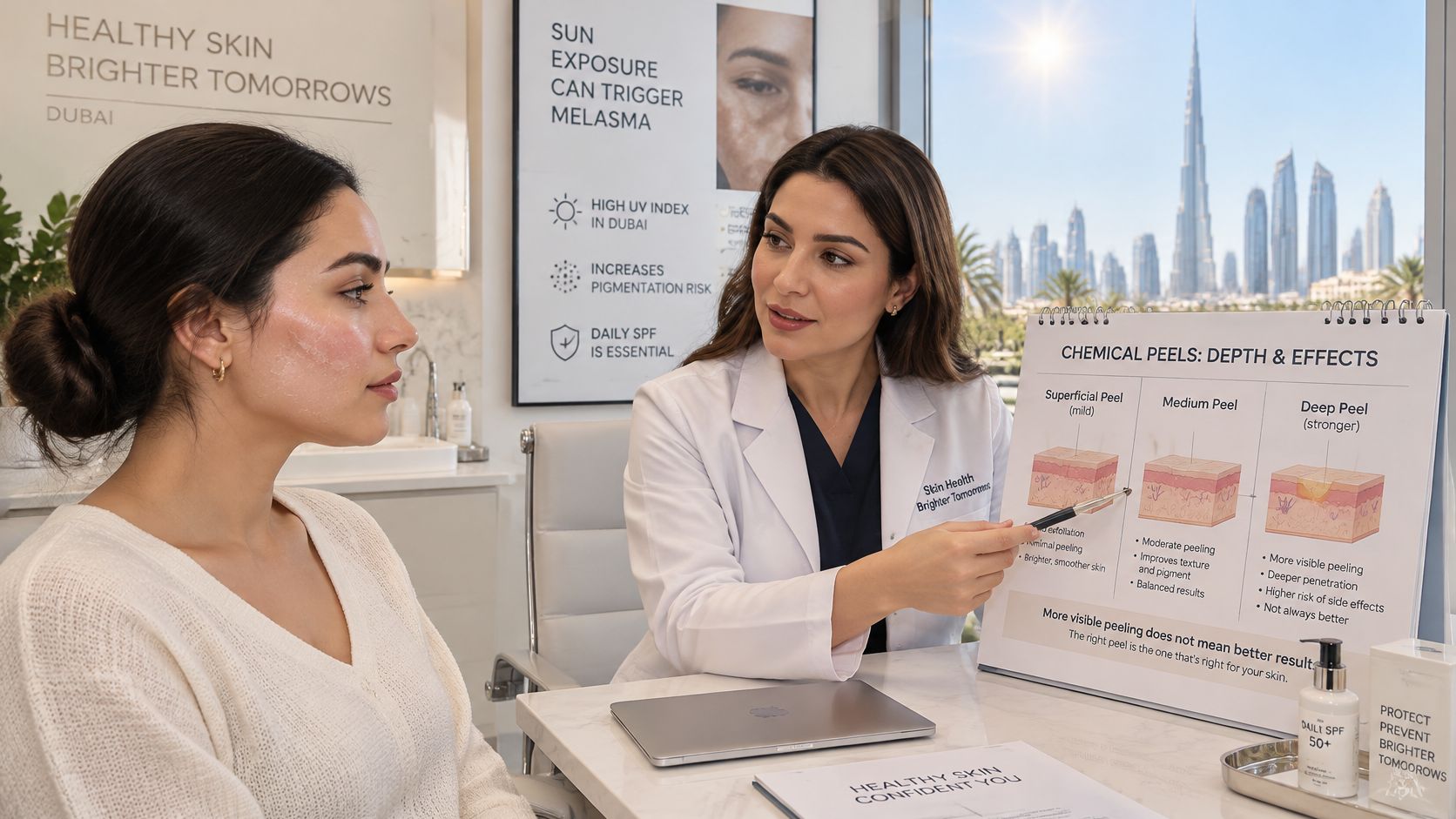
Dubai's sun exposure makes this especially relevant. The Dr Sulaiman Al Habib dermatology service identifies pigmentation disorders as a common local concern associated with sun exposure and describes individualised treatment using skincare, topical therapy and procedures rather than a single universal solution.
A clinician considers Fitzpatrick skin type, a classification based on how skin responds to sunlight, together with current pigment and barrier health. In darker skin, excessive inflammation can stimulate additional melanin, the pigment responsible for skin colour.
A gentler plan can be the more appropriate plan
Consider a hypothetical patient with patchy melasma who chooses an aggressive peel because they want rapid clearing. The resulting inflammation could make the patches darker and leave a more difficult problem to manage.
Another hypothetical patient with the same concern might receive a conservative superficial series, topical pigment treatment and consistent sun protection. That approach allows the clinician to assess tolerance and adjust treatment, although improvement still isn't guaranteed.
Peeling is a treatment reaction. A calmer, more even complexion is the clinical goal.
A sensible plan includes:
- Confirm the diagnosis: Separate melasma, sun spots and acne-related marks before selecting treatment.
- Build gradually: Adjust the series to your response rather than chasing a dramatic reaction.
- Protect every day: Use broad-spectrum sunscreen, shade and suitable clothing.
- Postpone when necessary: Active dermatitis, infection or a damaged skin barrier should be addressed first.
For additional visual context, the following video can support the discussion with your clinician.
Tell the clinician about outdoor work, beach visits, sports and upcoming travel. Those practical details can change when treatment should happen. A doctor-led assessment decides the depth, rather than a product name or the amount of peeling you hope to see.
Who Is a Good Candidate and Who Should Wait
A suitable candidate has a treatable concern, stable skin and a realistic opportunity to follow aftercare. Final suitability depends on clinical examination and individual patient needs, not a photograph or an online checklist.
The distinction is often between skin that is ready for controlled exfoliation and skin that needs treatment or recovery first.
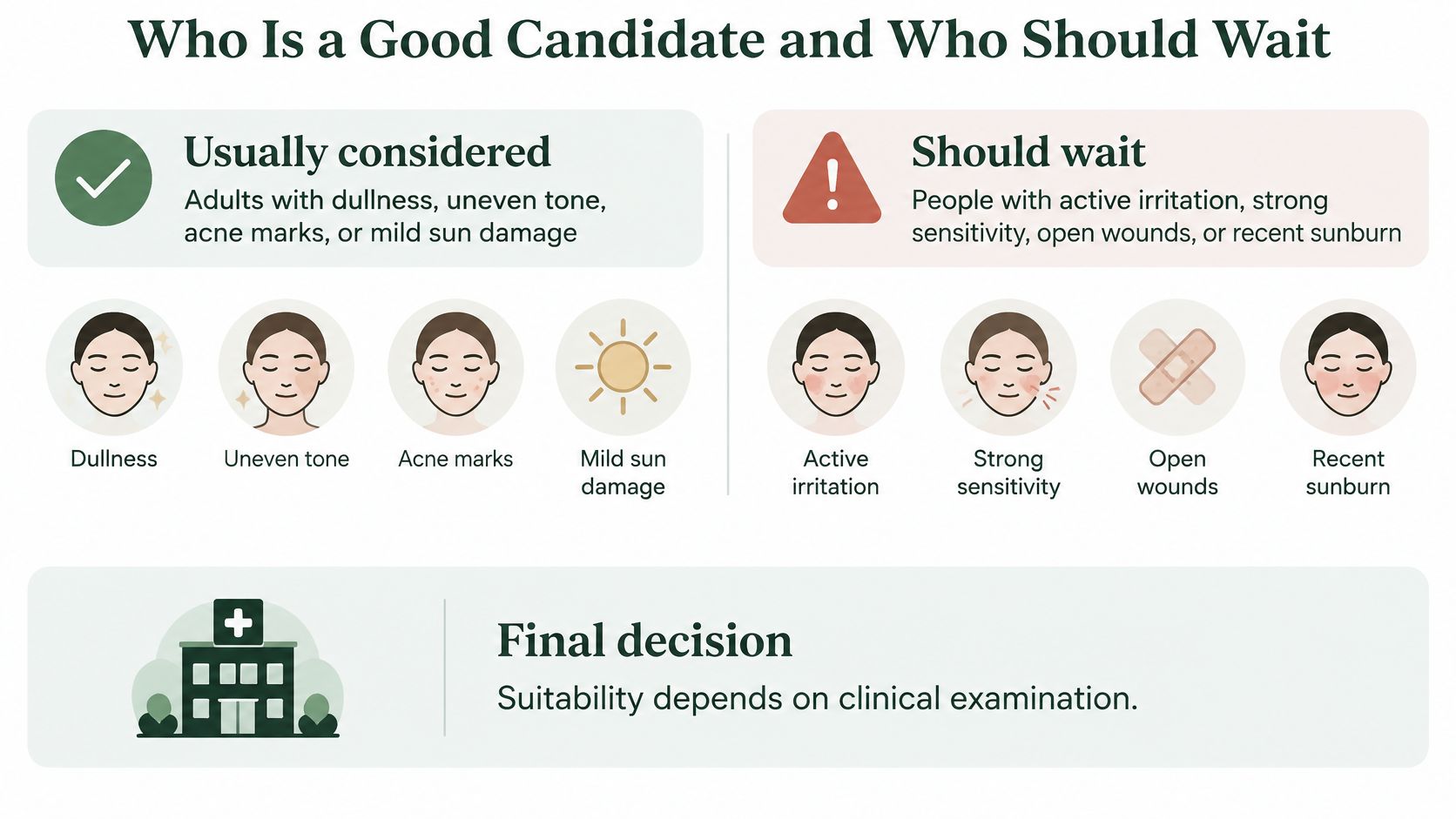
Usually considered
- Defined concern: Adults with dullness, uneven tone, acne marks or mild sun damage.
- Stable skin: No current irritation, broken skin or uncontrolled sensitivity.
- Manageable skincare routine: Willingness to pause irritating products when advised.
- Aftercare readiness: Ability to use sunscreen consistently and attend follow-up.
- Realistic expectations: Acceptance that improvement may be partial and require maintenance.
Wait or obtain medical assessment first
- Inflammatory acne: An active flare without an established treatment plan.
- Recent tanning: Sunburn or substantial recent sun exposure.
- Pregnancy or breastfeeding: Product and procedure suitability need individual review.
- Isotretinoin use: Current or recent treatment must be discussed with the clinician.
- Abnormal scarring: A history of keloids or difficult healing.
- Cold sores: Previous outbreaks may affect preventive treatment planning.
- Damaged skin: Dermatitis, infection, open wounds or a compromised barrier.
- Recent procedures: Laser treatment, another peel or other resurfacing that hasn't fully healed.
These situations aren't all permanent exclusions. They may change the formulation, preparation, treatment date or whether a peel is advisable at all.
Bring the names of prescription medicines, supplements and skincare products, including retinoids and exfoliating acids. Don't stop prescribed medication yourself to become eligible for an aesthetic treatment.
If you're unsure whether a product counts as an exfoliant, bring its packaging or a clear photograph of the ingredient list. A clinician can review the actual formulation rather than relying on terms such as brightening or renewal.
This list is screening, not diagnosis. Skin that looks calm on the surface may still need closer assessment before treatment.
How to Check a Clinic and Practitioner in Dubai
Two clinics can offer a peel by the same name yet differ completely in who applies it, under what licence, and with what plan for your skin. In Dubai those differences are regulated, which gives you a concrete way to compare providers instead of relying on the word "best."
Licensing works like a driving licence category: passing the test proves competence, but the category decides which vehicles you may drive. The DHA non-surgical cosmetic services checklist applies the same logic to aesthetic procedures. It distinguishes practitioner scope by procedure, reserves deep chemical peels for dermatologists or plastic surgeons, and requires access to a DHA-licensed consultant or specialist dermatologist and/or plastic surgeon to supervise these services.
The scope column in the peel comparison gives you a starting point for questions. A licence on its own does not mean a practitioner may perform every peel depth.
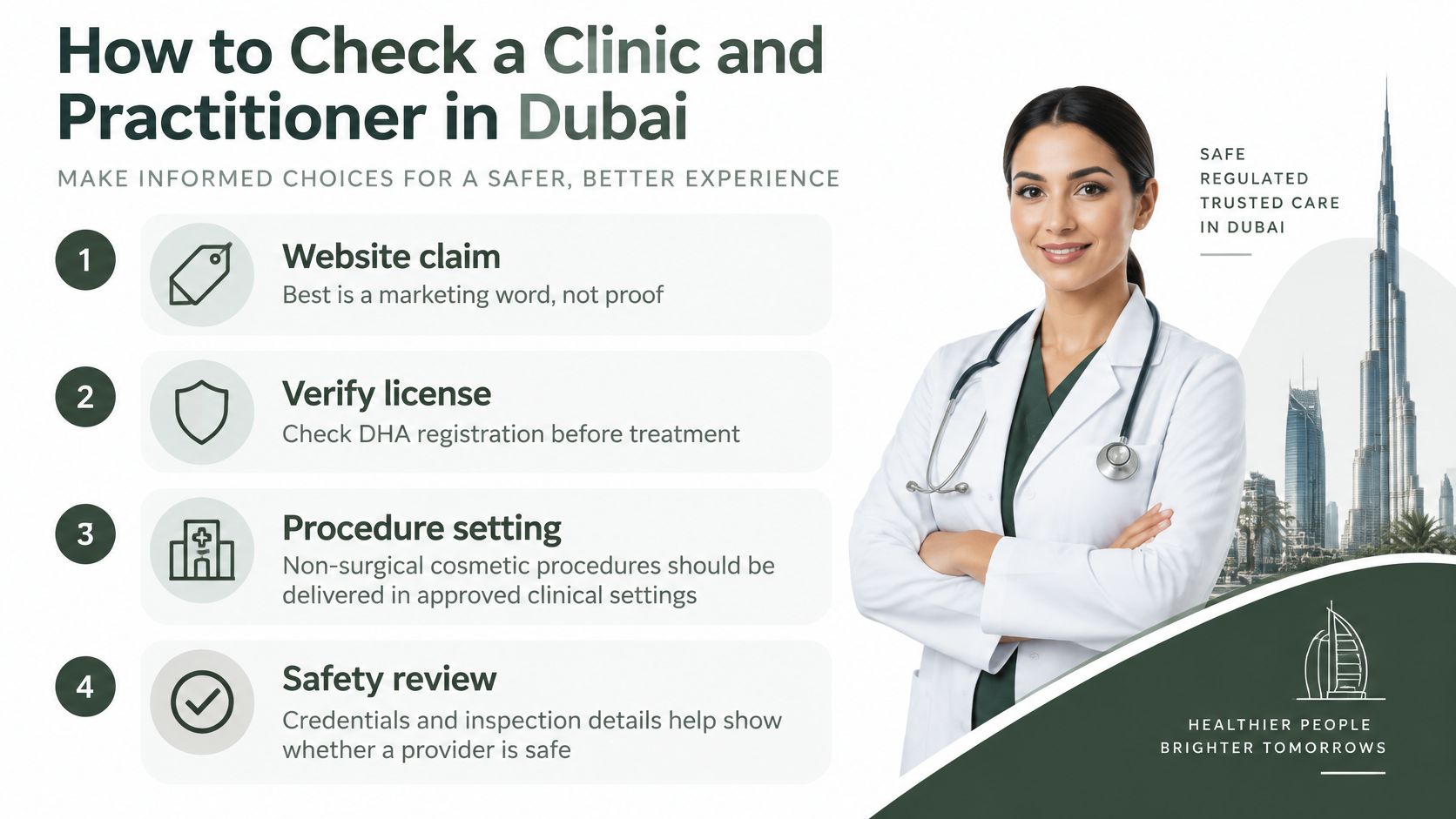
Pre-booking checklist for chemical peels in Dubai
| Check | Good answer | Why it matters |
|---|---|---|
| DHA licensing | Facility and practitioner licences are verifiable | Establishes the regulated framework for cosmetic services |
| Practitioner specialty | Appropriate specialty and approved privileges for the intended depth | Scope differs by peel depth; deep peels require a dermatologist or plastic surgeon |
| Diagnosis before treatment | Written assessment of skin type, pigmentation and acne status | Helps avoid choosing treatment for the wrong concern |
| Peel agent and strength | Named acid and concentration, with intended depth explained | Makes treatment comparisons more meaningful |
| Test-area or patch policy | Clinician explains when testing is appropriate and its limitations | May help assess tolerance, but doesn't eliminate risk |
| Aftercare and escalation | Written instructions and a contact for problems | Supports early assessment of complications |
| Package terms | Written price, session plan and refund policy | Prevents misunderstandings about what is included |
Ask before agreeing to treatment
Start with a direct question: what are you treating in my skin? A diagnosis should come before any recommendation for a stronger peel or a larger package. In a climate where sun exposure is part of daily life, the answer should cover pigmentation risk and your skin type alongside the concern that brought you in.
Next, ask who will apply the solution and what privileges they hold for that procedure. For a medium-depth treatment, expect a clear explanation of the planned depth and why that clinician is authorised to perform it. A confident answer is specific. A vague one is information too.
The DHA standards for non-surgical cosmetic procedures call for patient education and written information about risks, complications, expected outcomes and costs. Consent should be a discussion you understand well before the day of treatment.
Before paying: You should know what is being used, why it was selected and whom to contact if your skin reacts unexpectedly.
Yoyimé Clinic operates under the licensing and regulation of the Dubai Health Authority, and its doctors and specialists are DHA-licensed and trained to international clinical standards across dentistry, dermatology and aesthetics. Regulatory status sets the floor for safety. The proposed procedure still needs an individual suitability assessment for your skin.
The same questions apply wherever you compare providers. For a broader framework, the clinic's guide to assessing an aesthetic clinic in Dubai covers the same ground: licensing, practitioner scope, informed consent and follow-up you can reach.
Recovery, Aftercare and Safety Limits
Recovery follows the treatment depth and your individual skin response. A superficial peel generally settles faster than a medium-depth procedure, while deep treatment requires specialist-led care. Ask for a written timeline for the actual formulation being proposed rather than relying on a generic online calendar.
Healing skin works like a fresh coat of paint: it may look dry on the surface before the layers underneath have fully set. That is why visible flaking can end while barrier recovery is still incomplete.
Peel depth and typical recovery timeline
| Peel depth | Peeling period | Typical recovery | Main aftercare priority |
|---|---|---|---|
| Superficial | Light flaking may occur; clinician confirms the expected period | Shorter recovery, guided by redness, comfort and barrier healing | Daily broad-spectrum sunscreen and no irritating exfoliants until cleared |
| Medium-depth | More noticeable peeling; formulation-specific timing | Longer recovery requiring clinical review | Strict sun protection and close pigment follow-up |
| Deep | Specialist-defined healing period | Prolonged recovery under specialist supervision | Specialist-led follow-up only |
There is no reliable universal recovery timetable for each formulation. Plan work, exercise, travel and social events around the clinician's assessment, particularly if redness or peeling would be difficult to accommodate.
Mild tightness and surface flaking may be expected with some protocols. Blistering, worsening pain or spreading redness should not be dismissed as proof that the peel is working.
Your aftercare routine
Use the recommended moisturiser. Apply the clinic-approved product gently, without rubbing away loose skin. Choose the cleanser recommended for your recovery rather than adding fragranced or exfoliating products.
Apply broad-spectrum sunscreen every morning. Use the protection level your clinician specifies and reapply outdoors according to the product directions. Add shade and a hat, because sunscreen alone does not make deliberate sun exposure advisable.
Leave peeling skin alone. Do not pick, pull or scrub it off. Removing attached skin can injure the new layer underneath.
Pause irritating treatments until cleared. Retinoids, scrubs, exfoliating acids and waxing should only restart when the clinic confirms your skin has healed sufficiently.
Avoid unnecessary heat and sun exposure. Follow the clinic's restrictions on saunas, hot baths and activities that cause pronounced flushing during recovery.
Contact the clinic promptly about warning signs. Blistering, spreading redness, fever, discharge or pain out of proportion need assessment. Seek urgent medical care if symptoms are severe or rapidly worsening.
Dubai's sun makes protection a daily responsibility, including during ordinary journeys and outdoor errands. The end of visible flaking is not automatic clearance to restart every active skincare product.
Dryness and delayed reactions
Temporary dryness is a reason to simplify your routine and pause extra acids. General dryness advice, such as a page where you browse dry skin remedies, can explain barrier dryness in ordinary skincare, while your post-peel plan should come from the treating clinic.
For preparation that matches your procedure, consult Yoyime Clinic post-treatment skin care and confirm which instructions apply to your treatment. The written plan given after your procedure should guide product timing, sun limits and follow-up.
Watch for new darkening, signs of infection or abnormal healing. Send clear photographs if the clinic requests them, and arrange direct assessment when symptoms are worsening.
If a reaction concerns you, make contact rather than trying to correct it with another brightening serum or home peel. Early assessment gives the clinician a better opportunity to identify the problem and adjust care.
Book a Consultation Before Your First Peel
Book an assessment before committing to a course. The first question is whether controlled exfoliation fits the diagnosis, the peel depth being considered, and the amount of Dubai sun your skin can realistically avoid while it heals. A peel works like a measured injury: the right depth can prompt renewal, while the wrong depth or poor timing can push pigment or barrier problems in the wrong direction.
Bring your current skincare products, medication list, previous procedure details and daylight photographs of the concern. Mention past reactions, pigment changes after irritation, recent tanning, outdoor work, travel and events that would limit aftercare. Ask which acid, concentration and depth are proposed, and confirm the clinician's DHA licence and scope cover that depth rather than relying on a brand name.
What your written plan should include
- Treatment choice: The acid, concentration and intended depth.
- Course design: The proposed sessions and how your response will be reviewed.
- Recovery expectations: Likely symptoms, restrictions and return-to-skincare guidance.
- Safety arrangements: Follow-up timing and a contact for unexpected symptoms.
- Costs: A written breakdown of treatment, consultation and follow-up charges, including what any first-visit package covers.
Price is influenced by peel depth, the planned course, practitioner specialty, products used and the extent of follow-up. A lower advertised session price may not include the same assessment or aftercare, so compare what's included rather than the headline amount alone.
Our Deira clinic is at 106 Salah Al Din St, Deira, Dubai, United Arab Emirates. A consultation there can establish whether controlled exfoliation is suitable or whether acne care, pigment management or barrier repair should come first. If hydration and maintenance are the priority, Hydrafacial may be discussed as a separate option, not a substitute for a peel.
No outcome is guaranteed. Your final treatment plan depends on examination, individual needs and how your skin responds.
Frequently Asked Questions About Chemical Peels in Dubai
Is a chemical peel suitable for melasma?
Sometimes, after the diagnosis is confirmed. Gentle superficial treatment may form part of a wider plan, but improvement can be partial and pigmentation can return.
Does a chemical peel hurt?
Stinging, tingling or warmth can occur. The clinician should explain the expected sensations for the selected depth, and no peel is guaranteed to be painless.
How many sessions will I need?
Superficial treatment is often planned as a series. The clinician sets the interval and reviews your response before deciding whether further sessions are appropriate.
Can I have a peel during summer?
Possibly, if your schedule allows appropriate sun protection and aftercare. Outdoor work, holidays and recent tanning can make postponement the better decision.
When can I wear makeup again?
Wait until your skin has healed sufficiently and the clinic approves the products. Don't use makeup to conceal a worsening reaction.
How do I check the practitioner's qualifications?
Request licence details, specialty and confirmation of privileges for the intended peel depth. A general cosmetic-treatment credential doesn't establish permission for every procedure.
At Yoyime Clinic, our doctor-led dermatology and aesthetic consultations help distinguish acne, pigmentation and texture concerns before treatment is selected. Visit us in Deira with your skincare list and treatment history to discuss whether a chemical peel is suitable and develop a written plan around your skin's needs.