


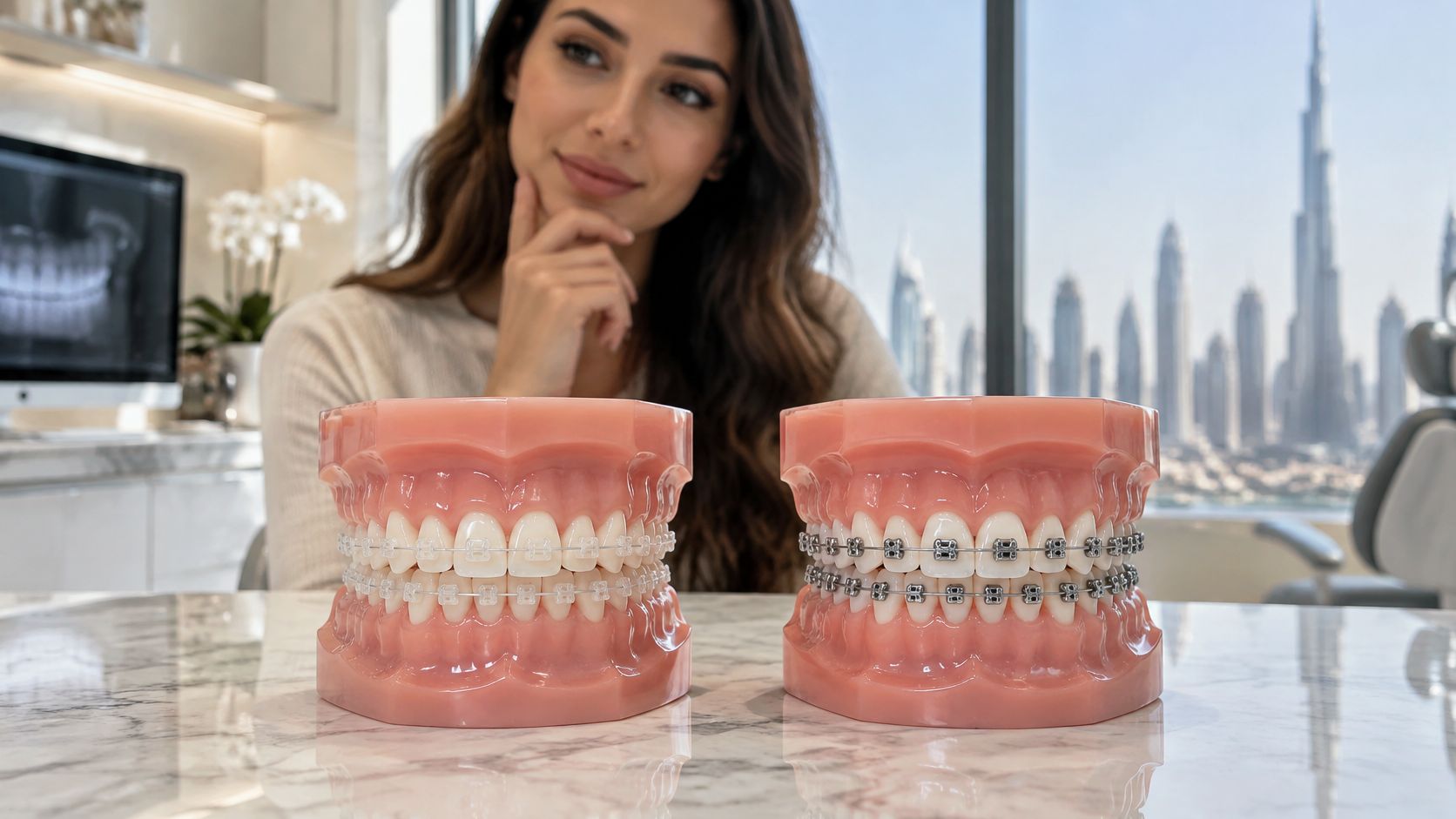
The familiar advice that ceramic braces are discreet but slower, while metal braces work faster, is too simplistic. Ceramic braces vs metal braces is primarily a choice about appearance, durability under biting forces and overall cost, not two different ways of straightening teeth. Ceramic can be a reasonable choice when visibility matters, but the orthodontist should assess where each bracket will sit and how your teeth meet before recommending it.
Table of Contents
- Ceramic and Metal Braces at a Glance
- How Ceramic and Metal Braces Work
- How Long Each Option Takes in Practice
- Durability and Bracket Failure by Tooth Position
- Hygiene and Daily Maintenance With Braces
- Dubai Costs and What Drives the Price
- Who Each Option Suits Best
- Frequently Asked Questions About Ceramic and Metal Braces
- Confirm the Right Brace at Your Consultation
Ceramic and Metal Braces at a Glance
Put side by side, ceramic and metal braces look more alike than different. Both rely on the same fixed bracket-and-wire mechanism, both correct alignment and bite function, and comparative research has not shown a consistent speed advantage for either material. The meaningful trade-off sits between how visible the appliance is and how well its brackets tolerate biting forces on particular teeth.
Ceramic vs metal braces at a glance
| Factor | Ceramic braces | Metal braces |
|---|---|---|
| Appearance | Tooth-coloured or translucent brackets, less noticeable | Stainless steel brackets, more visible |
| Tooth-movement rate | Similar monthly movement to metal in comparative research | Similar monthly movement to ceramic, with no proven speed advantage |
| Bracket breakage risk | Higher in clinical comparisons, especially under heavy bite loads | Lower and more forgiving under load |
| Hygiene demands | Daily brushing and careful cleaning around brackets and wires | The same daily brushing and cleaning routine |
| Typical duration | Set by case complexity, not bracket material | Set by case complexity, not bracket material |
| Cost | Premium aesthetic option, priced above standard metal braces | Standard appliance at a lower price point |
| Best suited to | Visible front teeth where appearance is a priority, subject to bite assessment | Heavy bites, lower teeth, frequent elastics or younger patients when durability matters |
For an adult in Dubai, the distinction that matters is between tooth movement and appliance reliability. Teeth can move at comparable rates with either material, yet a bracket that repeatedly detaches interrupts planned treatment and adds unscheduled visits. Ceramic moves teeth as efficiently as metal, so the question is how much load each bracket will carry.
Appearance is a legitimate treatment priority
Wanting less visible braces is a defensible clinical preference. If you speak with customers, attend meetings or prefer a subtler appliance, tooth-coloured brackets can make a fixed course of treatment acceptable that you might otherwise decline.
That preference should sit alongside the bite assessment rather than replace it. Ceramic brackets are not automatically unsuitable for demanding cases, but an orthodontist may recommend metal on particular teeth, commonly lower teeth under heavy contact, to reduce avoidable repairs.
Decision principle: Choose the least conspicuous appliance that can reliably deliver the movements your bite needs, rather than assuming the same material must be used everywhere.
Direct UAE evidence comparing outcomes in Emirati populations remains limited. International clinical findings can inform a Dubai consultation, but they don't justify promises about local success rates, guaranteed finishing dates or one material being universally superior.
The practical decision therefore combines your appearance preference with bite contacts, appointment commitments, cleaning habits and a written treatment quotation.
How Ceramic and Metal Braces Work
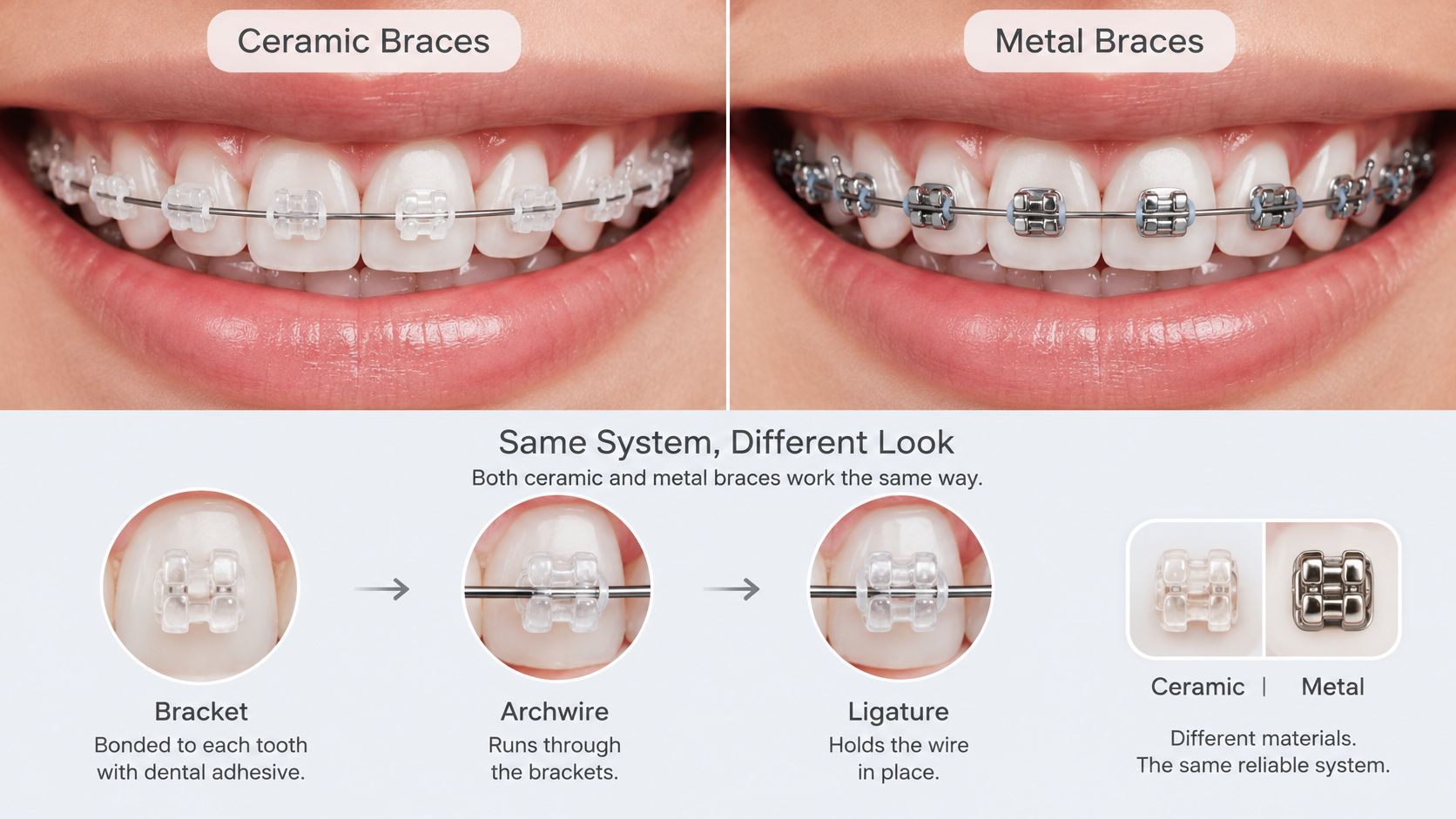
A bracket is a small attachment fixed to a tooth. An archwire passes through the brackets and applies controlled forces that guide teeth towards their planned positions, with small ties called ligatures holding the wire in place in conventional systems.
The shared mechanism matters more than the colour. Medcare's guide to teeth braces describes ceramic and metal appliances as using the same basic concept, with tooth-coloured or translucent ceramic brackets offering a less noticeable alternative to conventional metal.
The illustration shows the components of both systems.
What the orthodontist is correcting
Malocclusion means the teeth or jaws don't line up or meet well. It includes problems such as crowding, spacing and bite discrepancies.
A deep bite means the upper front teeth overlap the lower front teeth excessively. An underbite describes a relationship in which the lower front teeth sit ahead of the upper front teeth. Both bracket materials may form part of treatment for these problems, but the complete plan determines what correction is achievable.
- Bracket bonding: The orthodontist attaches each bracket to the enamel using dental adhesive.
- Active treatment: At periodic appointments, the clinician checks progress and adjusts or changes wires and other components.
- Completion: The brackets are removed, adhesive is cleaned away and the teeth are polished before retention begins.
Our Clear Smile package uses tooth-coloured ceramic brackets bonded to the teeth and connected with orthodontic wires. The ceramic braces are carefully removed once the desired alignment and bite correction have been achieved.
Retainers then help maintain the new positions. The suitable bracket material, supporting mechanics and retention plan depend on a clinical examination and your individual treatment needs.
How Long Each Option Takes in Practice
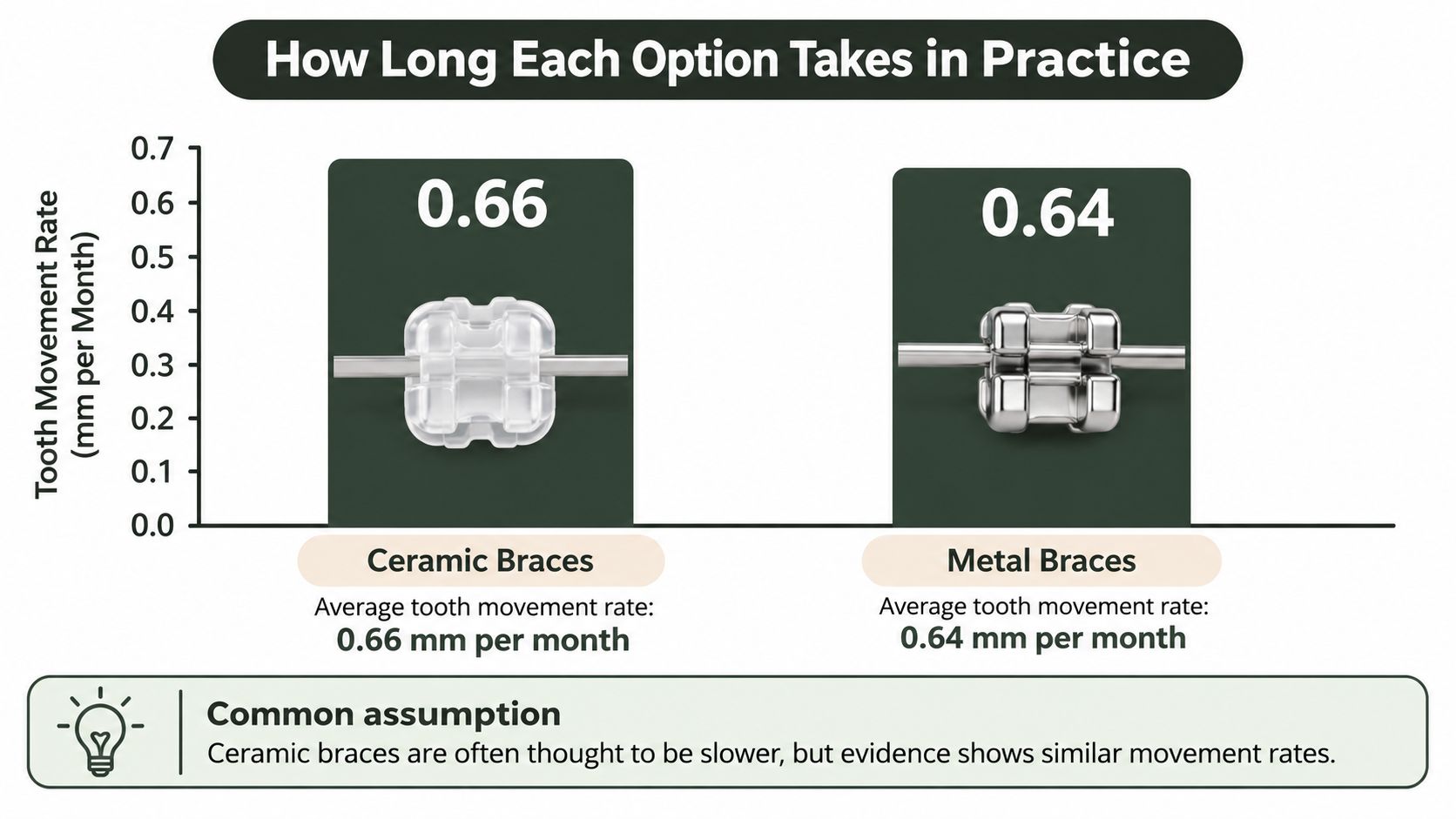
Ceramic braces aren't automatically slower. An Ajman University-affiliated systematic review reported approximately 0.66 mm of tooth movement per month with ceramic brackets versus 0.64 mm with metal, with no statistically significant difference.
Those are movement measurements, not guaranteed completion times. They don't show that ceramic finishes sooner, or that every bite responds identically.
The chart illustrates how close the reported movement rates were.
A regional benchmark, not a personal forecast
A Middle Eastern academic study published in Scientific Reports reviewed 201 patients treated between 2015 and 2022, representing more than 40 nationalities, and reported an average treatment duration of 816 days, approximately 2.2 years, with a standard deviation of 376.4 days. It also reported a mean of 28.8 visits, with a standard deviation of 12.6, and recalls generally scheduled every 3–4 weeks.
The study used stainless-steel brackets only. It provides a useful regional example of the commitment fixed braces can require, but it doesn't compare ceramic and metal finishing times.
The broad spread around the average is important. A straightforward alignment problem and a complex bite correction shouldn't receive the same forecast merely because both use fixed braces.
What changes your estimate
- Bite severity: The required movements and bite correction influence the treatment sequence.
- Age and oral health: The orthodontist considers your dental and gum condition when planning safe movement.
- Anchorage: This means controlling which teeth should remain relatively stable while others move.
- Attendance and cooperation: Missed adjustments, appliance damage and inconsistent elastic wear can interrupt the plan.
Our Clear Smile pathway includes periodic orthodontic appointments to monitor progress, adjust the braces and keep treatment on track. For appointment planning, our guide to how long braces take to straighten teeth explains why an individual estimate matters.
This video offers additional context for discussing fixed-brace treatment.
Request an estimated duration, likely visit schedule and explanation of what could change them.
Durability and Bracket Failure by Tooth Position
A less visible bracket isn't necessarily the right bracket for every tooth. The clinically important question is whether it can withstand the forces it will encounter in that position.
A prospective 12-month comparative clinical trial found significantly higher bracket-failure rates with ceramic appliances, particularly in the mandibular arch, meaning the lower teeth, and posterior regions, meaning the back teeth. This finding supports assessing bracket material by tooth position rather than treating the entire mouth as one uniform environment.
What bracket failure means
Bracket failure usually means a bracket has detached from its adhesive attachment. Ceramic can also chip or fracture because it is more brittle than stainless steel.
A detached bracket no longer controls its tooth as intended. The patient may need an unplanned repair visit, and the interruption can sometimes extend treatment or add replacement charges. A single breakage doesn't automatically mean a poor final result, but repeated failures can make treatment less predictable.
Bracket material suitability by tooth position and bite
| Situation | Ceramic braces | Metal braces |
|---|---|---|
| Upper front teeth, most visible | Commonly chosen for appearance | Suitable, but more visible |
| Upper back teeth | Used with caution under chewing load | Usually preferred for strength |
| Lower arch | Used with caution because of the trial's higher failure finding | Usually preferred when durability is a concern |
| Deep bite or heavy biting forces | Higher concern about chipping or damaging contact | More resilient |
| Frequent elastic changes or strong forces | Discuss bracket loading before choosing | More forgiving |
| Hybrid plan | Ceramic on visible front teeth | Metal on posterior or lower teeth |
These are discussion points, not automatic prescriptions. The orthodontist must examine the actual bite and the forces required to move your teeth.
When ceramic becomes a clinical compromise
A deep bite may bring opposing teeth into contact with a bracket. Grinding or clenching can create additional loading, while back teeth experience substantial chewing forces.
The clinician should check:
- Bite contacts: Whether an opposing tooth strikes the proposed bracket position.
- Grinding and clenching: Whether your habits create a less forgiving force environment.
- Planned mechanics: Where elastics or other components will apply force.
- Access for cleaning: Whether you can maintain the appliance and surrounding gumline.
Ceramic at the front and metal at the back can be a deliberate biomechanical plan, not an incomplete cosmetic upgrade.
A hybrid approach may preserve a discreet appearance where brackets are most visible while using stronger components elsewhere. It isn't required for everyone, and it shouldn't be sold as a universal solution.
Ask the clinician to explain the recommendation for each arch. The meaningful answer is not that metal is stronger, but why that strength matters for your particular bite.
Hygiene and Daily Maintenance With Braces
Ceramic braces aren't more hygienic by nature. An Ajman University laboratory investigation comparing bracket materials found no significant difference in mean bacterial concentrations between ceramic and metal bracket groups, while wires showed greater biofilm-related measurements than brackets.
Biofilm is a layer of microorganisms attached to a surface, including the plaque that develops around teeth and appliances. Choosing a tooth-coloured bracket doesn't remove the need to clean around the wire and gumline.
A routine for either material
- Brush carefully: Clean above, below and around every bracket and along the gumline, ideally after meals, using fluoride toothpaste.
- Clean between teeth: Use an appropriately sized interdental brush beneath the archwire, or a floss threader to guide floss between teeth.
- Reduce frequent sugar exposure: Limit repeated sugary snacks and drinks rather than sipping them throughout the day.
- Protect the appliance: Avoid hard and sticky foods that can dislodge brackets or distort components.
- Keep reviews: Attend orthodontic appointments and any separately recommended dental hygiene visits.
Don't force an interdental brush into a tight space. Ask the dental team to demonstrate the right size and technique for your teeth.
Keeping discreet braces looking discreet
Ceramic brackets can blend with enamel, but plaque and discoloured elastic ties can still make the appliance more noticeable. Cleaning should protect dental health first, rather than just make the brackets look clear.
Our Clear Smile patients receive an oral hygiene kit and care instructions covering braces, daily cleaning and protection of teeth during treatment. Request a demonstration if any part of the routine feels difficult.
For care between orthodontic appointments, our guide to professional teeth cleaning explains the role of professional plaque and stain removal.
The bracket findings came from laboratory work. They don't establish that either material causes better or worse hygiene outcomes in an individual patient.
Dubai Costs and What Drives the Price
A 2026 Dubai clinic pricing analysis published by OnSDM listed AED 7,500 for two-jaw metal braces and AED 9,500 for two-jaw ceramic braces at one clinic. These are published comparison figures, not Yoyimé Clinic prices.
Published Dubai price ranges for two-jaw braces
| Source | Metal braces (AED) | Ceramic braces (AED) | Scope |
|---|---|---|---|
| OnSDM 2026 Dubai clinic analysis | 7,500 | 9,500 | Two-jaw treatment at one clinic |
| UAE-oriented comparison and Dubai cost guidance | 5,000–10,000 | 6,000–12,000 | Range, inclusions not stated |
| Dubai standard-clinic cost table discussed in that guidance | 8,000–14,000 | 10,000–16,000 | Standard clinic tier |
The broader ranges don't establish identical two-jaw inclusions. They shouldn't be compared as though every quotation covers the same complexity, clinic tier, appointments, repairs and retainers.
Compare the complete pathway
The initial ceramic fee may be higher, and replacement brackets can increase spending if repairs are charged separately. Conversely, a package with more included care may appear expensive beside a basic fitting fee without necessarily costing more overall.
Request a written breakdown covering:
- Assessment and records: Consultation, diagnostic imaging, photographs and scans where needed.
- Fitting and adjustments: Appliance placement, scheduled reviews and any limits on included visits.
- Repairs: Emergency appointments, rebonding and replacement bracket charges.
- Completion: Removal, polishing, any additional finishing work and retainers.
- Retention: Follow-up reviews, replacement retainers and ongoing care.
Ask whether ceramic pricing applies per arch or to the complete treatment. A quotation isn't automatically a guaranteed total unless its terms clearly define what happens when treatment changes.
Packages and insurance
Our Clear Smile package is a premium aesthetic option that costs more than standard metal braces. One set of post-treatment retainers is fully included, so that component should be accounted for when comparing quotations.
Our ceramic braces price guide provides further context for evaluating costs rather than relying on an advertised starting fee.
Insurance also needs checking before you commit. Some policies contribute to medically necessary orthodontics, while others classify braces as elective; confirm eligibility, exclusions and approval requirements directly with your insurer.
Cost check: Compare the same treatment scope, not simply the lowest number on each clinic's price list.
Who Each Option Suits Best
The right material becomes clearer when the orthodontist considers your priorities alongside your bite. Dubai patient guidance on ceramic braces identifies bite-related durability as a reason to recommend metal, rather than assuming ceramic cannot straighten the teeth.
An adult prioritising discreet front-tooth treatment
Say you regularly speak face to face with customers and would prefer less noticeable brackets. Your bite doesn't appear to place heavy contact on the proposed front brackets, but that still needs examination.
Ceramic is a reasonable option to discuss. The clinician should explain whether it is appropriate throughout the mouth or mainly in visible areas, using the tooth-position considerations in the durability table.
A patient with a deep bite or grinding habits
You may care strongly about appearance while also clenching your teeth or having a pronounced overlap. In that situation, choosing an entirely ceramic appliance before checking contact points could prioritise visibility over reliability.
Metal or a hybrid plan may be more appropriate. The recommendation should identify the teeth at risk and explain how the proposed arrangement manages those contacts.
A younger patient likely to damage brackets
A teenager who regularly bites hard foods, struggles with care instructions or participates in contact sport needs a practical discussion about appliance protection. Age alone shouldn't decide the material, but likely damage and maintenance demands matter.
Metal may offer a more forgiving option. The clinician should also discuss suitable protection for sport and the food habits that could damage either appliance.
An adult who wants no brackets or wires
If fixed brackets themselves are the main objection, changing their colour may not address your concern. Clear aligners use custom-made removable trays instead of a bracket-and-wire system.
Our orthodontic services include ceramic braces, clear aligners, interceptive orthodontics and Invisalign®, which straightens teeth without brackets or wires. Aligners generally need 20 to 22 hours of daily wear, with removal for eating, drinking anything other than water and oral hygiene.
- Potential advantage: You can remove the trays for meals and cleaning.
- Practical limitation: You must consistently replace them and follow the prescribed wear schedule.
- Clinical limitation: Not every bite or planned movement is equally suitable for aligners.
An orthodontist should compare these options for the same diagnosis and treatment goals. A removable appliance isn't automatically simpler, and a more discreet appliance isn't automatically the most suitable one.
Frequently Asked Questions About Ceramic and Metal Braces
Are ceramic braces more comfortable than metal?
Both can cause soreness after fitting or adjustments, and brackets may irritate the lips or cheeks while you adapt. Ceramic shouldn't be presented as a completely painless alternative. Your orthodontist should assess the appliance design and your individual comfort needs before recommending a plan.
Do ceramic braces stain?
The ceramic bracket and its small elastic tie are different components. Light-coloured ties can discolour even when the bracket itself remains tooth-coloured, so discuss cleaning, dietary habits and tie choices rather than assuming all visible staining comes from ceramic. Your orthodontist should advise which components suit your individual plan.
Can I eat normally with braces?
You'll need to adapt how you eat rather than abandon a balanced diet. Avoid hard, sticky and chewy foods that could damage brackets, and cut firm foods into manageable pieces instead of biting directly into them. Your orthodontist should tailor food and appliance-protection advice to your treatment.
Will ceramic braces take longer?
There's no sound basis for assigning every ceramic case a longer timetable due to the bracket material. The planned bite correction, appliance reliability and your cooperation matter more than colour alone. Your orthodontist needs to assess your records before estimating your individual treatment duration.
What happens if a bracket breaks?
Suppose a bracket starts sliding along the wire after a meal. Contact the clinic, explain which tooth is affected and whether the wire is causing discomfort; don't pull the bracket off or try to glue it back yourself. Your orthodontist should assess whether it needs rebonding, replacement or another adjustment for your particular plan.
Do I need retainers afterwards?
Retainers are normally part of maintaining the corrected tooth positions after fixed braces are removed. In our Clear Smile pathway, the orthodontist provides retainer-care guidance and schedules follow-up visits to support stability. Your orthodontist should prescribe the individual wear schedule and review requirements rather than leaving you to choose them yourself.
Confirm the Right Brace at Your Consultation
A useful consultation produces a tooth-by-tooth plan, not a simple preference for ceramic or metal. The question is which bracket belongs on the upper arch, which belongs on the lower arch, and which teeth need the tougher option because of bite contact. The goal stays the same for both materials: aligned teeth and a functioning bite, with appearance traded against durability where the mouth is harder on brackets.
At Yoyimé Clinic in Deira, Dubai, Clear Smile treatment begins with an orthodontic consultation followed by digital diagnostic X-rays. Ask the orthodontist to show how those records change the recommendation, and whether photographs or other records are needed before the plan is final.
Questions to bring
- Material by arch and tooth: Which teeth get ceramic brackets for appearance, and which get metal because bite load or bracket position makes failure more likely?
- Evidence behind the plan: Which findings from the X-rays and examination rule a material in or out, and where is the choice mainly aesthetic?
- Package boundaries: For Clear Smile, confirm the tooth-coloured brackets and wires, included scaling and polishing before placement, periodic adjustment visits, oral hygiene kit and one set of post-treatment retainers.
- Metal comparison: If metal is advised anywhere, ask whether that reflects durability, cost, or both, and how it compares with the StraightUp Smile pathway of imaging, metal braces and retainers.
- Finish line: What tooth positions and bite checks define completion, and what happens at removal and retention review?
Bring recent dental records if you have them and state your priority plainly: visible brackets, fewer repair visits, lower fee, or the shortest reliable review schedule. A clear answer should tie each bracket to a finding and present ceramic and metal as tools with different limits.
A sound recommendation sounds specific: this material on these teeth, for this bite, with these reviews.
Yoyimé Clinic offers ceramic braces, metal braces and clear aligner options with orthodontic assessment to compare appearance, durability and treatment commitments. Visit Yoyime Clinic in Deira, Dubai, to arrange a consultation and review the options using your own dental records.