


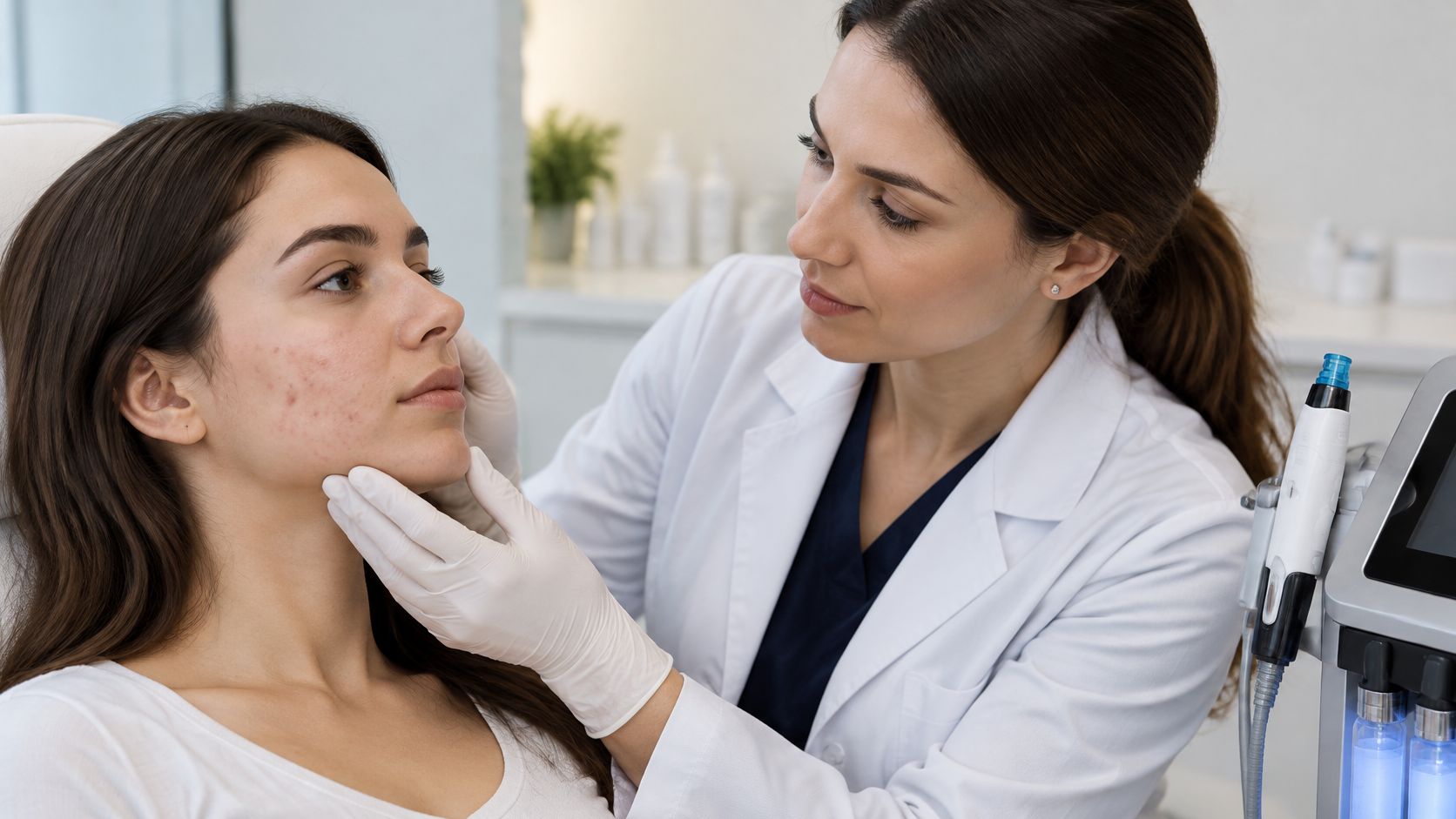
Why do so many people assume a facial that unclogs pores must be safe on every kind of breakout? That assumption is where people get into trouble. A blackhead, a tender pustule and a deep cyst look different because they behave differently. One is mainly surface congestion. The others involve inflamed, sometimes infected tissue that shouldn't be suctioned, exfoliated or squeezed.
So if you're asking, can I get HydraFacial if I have active acne, the honest answer is possibly, for selected mild cases, after a clinical assessment. It isn't a yes for painful, widespread, cystic or broken skin. It's also not a replacement for medical acne treatment. The decision depends on your lesion type, how inflamed your skin is today, what medicines you're using and whether your skin barrier is intact.
Table of Contents
- The Short Answer Depends on Your Lesion Type
- Why Lesion Type Matters So Much in the UAE
- What a HydraFacial Can and Cannot Do for Acne Prone Skin
- What the Clinical Evidence Actually Shows
- When to Postpone and Treat the Acne First
- Preparing for a Consultation, the Appointment and Aftercare
The Short Answer Depends on Your Lesion Type
Think of active acne as a spectrum rather than one condition. At one end sit comedones, the blackheads and whiteheads that form when oil and dead skin cells block a follicle. They're usually not red or sore. At the other end sit pustules, nodules and cysts. Those are inflamed, often painful and sometimes deep below the surface.
A HydraFacial uses cleansing, exfoliation and vacuum extraction on the skin's surface. That mechanical process is why lesion type matters so much. Gentle suction over a closed blackhead is a very different proposition from suction over an open, crusted or excoriated spot.
Practical rule: If a lesion is open, weeping, crusted or hurts when you touch it lightly, don't book a facial over it. Get it assessed first.
A Simple Way to Sort What You See
Use this sorting exercise in the mirror before you book anything. It won't replace an examination, but it'll help you describe your skin clearly.
Mostly blackheads and whiteheads, little redness: You may be a candidate for a modified, gentler protocol after screening.
Several red, raised bumps or pus-filled spots: You'll likely need acne control first, and any facial would need careful modification or deferral.
Deep, painful lumps, cysts or spreading inflammation: Postpone the facial and seek medical assessment.
Picked, scratched or broken areas: Wait until the skin has healed fully, whatever caused the breakout.
Available clinical claims make this boundary explicit. The HydraFacial claims page states procedures are intended for intact skin and should not be performed over severe inflammatory acne or acne cysts. That distinction between limited use in selected acne and treatment of severe inflammatory disease is the whole answer in miniature.
Why Lesion Type Matters So Much in the UAE
Acne is common in the UAE, and clinics here see the full range: teenage congestion, adult hormonal breakouts, and scarring cystic disease. That range is why a single facial policy cannot work. The label is the same; the decision is not.
A useful way to think about it is depth plus activity. A student with oily T-zone blackheads has blockage near the surface. An adult with tender jawline cysts has inflammation deeper in the follicle. Both are called acne, but one may suit careful timing around intact, calm skin while the other needs medical control first. The question is never only "do you have acne?" It is "which lesions are present this week, and how reactive is the skin around them?"
That makes triage a normal part of booking. Describing whether spots are flat, raised, painful, widespread, or leaving marks gives the clinician the information needed to choose between proceeding, modifying, or postponing.
Skin Tone and Post Inflammatory Marks
The local factor many readers overlook is pigment behaviour. Mechanical irritation over inflamed lesions can prolong redness and worsen post inflammatory hyperpigmentation, the flat brown or dark marks that linger after a spot heals. For many Middle Eastern skin phototypes, pigment can respond readily to inflammation, so the cost of an overly aggressive session may outlast the breakout itself.
Gentler is not a marketing phrase here. It is a pigment protection strategy: less provocation now can mean fewer marks to treat later.
What a HydraFacial Can and Cannot Do for Acne Prone Skin
A HydraFacial is a form of hydradermabrasion. The device cleanses, exfoliates with solutions, extracts superficial debris with low intensity vacuum and infuses hydrating serums. At Yoyime Clinic we offer Hydrafacial as a Vortex-Fusion hydradermabrasion treatment with customisable boosters. The relevant question is what that sequence does to an acne prone follicle.
For noninflamed comedonal congestion, cleansing and controlled exfoliation can remove superficial sebum and keratin sitting at the pore opening. That's a surface effect. It can make skin feel smoother and less congested. It doesn't switch off oil production, correct hormonal triggers or stop new comedones forming next week.
The UAE consensus recommendations on acne vulgaris management recommend first assessing severity and tailoring management to the acne phenotype rather than treating all breakouts identically. Applied to facials, that means suction and exfoliation shouldn't be applied over open pustules, erosions, crusting or painful nodules.
Where Readers Usually Get Confused
Confusion often starts with ingredients. Salicylic acid, for example, is oil soluble and helps loosen material inside pores, which is why it's used in acne care. That doesn't turn a facial into an antibacterial cure. A booster is one part of one appointment. Your daily routine and any prescribed treatment do the ongoing work between visits.
LED light causes similar confusion. Blue LED is sometimes added to clarifying protocols, but an add on isn't medical acne therapy on its own. Ask which device is being used, what it's intended for and what it won't do. If the answer sounds like it treats every lesion type, ask more questions.
A facial can address what's sitting on and near the surface. It can't reach a deep cyst, and it shouldn't try.
What It Won't Fix
Be clear about the limits before you pay for a course.
Painful nodules and cysts: These sit deep and need medical assessment, not extraction.
Hormonal patterns: Recurrent breakouts along the jawline or around your cycle won't be resolved by surface cleansing.
Acne scars: Pitted or raised scars are a separate concern, assessed only once active disease is controlled.
Ongoing prevention: No facial replaces the routine that keeps pores from reclogging between appointments.
What the Clinical Evidence Actually Shows
The principal clinical evidence for this use is narrower than most marketing suggests. Understanding who was studied tells you whether the results apply to you.
A study described in PubMed Central enrolled 20 adults with mild to moderate acne who received six clarifying treatments at two week intervals over 12 weeks, combining cleansing, exfoliation, extraction and blue LED light. That's a structured series in a selected group, not a single walk in facial for anyone with a breakout.
The exclusions matter as much as the treatment. People with cystic acne, active facial herpes, certain autoimmune conditions and oral isotretinoin use within the preceding six months were excluded. So the findings can't be stretched to cover deep cysts, active cold sores or recently treated, fragile skin.
How to Read That as a Patient
Ask yourself three questions when you see a before and after claim. Did those patients have my type of acne? How many sessions did they have? What else were they using at home?
If you have mild congestion and stable skin, a clinician supervised series may be reasonable to discuss. If you have painful inflammatory disease, this evidence doesn't describe you. One session also shouldn't be expected to clear active breakouts. Acne develops over weeks inside the follicle, so visible change, when it happens, tends to be gradual and depends heavily on what happens between appointments.
That isn't a reason to dismiss the treatment. It's a reason to place it correctly, as a possible adjunct for the right skin, alongside rather than instead of proper acne care.
When to Postpone and Treat the Acne First
Some presentations should move you straight from facial booking to medical review. Postponing isn't a rejection. It's sequencing. Calm the disease first, then reassess what a facial could add.
The Dubai Health Authority telehealth clinical guidelines for virtual management of acne identify topical retinoids as beneficial for both comedonal and inflammatory acne and recommend antimicrobial approaches such as benzoyl peroxide or topical antibiotics when inflammation is present. That guidance underlines a key point. Inflamed acne has established medical treatments, and a cosmetic facial shouldn't displace them.
Red Flags That Mean Defer
Contact a clinician before booking if any of these describe your skin today.
Open wounds or broken skin: Hydradermabrasion should be postponed until the barrier has healed.
Signs of infection: Increasing pain, warmth, spreading redness or crusting needs review, not suction.
A significant flare: A sudden widespread worsening is a reason to reassess your whole plan.
Severe cystic or scarring acne: Deep lesions that leave marks or scars need timely medical management.
Active irritation: Stinging, peeling or a compromised barrier from over exfoliation makes further exfoliation unwise.
Medicines change the calculation too. Always disclose retinoids, benzoyl peroxide, topical or oral antibiotics, isotretinoin history, recent peels or waxing and any allergies. Don't stop a prescribed medicine on your own just to prepare for a facial. Ask your prescriber and the treating clinician how timing should work, because these products affect skin tolerance in different ways.
Remember this sequence: Diagnose, control inflammation, restore the barrier, then consider cosmetic procedures. Reversing that order is how flares happen.
Preparing for a Consultation, the Appointment and Aftercare
A good pre treatment screen is specific. Your clinician should document whether your lesions are mainly comedonal or inflammatory, check barrier sensitivity and review recent procedures. You can make that conversation far more useful by arriving prepared.
Bring a list, or photos, of everything you put on your face: prescription creams, over the counter acids, supplements relevant to skin and anything you have started or stopped recently. Note when breakouts appear, where they cluster and whether they leave marks or scars. Say a patient reports monthly tender chin cysts plus forehead blackheads. Those are two different problems, and the plan should treat them as such.
That distinction shapes the booking itself. Congested blackheads may suit a modified session, while tender cysts point toward medical review first.
During a Modified Treatment
If you're cleared for treatment with mild, stable congestion, expect modifications rather than a standard protocol run at full intensity. That can mean lower suction, gentler exfoliation, avoiding inflamed zones entirely and skipping aggressive manual extraction. Active lesions shouldn't be squeezed during the appointment.
Speak up during the session if you feel burning, sharp stinging or increasing pain. Mild tingling during exfoliation is different from escalating discomfort, and flagging it early lets the practitioner reduce intensity before irritation sets in.
Aftercare That Protects Your Barrier
Keep things simple for the first few days. Your skin has just been exfoliated, so layering strong actives immediately can undo the benefit.
Cleanse gently: Use a mild cleanser and lukewarm water, without scrubs or cleansing brushes.
Moisturise and protect: Use a plain moisturiser and daily sunscreen, since exfoliated skin is more sun sensitive.
Pause strong actives briefly: Ask your clinician when to restart retinoids or acids rather than guessing.
Don't pick: Picking at a post treatment purge or lingering spot raises your risk of marks and infection.
Watch for warning signs: Persistent burning, swelling, blistering or spreading redness warrants prompt clinical advice.
There's also no fixed schedule that guarantees acne control. Monthly appointments suit some people with congestion, but frequency should follow your skin's tolerance and whether the sessions are adding value. If your acne is worsening between visits, the answer is reassessment, not more frequent suction.
Frequently Asked Questions
Will a HydraFacial make my acne worse? It can if it's performed over inflamed, open or infected lesions, or if extractions are aggressive. On carefully screened mild congestion, a modified treatment is far less likely to aggravate things. The screening is what separates those outcomes.
Can it treat cystic acne? No. Cystic lesions are deep and were excluded from the main clinical evidence. They need medical assessment and appropriate therapy.
What if I'm using a retinoid or benzoyl peroxide? Don't stop or start anything without advice. Disclose it at booking, because it affects exfoliation tolerance and timing.
How soon after a breakout can I book? Wait until tenderness, openness and crusting have fully settled and the barrier feels comfortable again. If you're unsure, send a clear description or attend for assessment first.
Do I still need acne treatment if I have facials? In most cases, yes. Facials address surface congestion. They don't replace the daily or prescribed care that prevents new lesions forming.
If you're in Dubai and you can't tell whether your breakouts are simple congestion or inflammatory acne that needs treatment first, book a dermatologist-led consultation at Yoyime Clinic in Deira, Dubai. Bring your product and medication list, and we'll examine your lesion type, barrier and treatment history before advising whether a HydraFacial is appropriate now, should be modified, or should wait until your acne is controlled.