


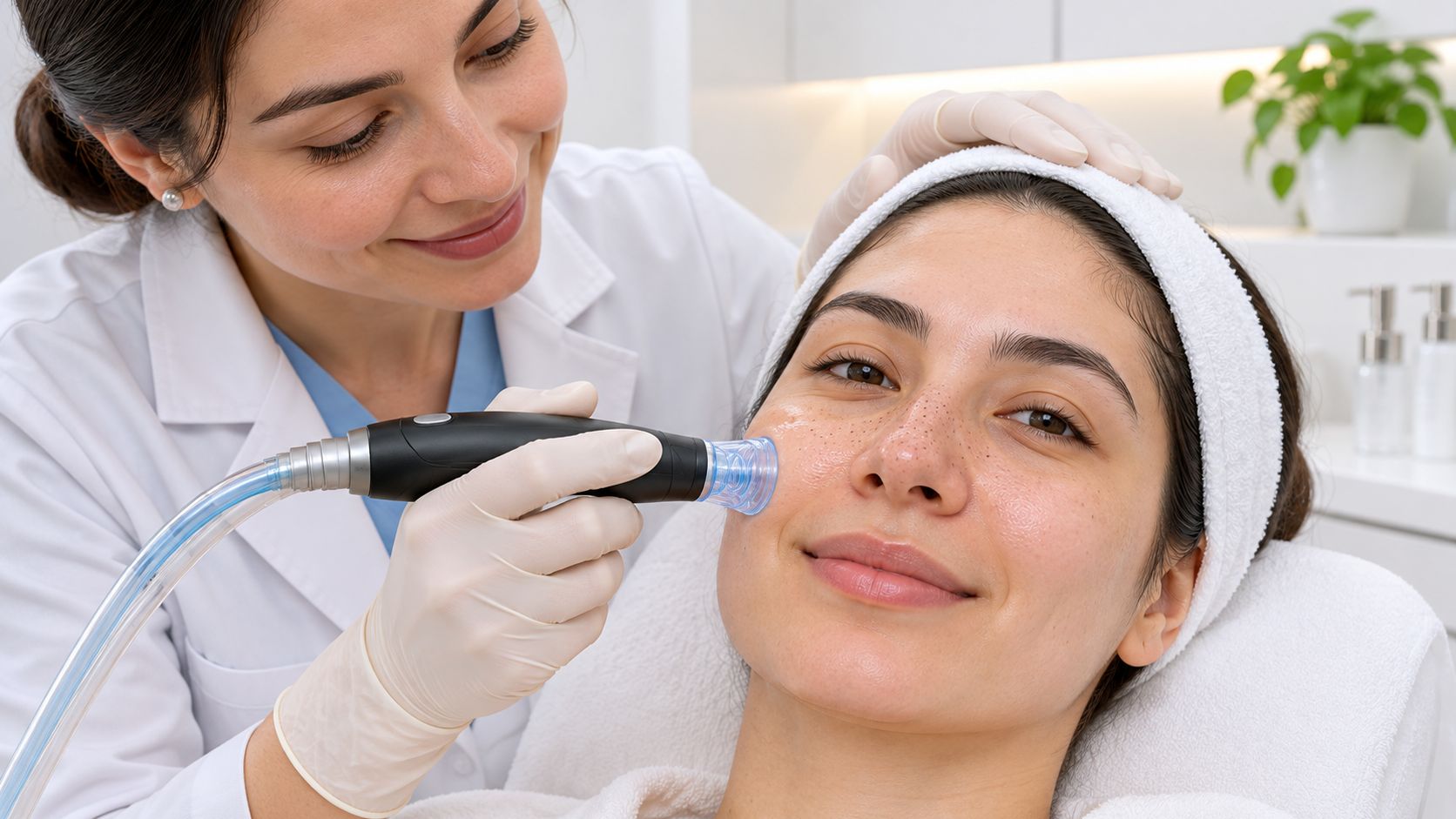
Can a facial improve acne without treating the condition behind it? HydraFacial may help mild blackheads and whiteheads as an adjunct to good skin care, but it does not replace medical care for inflamed, deep or scarring acne.
A small, open-label study followed adults with mild-to-moderate acne during treatment. It reported improvement in acne ratings, but had no control group. That means it cannot show whether HydraFacial works better than a retinoid, or establish how much of the improvement came from the treatment itself.
The practical distinction is the type of lesion. A cleansing treatment may help clear material from pores, while red, painful or deep bumps involve inflammation that a facial alone cannot address. Which lesions are present matters more than the general label “acne.”
Table of Contents
- Which Acne Types HydraFacial Can Help
- What the Clinical Evidence Shows So Far
- How the Session Works and Who Should Wait
- When Medical Acne Treatment Is the Better Choice
- Frequently Asked Questions About HydraFacial for Acne
- Book a Skin Assessment Before Your First Facial
Which Acne Types HydraFacial Can Help
HydraFacial can help mild blackheads and whiteheads as an adjunct, but it doesn't treat inflammatory acne on its own. The treatment works on what sits inside the pore, not on what's happening underneath the skin, so the sorting question isn't "do I have acne" but "which lesion is dominant today".
That distinction matters more in Dubai than is often realised. A retrospective review of 5,969 patient visits over 12 months at a Dubai dermatology outpatient clinic recorded acne in 1,050 visits, or 17.6% of all visits, making it the most frequently encountered skin condition there, with women accounting for 805 acne-related visits, or 76.7%, against 244 among men (Springer dermatology review). That's one clinic's caseload, not a national prevalence figure, and the same regional consensus work notes that UAE-wide acne numbers remain limited. Read it as evidence of how much acne drives dermatology visits here.
The review also describes acne as including non-inflammatory lesions, meaning blackheads and whiteheads, alongside inflammatory papules, pustules, nodules and cysts. That one sentence explains why a facial suits some patients and not others.
| Acne type | What it looks like | Likely fit for HydraFacial | Next step |
|---|---|---|---|
| Blackheads (open comedones) | Dark, open pores, most often on the nose, chin and forehead | Often a suitable adjunct for mild congestion | Extraction and cleansing target them directly; review with a dermatologist first |
| Whiteheads (closed comedones) | Small, skin-coloured bumps under the surface | Often a suitable adjunct for mild congestion | Superficial cleansing may help; permanent clearance isn't guaranteed |
| Mild inflamed papules and pustules | Red, tender or pus-filled bumps | Limited; adjunct at most, only once the skin is calm | Medical treatment first, facial later if appropriate |
| Nodules and cysts | Deep, painful lumps under the skin | Not suitable as a main treatment | Dermatologist-led care without delay |
| Acne marks and scars | Dark spots, redness, pitting or uneven texture | Limited; depends on the mark type and skin tone | Pigment and scar plan from a dermatologist |
Why the two comedone rows sit at the top. A blackhead is an open pore packed with oil and dead skin cells. A whitehead is the same plug with a closed surface. Both are within reach of a cleansing tip and gentle suction, which is exactly what this treatment does well.
Why inflamed lesions rank lower. A red papule or pus-filled pustule is inflamed tissue, and dragging a resurfacing sequence across it tends to irritate it further. Nodules and cysts sit deeper still and can leave permanent scars, so a facial booked in place of medical care costs you time you can't get back.
Why marks need a separate plan. Flat brown or red patches left after a breakout are pigment. Pitted texture is structural damage. Neither is a pore problem, so neither responds to cleansing. If marks are your main concern, browse atrophic and icepick scar solutions to see which approach matches which mark type.
Before booking, check your skin in good daylight with a mirror and a phone torch held at an angle. Note whether the dominant lesion is an open dark dot, a skin-coloured bump, a red tender spot or a deep lump, and write down whether any of them hurt or are leaving marks. That note changes the plan before a single session is scheduled.
What the Clinical Evidence Shows So Far
The design matters as much as the result, so start with the shape of the study rather than its headline.
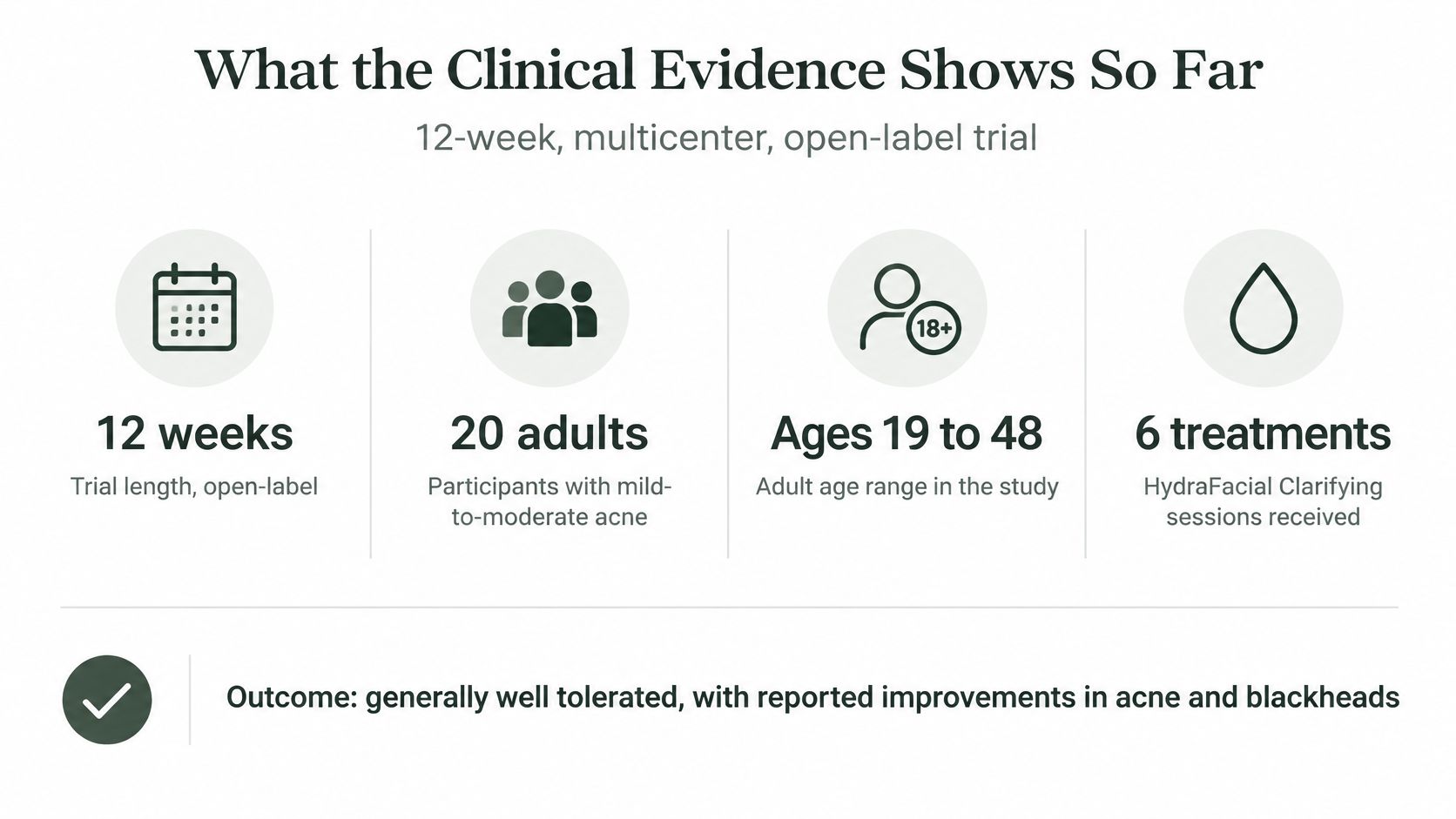
A 12-week, multicenter, open-label prospective study followed 20 adults aged 19 to 48 with mild-to-moderate acne through six HydraFacial Clarifying treatments, generally scheduled every two weeks (PMC study report). By the final assessment, the proportion judged by investigators to have clear or almost-clear skin rose from 20% to 65%, and patient self-assessment rose from 5% to 55%.
| Rater | Baseline | Final visit (week 12) |
|---|---|---|
| Investigator-rated | 20% | 65% |
| Patient self-rated | 5% | 55% |
Both changes were statistically significant, with reported p-values of 0.0027 and 0.0016. A p-value below 0.05 means the change measured inside this group was unlikely to have appeared by chance alone. It doesn't mean the treatment is powerful, permanent, or better than anything else. It means something real moved.
What the study can and cannot tell you
It can tell you a course of six treatments improved how acne looked in a group whose severity scoring included both non-inflammatory and inflamed lesions. It can't tell you the device caused that rather than the extra cleansing, the serums, the sunscreen advice or the simple fact of being watched for three months.
The limits are structural. Twenty participants, no control group, no randomisation, no blinding, and follow-up capped at 12 weeks. Nothing here shows superiority over a topical retinoid, benzoyl peroxide or azelaic acid, and nothing shows the improvement held beyond the study window.
How to read the next headline you see: a credible claim about permanent clearance needs a control group, blinded assessment and follow-up measured in months, not weeks. Until a study clears that bar, treat "permanent" as marketing.
Because acne scales count blackheads and whiteheads alongside inflamed lesions, the honest reading is narrow: a series may improve overall acne appearance in selected mild or comedonal cases, while active, scarring or recurrent acne belongs with a dermatologist.
How the Session Works and Who Should Wait
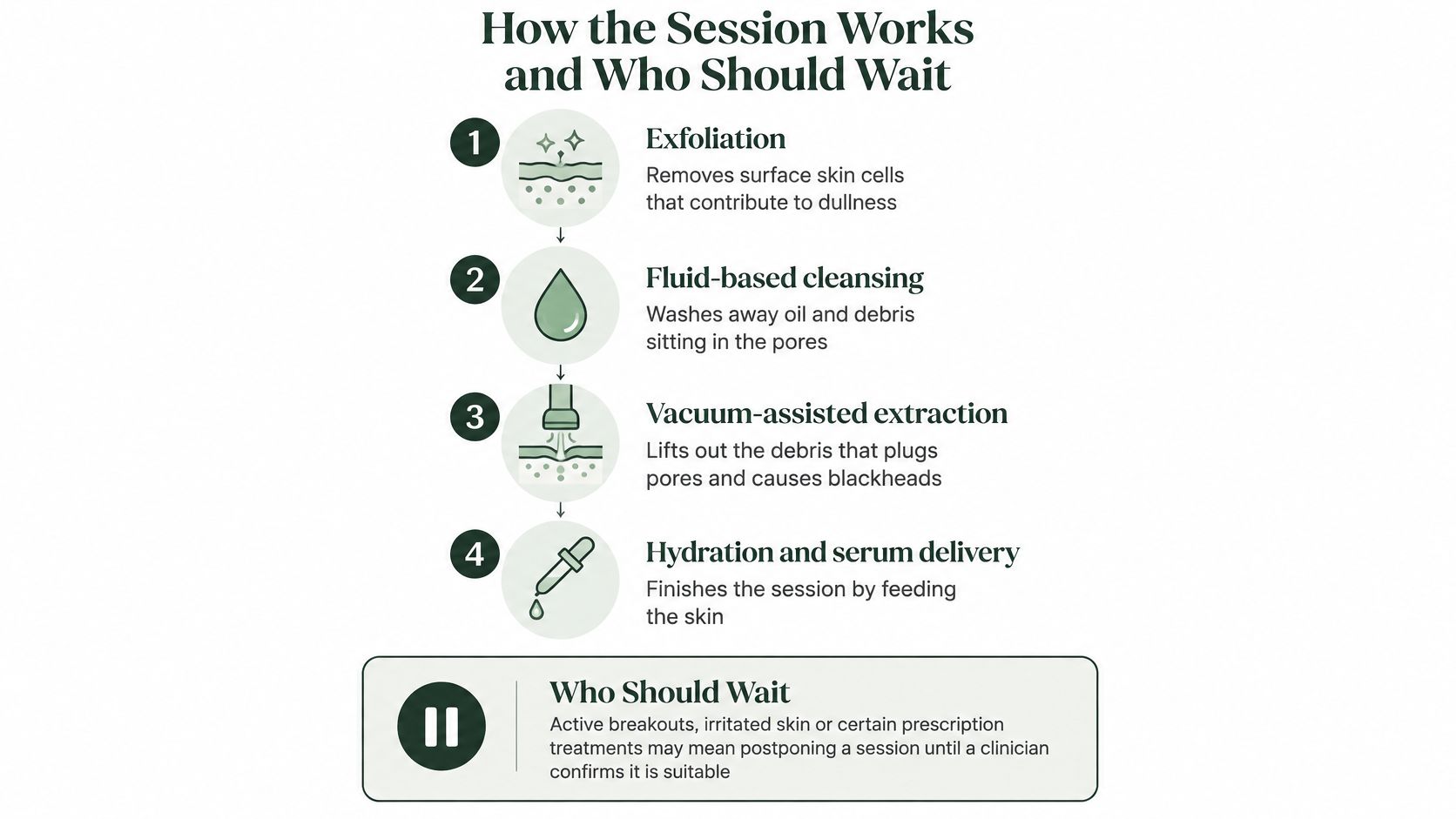
A HydraFacial can clear some surface congestion, but it cannot treat every form of acne. Its exfoliation and vacuum-assisted extraction steps lift surface debris and oil from pores. That may help with blackheads and whiteheads; it does not change the processes that contribute to new lesions, such as oil production, keratinisation or bacterial activity. Clearing a pore is different from treating acne as a continuing condition.
The session, step by step
- Cleanse and assess. The clinician examines the skin, distinguishes open comedones from inflamed lesions, and identifies areas to avoid.
- Exfoliate. A fluid-based solution loosens surface debris before extraction.
- Extract. Vacuum suction can remove blackheads and whiteheads. Inflamed, excoriated or cystic lesions should be left alone.
- Hydrate. A serum is applied to support the skin barrier.
- Protect. The session ends with barrier care and guidance on daily photoprotection.
The order matters: extraction is intended for suitable congested pores, not tender or damaged areas. A brief HydraFacial treatment in Dubai walkthrough shows the sequence.
What it feels like, honestly
Light suction and temporary pinkness are typical, although sensation depends on skin sensitivity, the areas treated and the pressure used. Mild redness may settle within the day. Comfort varies, so a pain-free session should not be promised.
Who should wait
- Active inflamed or cystic acne. Resurfacing over inflamed tissue may increase irritation.
- Sore, scratched or broken skin. Further picking or scrubbing can interfere with healing and raise the risk of dark marks.
- Recent sunburn or an irritating procedure. Give a compromised skin barrier time to recover before exfoliation.
- Recent isotretinoin use or a prescription retinoid. Ask the prescriber whether and when a facial is appropriate.
The pigmentation point most people miss
More suction is not automatically better. Scrubbing and other forms of trauma can aggravate acne-related skin changes, and post-inflammatory hyperpigmentation warrants care, particularly in deeper skin tones. The Journal of Drugs in Dermatology discusses this concern. Pressure, technique, treatment frequency and time for barrier recovery matter more than the number of passes.
The evidence described earlier also sets limits on expectations. The small HydraFacial acne study reported improvement after a course of treatments, but its design cannot establish that the device alone caused the change or that results last. A facial may address some visible congestion; it does not replace assessment and treatment of inflammatory or scarring acne. Acne management guidance, including the DHA telehealth acne guidelines, concerns clinical acne care rather than the mechanism or immediate result of a facial.
A worked example
A person arrives with blackheads across the nose and three red, tender pimples on the chin. The nose may be suitable for extraction after assessment, while the inflamed chin needs to be avoided and may require medical care. Treating both areas with the same resurfacing approach would ignore the difference between non-inflammatory congestion and active lesions. Suitability depends on clinical examination, and any treatment course should be planned only after that assessment.
When Medical Acne Treatment Is the Better Choice
When should acne move from facial care to medical treatment? The UAE Consensus Recommendations for Management of Acne Vulgaris describe acne as a common condition in the Emirates, with possible psychosocial effects, dyspigmentation and scarring. They recommend that management be guided by severity (PubMed consensus summary). That distinction matters: a facial may help with surface congestion, while persistent inflammation or tissue damage calls for medical care.
The five signs it's time for a dermatologist
- Returning inflamed papules and pustules. Breakouts that keep returning in the same areas need more than cleansing.
- Deep nodules or cysts. These lesions sit below the surface and can leave scars.
- Spread beyond the face. Back or chest acne may need a broader medical approach.
- Any scarring. Scars indicate that acne has damaged the skin.
- Marks that aren't fading. Persistent pigmentation calls for assessment and a targeted plan, not repeated extraction.
What a dermatologist may discuss
Treatment depends on lesion type and severity. A dermatologist may discuss topical retinoids for clogged pores and some pimples, benzoyl peroxide to reduce acne-causing bacteria, azelaic acid for inflammation and pigmentation, or prescription oral treatment for severe or scar-forming acne. The right choice depends on an examination of your skin.
A stepwise plan is built around the acne present, not one device or procedure. People seeking clearer skin without general anesthesia may find that a facial suits surface congestion, while nodular or inflamed acne requires a different level of care.
Where a facial fits alongside medicine
Medical treatment addresses inflammation and new breakouts. A facial can support maintenance and surface congestion when the skin is calm. These approaches can sit alongside each other, but a facial does not treat deep nodules, active inflammation or acne scarring.
For persistently oily, congested skin, a chemical peel for acne face dubai is another option to discuss with a clinician. Suitability depends on the skin and acne pattern; it should not be presented as a substitute for medical treatment.
The decision rule: if acne is changing your skin, confidence or daily life, start with a dermatologist rather than a facial appointment.
Frequently Asked Questions About HydraFacial for Acne
Does HydraFacial hurt?
You may feel light suction and some warmth, followed by pinkness that usually settles within the day. Sensation varies with skin sensitivity and with how many lesions are treated. No session is promised to be painless.
How many sessions will I need, and how often?
The published study used six treatments, generally about two weeks apart. Your own schedule is set after a clinical assessment of your lesion type, your skin sensitivity and how your skin responds to the first session.
How long do results last?
The evidence followed participants for 12 weeks and doesn't show long-term clearance of comedones. Maintenance intervals are decided by your clinician based on how quickly congestion returns, not by a fixed package.
Is HydraFacial expensive?
Cost depends on the number of sessions, the boosters and products used, whether an assessment is included, and the clinic's current pricing, which is confirmed directly rather than quoted in an article. Ask for the total cost of a course, not the price of one session.
Can a facial replace acne medication?
No. It can support congestion care and skin maintenance, but inflamed, nodular or scarring acne needs a dermatologist's plan. A facial sits beside medical treatment, never in place of it.
Book a Skin Assessment Before Your First Facial
Could a facial address your acne, or does your skin need medical treatment first? A skin assessment helps answer that by identifying which lesions are present and whether HydraFacial is an appropriate option. The distinction matters: a facial may be considered for congestion, while inflamed or scarring acne may call for dermatologist-led care.
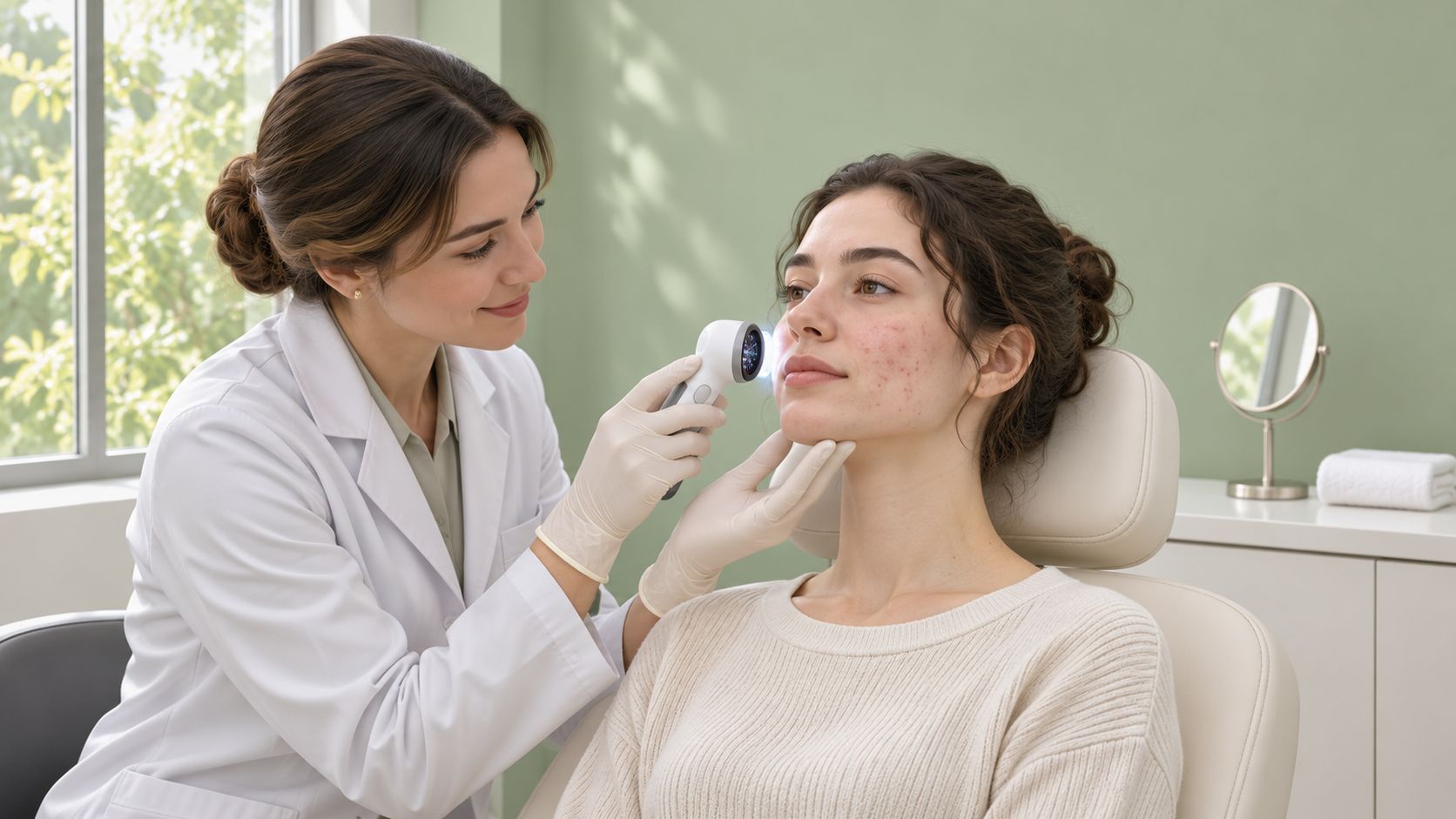
Yoyime Clinic provides dermatology services for acne, pigmentation and chronic skin conditions. Its Advanced Diagnostic Dermatology Package includes in-depth skin analysis and diagnosis before treatment begins. HydraFacial, a Vortex-Fusion hydradermabrasion treatment with customizable boosters, may be considered if the assessment supports it. The findings may instead point to another treatment or a dermatology referral.
What to bring to the assessment
- Photos of your worst days. Images from recent months can show patterns that may not be visible on the day of your visit.
- A list of current products and medicines. Include retinoids, antibiotics and products bought online.
- Recent treatments and sun exposure. Peels, laser sessions, waxing and sun exposure can affect what is suitable for your skin.
- The spots that bother you most. Show the clinician your priorities; the lesions you notice may differ from those that need attention first.
Yoyime Clinic is in central Deira, Dubai, with private, low-noise clinical rooms, so the assessment takes place in a discreet setting. Start with the examination and let its findings guide the next step, rather than committing to a course of facials before confirming that it fits your acne. Book an assessment at Yoyime Clinic.